
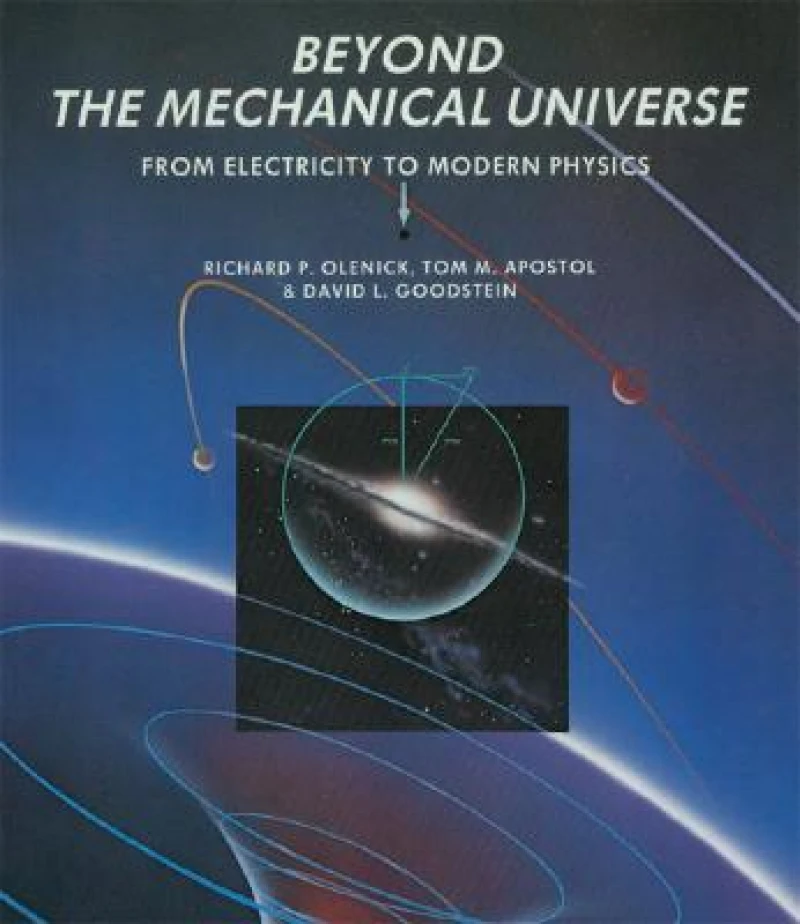
Beyond the Mechanical Universe : From Electricity to Modern Physics
Book Details
Format
Paperback / Softback
ISBN-10
0521715911
ISBN-13
9780521715911
Publisher
Cambridge University Press
Imprint
Cambridge University Press
Country of Manufacture
GB
Country of Publication
GB
Publication Date
Jan 21st, 2008
Print length
590 Pages
Weight
1,198 grams
Dimensions
20.40 x 25.50 x 3.10 cms
Product Classification:
Physics
Ksh 12,550.00
Manufactured on Demand
0 in stock
Delivery Location
Delivery fee: Select location
Secure
Quality
Fast
This 1987 book studies electricity and magnetism, their relation to each other, and to light, and shows how the problem of light led to the special theory of relativity. It moves to modern physics, where particles may behave like waves and vice versa and where some of the great verities of Newtonian physics appear less certain.
This 1987 second volume of the Mechanical Universe studies electricity and magnetism, their relation to each other and light, and shows how the problem of light led to the special theory of relativity. Then, it moves on to modern physics, where particles may behave like waves and where some of the great verities of Newtonian physics appear less certain. Along with the first volume, this book is based on, though independent of, a public television series broadcast in the United States. Physics is presented as a human endeavor, with historical development forming a thread throughout the text. The prerequisites are minimal, only basic algebra and trigonometry since the necessary calculus is developed in the text, with physics providing the motivation. New concepts are introduced at the natural, logical point with many historical references to place physics in a social perspective. Many topics from twentieth-century physics are included. The book is attractively illustrated and will be a stimulating alternative to other, less-thorough treatments.
Get Beyond the Mechanical Universe by at the best price and quality guaranteed only at Werezi Africa's largest book ecommerce store. The book was published by Cambridge University Press and it has pages.

