
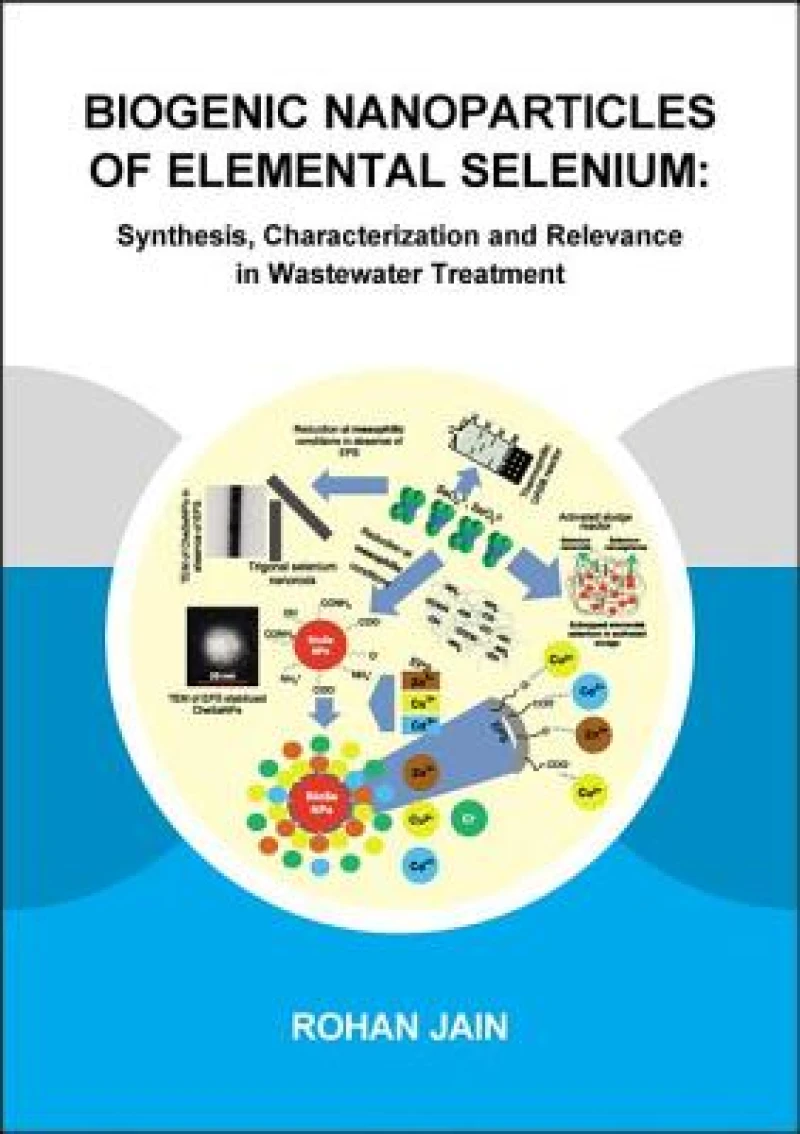
Biogenic Nanoparticles of Elemental Selenium : Synthesis, Characterization and Relevance in Wastewater Treatment
Book Details
Delivery Location
Delivery fee: Select location
This study is broadly divided into three different sub-sections a) synthesis and characterization of biogenic elemental selenium nanoparticles (BioSeNPs) where the role of temperature and extracellular polymeric substances were explored for their effect of BioSeNPs'' shape and mobility; b) application of BioSeNPs to preferentially adsorb heavy metals for treatment of cationic heavy metal containing wastewater; and c) development of single-step selenium oxyanions reduction and recovery of BioSeNPs in thermophilic upflow anaerobic sludge blanket (UASB) and activated sludge reactor.
Selenium is an intriguing element as on one hand it is toxic and on the other hand it is a necessary micro-nutrient for humans. It is also a desirable element due to its unique properties and hence it is used in xerogrpahy, rectifiers, solar cells etc. The presence of selenium in agriculture, acid-mine drainage wastewaters is known and their remediation is necessary. Since, selenium is not mined anywhere, it is important to recover the selenium from waste streams.
Bio-remediation of selenium containing wastewater is not only efficient but it also gives insight into the fate of selenium in the bioreactors and environment, thus improving the recovery efficiencies. However, there are still many unknowns in the fate of the selenium present in the wastestreams when treated using microbial processes. One of the biggest unknown is the characteristics of biogenic colloidal elemental selenium nanoparticles (BioSeNPs). These BioSeNPs are present in the bioreactors and are colloidal in nature, hence, present in the effluent of the reactor. BioSeNPs are also known to have the coating of organic polymer on its surface, however the origin of these coating are not known. Moreover, these BioSeNPs are always spherical in shape which is desirable in some cases and not so desirable in many. Furthermore, these BioSeNPs are produced extracellularly and also intracellularly, however the effect of the BioSeNPs'' trapping in the biomass is not well understood. This book throws light on the above questions and improves our fundamental understanding on the characteristics and fate of BioSeNPs in the bioreactors and environment. This book also uses the fundamental knowledge to improve the bioremediation process and recoverability of selenium.
This study demonstrates that extracellular polymeric substances (EPS) are capping the BioSeNPs and thus providing them colloidal stability and hence mobility, which is in contrast to our conventional understanding on the role of EPS in metal(loid) nanoparticles mobility. All the produced BioSeNPs are known to be spherical but nanowire shape is important to understand their fundamental properties and application. Thus, this study produced biogenic selenium nanowires by reduction of selenite by simply using thermophilic temperatures (55 and 65 oC) and characterized them for their magnetization properties. The practical applications of BioSeNPs were explored by preferentially adsorbing heavy metals in the following order: Cu>Zn>Cd. The development of one-step process for selenium oxyanions removal and BioSeNPs recovery using thermophilic UASB reactor and activated sludge process was attempted. Thermophilic reduction of selenate in an upflow anaerobic sludge blanket (UASB) reactor showed better retention of BioSeNPs and thus, higher total selenium removal as compared to mesophilic reactor. The aerobic reduction of selenite using activated sludge also showed better retention of BioSeNPs, however, continuous operation of the reactor was not achieved. The selenite fed activated sludge trapping BioSeNPs showed improved settling properties and hydrophilicity as compared to control sludge.
Get Biogenic Nanoparticles of Elemental Selenium by at the best price and quality guaranteed only at Werezi Africa's largest book ecommerce store. The book was published by Taylor & Francis Ltd and it has pages.

