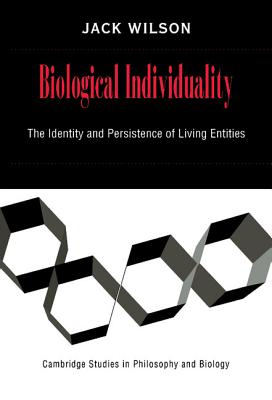
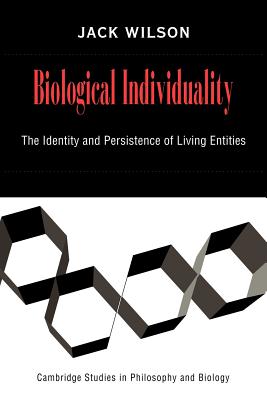
Biological Individuality : The Identity and Persistence of Living Entities
by
Jack Wilson
Book Details
Format
Paperback / softback
Book Series
Cambridge Studies in Philosophy and Biology
ISBN-10
0521036887
ISBN-13
9780521036887
Publisher
Cambridge University Press
Imprint
Cambridge University Press
Country of Manufacture
GB
Country of Publication
GB
Publication Date
May 15th, 2007
Print length
152 Pages
Weight
239 grams
Dimensions
22.90 x 15.30 x 1.00 cms
Product Classification:
Philosophy: metaphysics & ontologyHuman biologyPhilosophy: metaphysics and ontology
KSh 6,100.00
Currently unavailable
0 in stock
Delivery Location
Delivery fee: Select location
Secure
Quality
Fast
What makes a biological entity an individual? Jack Wilson shows that past philosophers have failed to explicate the conditions an entity must satisfy to be a living individual. This book explores and resolves paradoxes that arise when one applies past notions of individuality to biological examples beyond the conventional range.
What makes a biological entity an individual? Jack Wilson shows that past philosophers have failed to explicate the conditions an entity must satisfy to be a living individual. He explores the reason for this failure and explains why we should limit ourselves to examples involving real organisms rather than thought experiments. This book explores and resolves paradoxes that arise when one applies past notions of individuality to biological examples beyond the conventional range and presents an analysis of identity and persistence. The book's main purpose is to bring together two lines of research, theoretical biology and metaphysics, which have dealt with the same subject in isolation from one another. Wilson explains an alternative theory about biological individuality which solves problems which cannot be addressed by either field alone. He presents a more fine-grained vocabulary of individuation based on diverse kinds of living things, allowing him to clarify previously muddled disputes about individuality in biology.
Get Biological Individuality by Jack Wilson at the best price and quality guaranteed only at Werezi Africa's largest book ecommerce store. The book was published by Cambridge University Press and it has 152 pages.
Customers Who Bought This Also Bought

Neville Goddard
KSh 5,850.00
Groundwork for the Metaphysics of Morals
KSh 2,000.00
The Sovereignty of Good
KSh 5,400.00

The Life Of The Mind
KSh 3,950.00
Groundwork for the Metaphysics of Morals – With an Updated Translation, Introduction, and Notes
KSh 1,950.00

De Anima (On the Soul)
KSh 2,350.00
Kant: The Metaphysics of Morals
KSh 5,300.00

Prolegomena to Any Future Metaphysics
KSh 2,700.00
An Inquiry Into Meaning and Truth
KSh 3,750.00
Hegel''s Inversion of Philosophy
KSh 17,100.00

Duns Scotus: Philosophical Writings
KSh 4,150.00

Metaphysics as a Guide to Morals
KSh 2,700.00