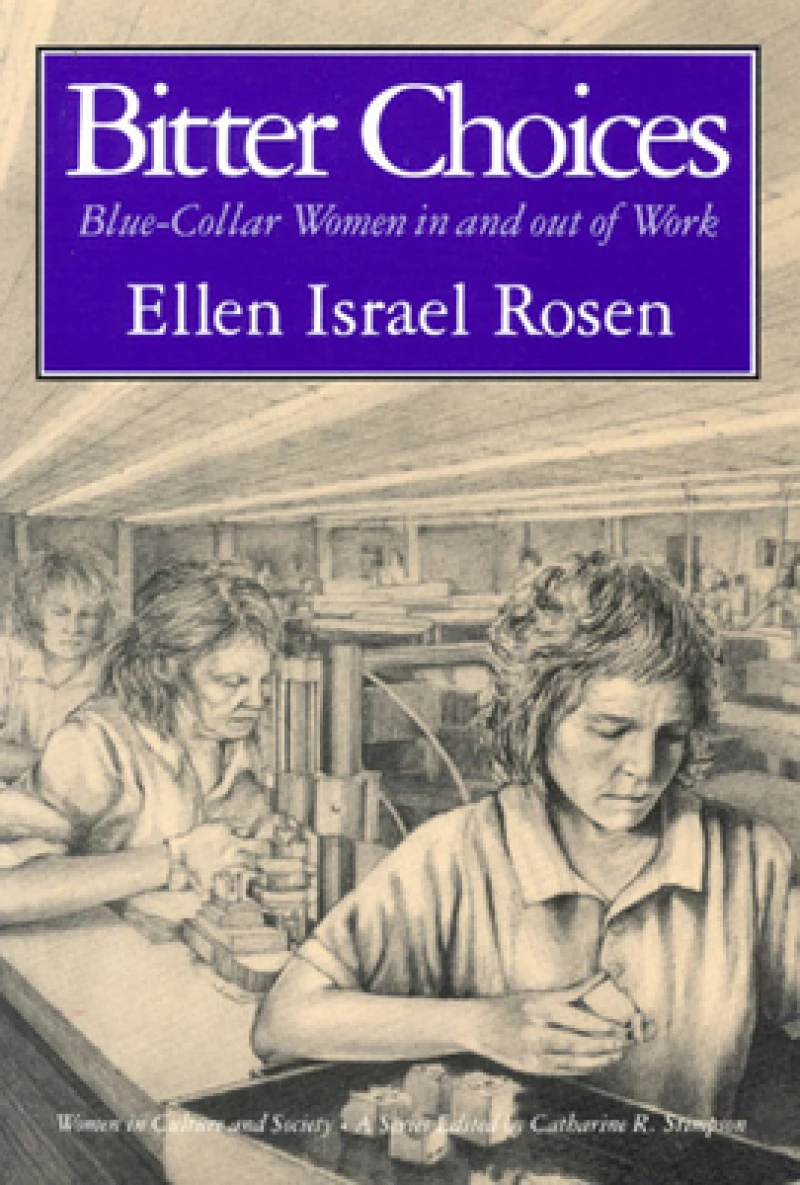
Bitter Choices : Blue-Collar Women in and out of Work
Book Details
Format
Paperback / Softback
Book Series
Women in Culture and Society
ISBN-10
0226726452
ISBN-13
9780226726458
Publisher
The University of Chicago Press
Imprint
University of Chicago Press
Country of Manufacture
GB
Country of Publication
GB
Publication Date
Mar 23rd, 1990
Print length
210 Pages
Weight
312 grams
Dimensions
2.30 x 1.60 x 0.10 cms
Product Classification:
Gender studies: womenSociology: work & labourLabour economics
Ksh 5,100.00
Werezi Extended Catalogue
0 in stock
Delivery Location
Delivery fee: Select location
Secure
Quality
Fast
Ellen Israel Rosen presents a compelling portrait of married women who work on New England's assembly lines while they also maintain their homes and marriages. With skill and sympathy, she documents the reasons these women work; their experiences on the job, in the union, and at home; the sources of their job satisfaction; and their management of the "double day." The major issue for this segment of the labor force, Rosen suggests, is not whether to work, but the availability and quality of jobs. Rosen argues that deindustrialization—plant closings and job displacement—confronts blue-collar women factory workers with a "bitter choice" between work at lower and lower wages or no work at all. Drawing on quantitative and qualitative data from interviews with more than two hundred such women factory workers, Rosen traces the ways in which women who do "unskilled" factory work have gained in self-esteem as well as financial stability from holding paid jobs. Throughout, Rosen explores the relationship between public work experiences and private family life. She analyzes the dynamics of two-paycheck, working class families, clarifies relationships between class and gender, and explores the impact of patriarchy and capitalism on working class women. At the same time Rosen places women's job loss within the broader economic context of global industrial transformations, demonstrating how international capital shifts to cheaper labor in developing countries, as well as technological progress, are changing the shape of the entire American labor force and are beginning to undermine the material and symbolic gains of the American female factory worker, the promise of market equality, and progressive working conditions. "This book is a significant contribution to our understanding of women's work and family lives, but it is also a valuable look at the consequences of deindustrialization in America for workers, their families, and their communities."—Myra Marx Ferree, American Journal of Sociology
Get Bitter Choices by at the best price and quality guaranteed only at Werezi Africa's largest book ecommerce store. The book was published by The University of Chicago Press and it has pages.