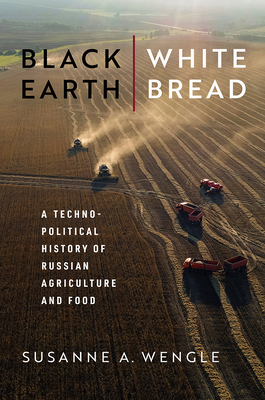
Black Earth, White Bread : A Technopolitical History of Russian Agriculture and Food
Book Details
Format
Hardback
ISBN-10
0299335402
ISBN-13
9780299335403
Publisher
University of Wisconsin Press
Imprint
University of Wisconsin Press
Country of Manufacture
GB
Country of Publication
GB
Publication Date
Mar 15th, 2022
Print length
296 Pages
Weight
574 grams
Dimensions
21.60 x 14.00 x 1.50 cms
KSh 11,500.00
Currently unavailable
0 in stock
Delivery Location
Delivery fee: Select location
Secure
Quality
Fast
Presents an important interdisciplinary history of Russia’s agriculture and food systems that documents far-reaching changes on farms, along with their effects on ordinary people and for successive political regimes.
Like all facets of daily life, the food that Russian farms grew and citizens ate—or, in some years, didn't eat—underwent radical shifts in the century between the Bolshevik Revolution and Putin's presidency. The modernization of agriculture during this time is usually understood in terms of advances in farming methods. Susanne A. Wengle's important interdisciplinary history of Russia's agriculture and food systems documents far-reaching changes on farms, along with their effects on ordinary people and for successive political regimes.
Wengle argues that we need to focus on the political actors who employed and favored particular agrotechnologies to provide "the good life" for citizens. Each of the large-scale rural reforms was rooted as much in political ambitions as in the need to increase crop and meat yields. Attempts to create the conditions of abundance relied heavily on top-down programs that nearly always had unexpected, and occasionally devastating, outcomes.
Bringing together a narrative on governance, production, consumption, nature, and the ensuing vulnerabilities of the agri-food system, Wengle reveals the intended and unintended consequences of Russian agricultural policies since 1917. Ultimately, Black Earth, White Bread is a call for attention to states' reliance on specific technologies to illuminate transformations in food systems everywhere.
Wengle argues that we need to focus on the political actors who employed and favored particular agrotechnologies to provide "the good life" for citizens. Each of the large-scale rural reforms was rooted as much in political ambitions as in the need to increase crop and meat yields. Attempts to create the conditions of abundance relied heavily on top-down programs that nearly always had unexpected, and occasionally devastating, outcomes.
Bringing together a narrative on governance, production, consumption, nature, and the ensuing vulnerabilities of the agri-food system, Wengle reveals the intended and unintended consequences of Russian agricultural policies since 1917. Ultimately, Black Earth, White Bread is a call for attention to states' reliance on specific technologies to illuminate transformations in food systems everywhere.
Get Black Earth, White Bread by Susanne A. Wengle at the best price and quality guaranteed only at Werezi Africa's largest book ecommerce store. The book was published by University of Wisconsin Press and it has 296 pages.
Customers Who Bought This Also Bought

Age of Revolutions
KSh 2,350.00

Eichmann in Jerusalem
KSh 2,350.00

Trouble With Being Born
KSh 2,000.00

Hiroshima
KSh 2,000.00

Freedom
KSh 6,300.00

Holocaust
KSh 2,700.00
The History of the Peloponnesian War
KSh 2,700.00

Annals
KSh 2,350.00

Greek Lives
KSh 2,150.00

Sleepwalkers
KSh 3,400.00

Napoleon The Great
KSh 3,600.00

Diary of a Young Girl
KSh 1,800.00