
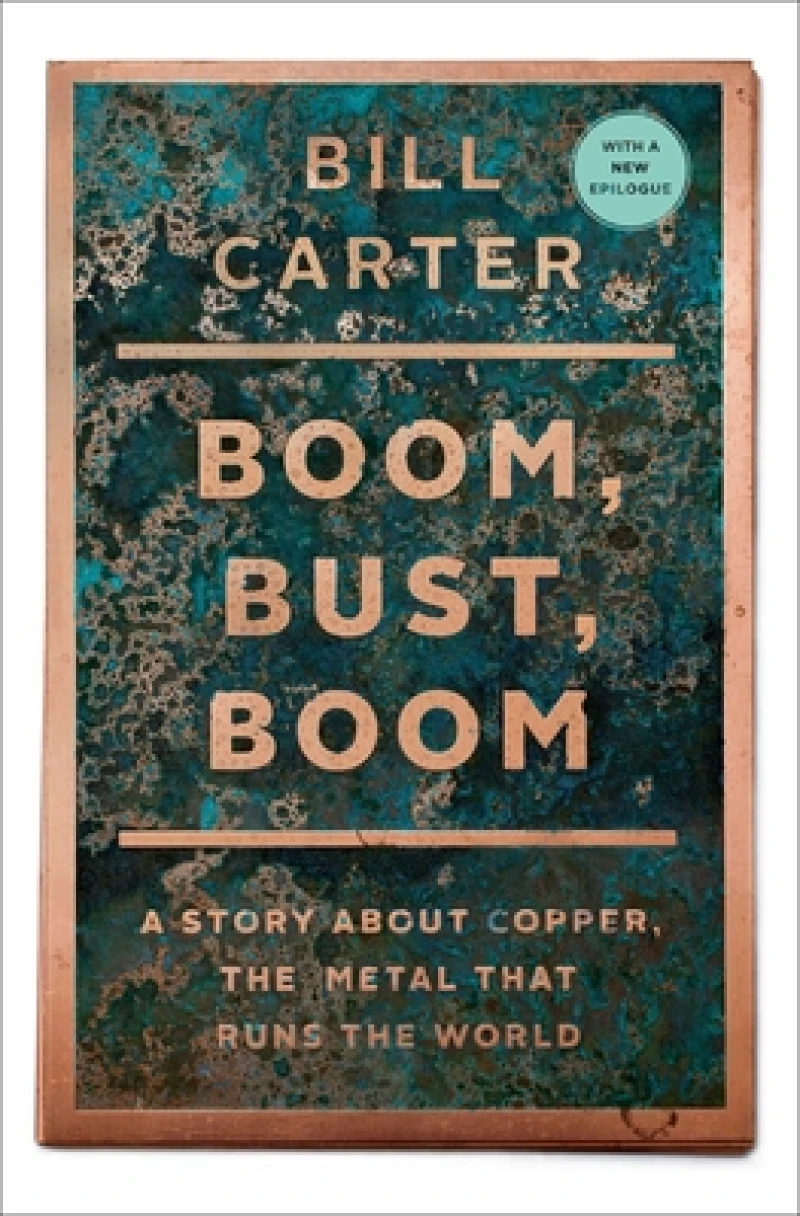
Boom, Bust, Boom : A Story About Copper, the Metal That Runs the World
by
Bill Carter
Book Details
Format
Paperback / Softback
ISBN-10
1439136580
ISBN-13
9781439136584
Publisher
Simon & Schuster
Imprint
Scribner
Country of Manufacture
US
Country of Publication
GB
Publication Date
Aug 31st, 2021
Print length
284 Pages
Weight
298 grams
Dimensions
16.00 x 30.10 x 2.50 cms
Product Classification:
Environmental management
Ksh 3,250.00
Werezi Extended Catalogue
0 in stock
Delivery Location
Delivery fee: Select location
Secure
Quality
Fast
This informative and thought-provoking account of civilization's complete dependence on copper, and what extracting it from the earth really means for people, nature, and the global economy is ';the best sort of journalism: beautifully written, rich in detail, and impossible to ignore' (Sebastian Junger).
Copper is a miraculous and contradictory metal, essential to nearly every human enterprise. For most of recorded history, this remarkably pliable and sturdy substance has proven invaluable: not only did the ancient Romans build their empire on mining copper but Christopher Columbus protected his ships from rot by lining their hulls with it. Today, this metal can be found in every house, car, airplane, cell phone, computer, and home appliance around the world, including in all the new, so-called green technologies.
Yet the history of copper extraction and our present relationship with the metal are fraught with profound difficulties. Copper mining causes irrevocable damage to the Earth, releasing arsenic, cyanide, sulfuric acid, and other deadly pollutants into the air and water. And the mines themselves have significant effects on the economies and wellbeing of the communities where they are located.
Now, Carter delivers a blazing and fact-rich narrative that helps us understand the paradoxical relationship we have with a substance whose necessity to civilization costs the environment and the people who mine it dearly. Starting in his own backyard in the old mining town of Bisbee, Arizonawhere he discovers that the dirt in his garden contains double the acceptable level of arseniche follows the story of copper to the controversial Grasberg copper mine in Indonesia; to the ';ring' at the London Metal Exchange, where a select group of traders buy and sell enormous amounts of the metal; and to an Alaskan salmon run threatened by mining. Part social history, part mining-town exploration, and part environmental investigation, this is a work of first-rate journalism that fascinates on every level.
Copper is a miraculous and contradictory metal, essential to nearly every human enterprise. For most of recorded history, this remarkably pliable and sturdy substance has proven invaluable: not only did the ancient Romans build their empire on mining copper but Christopher Columbus protected his ships from rot by lining their hulls with it. Today, this metal can be found in every house, car, airplane, cell phone, computer, and home appliance around the world, including in all the new, so-called green technologies.
Yet the history of copper extraction and our present relationship with the metal are fraught with profound difficulties. Copper mining causes irrevocable damage to the Earth, releasing arsenic, cyanide, sulfuric acid, and other deadly pollutants into the air and water. And the mines themselves have significant effects on the economies and wellbeing of the communities where they are located.
Now, Carter delivers a blazing and fact-rich narrative that helps us understand the paradoxical relationship we have with a substance whose necessity to civilization costs the environment and the people who mine it dearly. Starting in his own backyard in the old mining town of Bisbee, Arizonawhere he discovers that the dirt in his garden contains double the acceptable level of arseniche follows the story of copper to the controversial Grasberg copper mine in Indonesia; to the ';ring' at the London Metal Exchange, where a select group of traders buy and sell enormous amounts of the metal; and to an Alaskan salmon run threatened by mining. Part social history, part mining-town exploration, and part environmental investigation, this is a work of first-rate journalism that fascinates on every level.
This informative and thought-provoking account of civilization's complete dependence on copper, and what extracting it from the earth really means for people, nature, and the global economy is ?the best sort of journalism: beautifully written, rich in detail, and impossible to ignore? (Sebastian Junger).
Copper is a miraculous and contradictory metal, essential to nearly every human enterprise. For most of recorded history, this remarkably pliable and sturdy substance has proven invaluable: not only did the ancient Romans build their empire on mining copper but Christopher Columbus protected his ships from rot by lining their hulls with it. Today, this metal can be found in every house, car, airplane, cell phone, computer, and home appliance around the world, including in all the new, so-called green technologies.
Yet the history of copper extraction and our present relationship with the metal are fraught with profound difficulties. Copper mining causes irrevocable damage to the Earth, releasing arsenic, cyanide, sulfuric acid, and other deadly pollutants into the air and water. And the mines themselves have significant effects on the economies and wellbeing of the communities where they are located.
Now, Carter delivers a blazing and fact-rich narrative that helps us understand the paradoxical relationship we have with a substance whose necessity to civilization costs the environment and the people who mine it dearly. Starting in his own backyard in the old mining town of Bisbee, Arizona where he discovers that the dirt in his garden contains double the acceptable level of arsenic he follows the story of copper to the controversial Grasberg copper mine in Indonesia; to the ?ring? at the London Metal Exchange, where a select group of traders buy and sell enormous amounts of the metal; and to an Alaskan salmon run threatened by mining. Part social history, part mining-town exploration, and part environmental investigation, this is a work of first-rate journalism that fascinates on every level.
Copper is a miraculous and contradictory metal, essential to nearly every human enterprise. For most of recorded history, this remarkably pliable and sturdy substance has proven invaluable: not only did the ancient Romans build their empire on mining copper but Christopher Columbus protected his ships from rot by lining their hulls with it. Today, this metal can be found in every house, car, airplane, cell phone, computer, and home appliance around the world, including in all the new, so-called green technologies.
Yet the history of copper extraction and our present relationship with the metal are fraught with profound difficulties. Copper mining causes irrevocable damage to the Earth, releasing arsenic, cyanide, sulfuric acid, and other deadly pollutants into the air and water. And the mines themselves have significant effects on the economies and wellbeing of the communities where they are located.
Now, Carter delivers a blazing and fact-rich narrative that helps us understand the paradoxical relationship we have with a substance whose necessity to civilization costs the environment and the people who mine it dearly. Starting in his own backyard in the old mining town of Bisbee, Arizona where he discovers that the dirt in his garden contains double the acceptable level of arsenic he follows the story of copper to the controversial Grasberg copper mine in Indonesia; to the ?ring? at the London Metal Exchange, where a select group of traders buy and sell enormous amounts of the metal; and to an Alaskan salmon run threatened by mining. Part social history, part mining-town exploration, and part environmental investigation, this is a work of first-rate journalism that fascinates on every level.
This informative and thought-provoking account of civilizations complete dependence on copper, and what extracting it from the earth really means for people, nature, and the global economy is the best sort of journalism: beautifully written, rich in detail, and impossible to ignore (Sebastian Junger).
Copper is a miraculous and contradictory metal, essential to nearly every human enterprise. For most of recorded history, this remarkably pliable and sturdy substance has proven invaluable: not only did the ancient Romans build their empire on mining copper but Christopher Columbus protected his ships from rot by lining their hulls with it. Today, this metal can be found in every house, car, airplane, cell phone, computer, and home appliance around the world, including in all the new, so-called green technologies.
Yet the history of copper extraction and our present relationship with the metal are fraught with profound difficulties. Copper mining causes irrevocable damage to the Earth, releasing arsenic, cyanide, sulfuric acid, and other deadly pollutants into the air and water. And the mines themselves have significant effects on the economies and wellbeing of the communities where they are located.
Now, Carter delivers a blazing and fact-rich narrative that helps us understand the paradoxical relationship we have with a substance whose necessity to civilization costs the environment and the people who mine it dearly. Starting in his own backyard in the old mining town of Bisbee, Arizonawhere he discovers that the dirt in his garden contains double the acceptable level of arseniche follows the story of copper to the controversial Grasberg copper mine in Indonesia; to the ring at the London Metal Exchange, where a select group of traders buy and sell enormous amounts of the metal; and to an Alaskan salmon run threatened by mining. Part social history, part mining-town exploration, and part environmental investigation, this is a work of first-rate journalism that fascinates on every level.
Copper is a miraculous and contradictory metal, essential to nearly every human enterprise. For most of recorded history, this remarkably pliable and sturdy substance has proven invaluable: not only did the ancient Romans build their empire on mining copper but Christopher Columbus protected his ships from rot by lining their hulls with it. Today, this metal can be found in every house, car, airplane, cell phone, computer, and home appliance around the world, including in all the new, so-called green technologies.
Yet the history of copper extraction and our present relationship with the metal are fraught with profound difficulties. Copper mining causes irrevocable damage to the Earth, releasing arsenic, cyanide, sulfuric acid, and other deadly pollutants into the air and water. And the mines themselves have significant effects on the economies and wellbeing of the communities where they are located.
Now, Carter delivers a blazing and fact-rich narrative that helps us understand the paradoxical relationship we have with a substance whose necessity to civilization costs the environment and the people who mine it dearly. Starting in his own backyard in the old mining town of Bisbee, Arizonawhere he discovers that the dirt in his garden contains double the acceptable level of arseniche follows the story of copper to the controversial Grasberg copper mine in Indonesia; to the ring at the London Metal Exchange, where a select group of traders buy and sell enormous amounts of the metal; and to an Alaskan salmon run threatened by mining. Part social history, part mining-town exploration, and part environmental investigation, this is a work of first-rate journalism that fascinates on every level.
Get Boom, Bust, Boom by at the best price and quality guaranteed only at Werezi Africa's largest book ecommerce store. The book was published by Simon & Schuster and it has pages.

