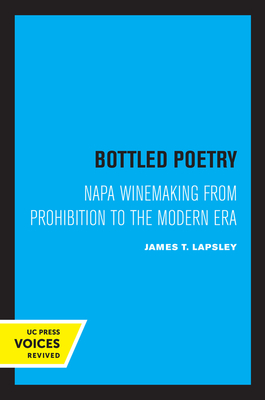
Bottled Poetry : Napa Winemaking from Prohibition to the Modern Era
Book Details
Format
Paperback / softback
ISBN-10
0520302540
ISBN-13
9780520302549
Publisher
University of California Press
Imprint
University of California Press
Country of Manufacture
US
Country of Publication
GB
Publication Date
Feb 25th, 2022
Print length
336 Pages
Weight
508 grams
Dimensions
15.20 x 22.80 x 2.40 cms
Product Classification:
History of the AmericasAlcoholic beveragesWinesLocal history
KSh 7,550.00
Currently unavailable
0 in stock
Delivery Location
Delivery fee: Select location
Secure
Quality
Fast
California's Napa Valley is one of the world's premier wine regions today, but this has not always been true. James T. Lapsley's entertaining history explains how a collective vision of excellence among winemakers and a keen sense of promotion transformed the region and its wines following the repeal of Prohibition. Focusing on the formative years of Napa's fine winemaking, 1934 to 1967, Lapsley concludes with a chapter on the wine boom of the 1970s, placing it in a social context and explaining the role of Napa vineyards in the beverage's growing popularity. Names familiar to wine drinkers appear throughout these pages—Beaulieu, Beringer, Charles Krug, Christian Brothers, Inglenook, Louis Martini—and the colorful stories behind the names give this book a personal dimension. As strong-willed, competitive winemakers found ways to work cooperatively, both in sharing knowledge and technology and in promoting their region, the result was an unprecedented improvement in wine quality that brought with it a new reputation for the Napa Valley. In The Silverado Squatters, Robert Louis Stevenson refers to wine as "bottled poetry," and although Stevenson's reference was to the elite vineyards of France, his words are appropriate for Napa wines today. Their success, as Lapsley makes clear, is due to much more than the beneficence of sun and soil. Craft, vision, and determination have played a part too, and for that, wine drinkers the world over are grateful. This title is part of UC Press's Voices Revived program, which commemorates University of California Press’s mission to seek out and cultivate the brightest minds and give them voice, reach, and impact. Drawing on a backlist dating to 1893, Voices Revived makes high-quality, peer-reviewed scholarship accessible once again using print-on-demand technology. This title was originally published in 1996.
Get Bottled Poetry by James T. Lapsley at the best price and quality guaranteed only at Werezi Africa's largest book ecommerce store. The book was published by University of California Press and it has 336 pages.
Customers Who Bought This Also Bought

Crusade for Justice – The Autobiography of Ida B. Wells, Second Edition
KSh 4,050.00

Killers of the Flower Moon
KSh 2,000.00
Warmth of Other Suns
KSh 3,050.00

Frederick Douglass
KSh 3,350.00

107 Days
KSh 4,500.00

Second Treatise of Government – Norton Library
KSh 1,600.00

Tuesdays With Morrie
KSh 2,000.00
My Bondage and My Freedom
KSh 1,600.00

Hidden Figures
KSh 2,000.00

America, América
KSh 3,650.00

Holding the Line
KSh 2,000.00

Nuclear Folly
KSh 3,050.00