
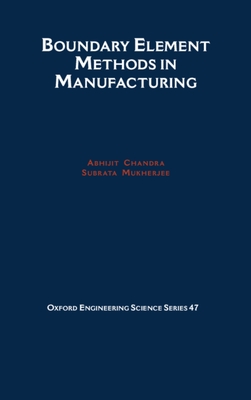
Boundary Element Methods in Manufacturing
Book Details
Format
Hardback
Book Series
Oxford Engineering Science Series
ISBN-10
0195079213
ISBN-13
9780195079210
Publisher
Oxford University Press Inc
Imprint
Oxford University Press Inc
Country of Manufacture
GB
Country of Publication
GB
Publication Date
Jun 12th, 1997
Print length
528 Pages
Weight
933 grams
Dimensions
24.10 x 16.00 x 3.10 cms
Product Classification:
Maths for scientistsApplied physicsMaths for engineersMechanical engineeringMechanics of solids
KSh 31,150.00
Temporarily out of stock, due soon
0 in stock
Delivery Location
Delivery fee: Select location
Secure
Quality
Fast
Numerical simulation of manufacturing processes, and its integration into the design cycle, are the dual themes of this book. The computational method of choice here is the boundary element method (BEM). Detailed discussions of forming, casting, machining and grinding process modelling are included in this book.
Manufacturing processes have existed, in some form, since the dawn of civilization. Modelling and numerical simulation of mechanics of such processes, however, are of fairly recent vintage; made possible, mainly by improved understanding of the fundamental mechanics and physics of these processes as well as by the availability of ever more powerful computers. Our capabilities of designing manufacturing processes, however, significantly lag behind our abilities in simulating such processes. In fact, research in the area of design of manufacturing processes is barely a decade old.Analysis of manufacturing processes, and its integration into the design cycle of these processes, are the dual themes of this book. The boundary element method (BEM) is the computational method of choice. This versatile and powerful method has enjoyed extensive development during the last two decades and has been applied to virtually all areas of engieering mechanics (both linear and nonlinear) as well as in other areas.The BEM infra-structure is presented in Chapters 2, 3, and 4. Chapters 2 and 3, respectively provide reviews of the fundamentals of nonlinear and thermal problems. Material and geometric nonlinearities are ubiquitous in manufacturing processes such as forming and machining while thermal issues play significant roles in casting and machining processes. Chapter 4 discusses design sensitivity analysis, and provides an avenue for utilizing insights gained from analysis toward design synthesis of manufacturing processes. Chapters 5 through 9 are devoted to detailed discussions of a broad range of manufacturing processes - forming, solidification, machining, and ceramic grinding.The unique features of this book are its emphasis on numerical simulation as well as on design of manufacturing processes, and the use of the boundary element method as the computational method of choice.
Get Boundary Element Methods in Manufacturing by Abhijit Chandra, Subrata Mukherjee at the best price and quality guaranteed only at Werezi Africa's largest book ecommerce store. The book was published by Oxford University Press Inc and it has 528 pages.
Customers Who Bought This Also Bought

Mathematical Analysis for Sciences and Engineering
KSh 13,950.00

Higher Category Theory
KSh 20,000.00
Mathematical Physiology
KSh 20,500.00
Computational Methods in Physics, Chemistry & Biology – An Introduction
KSh 35,650.00
Morphological Models of Random Structures
KSh 32,400.00
Programming for Computations - Python
KSh 8,100.00

An Introduction to Continuous-Time Stochastic Processes
KSh 9,000.00

From Statistical Physics to Data-Driven Modelling
KSh 10,800.00
Methods of Electronic–Structure Calculations – From Molecules to Solids
KSh 57,750.00
Green''s Functions and Ordered Exponentials
KSh 24,650.00

Hydrodynamic Limits and Related Topics
KSh 10,450.00
Mathematical Models in Biology
KSh 8,100.00
More by Abhijit Chandra, Subrata Mukherjee


More in This Genre
Mathematical Analysis for Sciences and Engineering
KSh 13,950.00
Higher Category Theory
KSh 20,000.00
Mathematical Physiology
KSh 20,500.00
Computational Methods in Physics, Chemistry & Biology – An Introduction
KSh 35,650.00
Morphological Models of Random Structures
KSh 32,400.00
Programming for Computations - Python
KSh 8,100.00
