
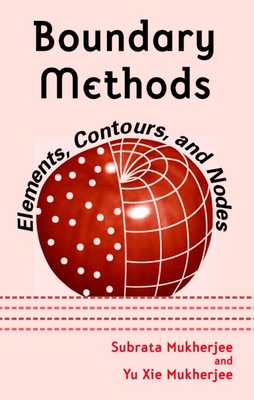
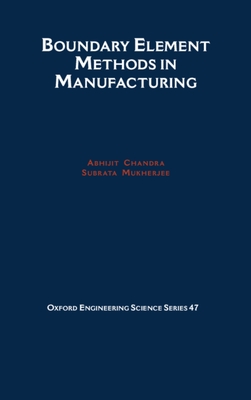
Boundary Methods : Elements, Contours, and Nodes
Book Details
Format
Hardback
Book Series
Mechanical Engineering
ISBN-10
0824725999
ISBN-13
9780824725990
Publisher
Taylor & Francis Inc
Imprint
CRC Press Inc
Country of Manufacture
GB
Country of Publication
GB
Publication Date
Mar 17th, 2005
Print length
248 Pages
Weight
604 grams
KSh 12,250.00
Werezi Extended Catalogue
Delivery in 12 days
1 copies in stock
Delivery Location
Delivery fee: Select location
Delivery in 12 days
Secure
Quality
Fast
Presents the results of research in boundary-based mesh-free methods. This work discusses topics such as shape sensitivities, shape optimization, and adaptive meshing.
Boundary Methods: Elements, Contours, and Nodes presents the results of cutting-edge research in boundary-based mesh-free methods. These methods combine the dimensionality advantage of the boundary element method with the ease of discretization of mesh-free methods, both of which, for some problems, hold distinct advantages over the finite element method.
After introducing some novel topics related to the boundary element method (BEM), the authors focus on the boundary contour method (BCM)-a variant of the BEM that further reduces the dimensionality of a problem. The final section of the book explores the boundary node method, which combines the BEM with moving least-squares approximants to produce a mesh-free, boundary-only method.
The authors, who are also the primary developers of these methods, clearly introduce and develop each topic. In addition to numerical solutions of boundary value problems in potential theory and linear elasticity, they also discuss topics such as shape sensitivities, shape optimization, and adaptive meshing. Numerical results for selected problems appear throughout the book, as do extensive references.
After introducing some novel topics related to the boundary element method (BEM), the authors focus on the boundary contour method (BCM)-a variant of the BEM that further reduces the dimensionality of a problem. The final section of the book explores the boundary node method, which combines the BEM with moving least-squares approximants to produce a mesh-free, boundary-only method.
The authors, who are also the primary developers of these methods, clearly introduce and develop each topic. In addition to numerical solutions of boundary value problems in potential theory and linear elasticity, they also discuss topics such as shape sensitivities, shape optimization, and adaptive meshing. Numerical results for selected problems appear throughout the book, as do extensive references.
Get Boundary Methods by Subrata Mukherjee, Yu Xie Mukherjee at the best price and quality guaranteed only at Werezi Africa's largest book ecommerce store. The book was published by Taylor & Francis Inc and it has 248 pages.
Customers Who Bought This Also Bought

Pearson Edexcel International A Level Mathematics Pure Mathematics 1 Student Book
KSh 6,050.00
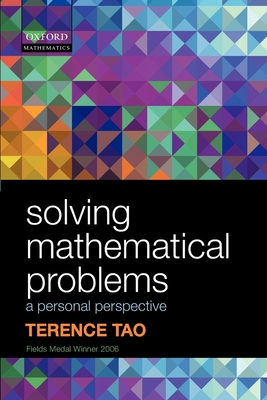
Solving Mathematical Problems
KSh 5,400.00

Pearson Edexcel International A Level Mathematics Mechanics 1 Student Book
KSh 5,850.00

Pearson Edexcel International A Level Mathematics Pure 2 Mathematics Student Book
KSh 5,950.00

Pearson Edexcel International A Level Mathematics Pure 4 Mathematics Student Book
KSh 5,850.00

Pearson Edexcel International A Level Mathematics Decision Mathematics 1 Student Book
KSh 6,000.00

Pearson Edexcel International A Level Mathematics Pure Mathematics 3 Student Book
KSh 6,000.00
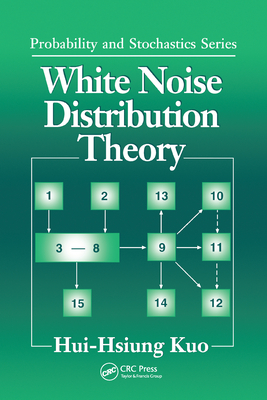
White Noise Distribution Theory
KSh 9,750.00

Dry-fly Fishing In Theory And Practice
KSh 5,500.00

Pearson Edexcel International A Level Mathematics Mechanics 3 Student Book
KSh 5,900.00
Pearson Edexcel International A Level Mathematics Further Pure Mathematics 3 Student Book
KSh 5,950.00
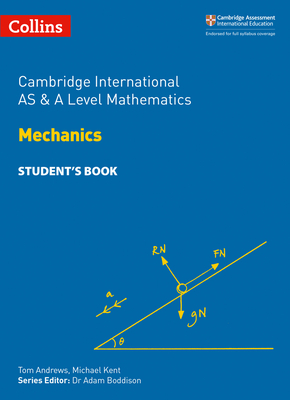
Caie Al Maths - Mechanics
KSh 4,500.00
More by Subrata Mukherjee, Yu Xie Mukherjee


More in This Genre
Pearson Edexcel International A Level Mathematics Pure Mathematics 1 Student Book
KSh 6,050.00
Solving Mathematical Problems
KSh 5,400.00
Pearson Edexcel International A Level Mathematics Mechanics 1 Student Book
KSh 5,850.00
Pearson Edexcel International A Level Mathematics Pure 2 Mathematics Student Book
KSh 5,950.00
Pearson Edexcel International A Level Mathematics Pure 4 Mathematics Student Book
KSh 5,850.00
Pearson Edexcel International A Level Mathematics Decision Mathematics 1 Student Book
KSh 6,000.00
