
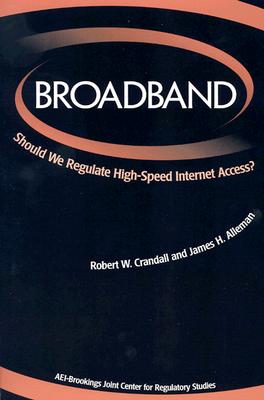
Broadband : Should We Regulate High-Speed Internet Access?
Book Details
Format
Paperback / softback
ISBN-10
0815715919
ISBN-13
9780815715917
Publisher
Bloomsbury Publishing Plc
Imprint
Brookings Institution
Country of Manufacture
US
Country of Publication
GB
Publication Date
Jan 17th, 2003
Print length
304 Pages
Weight
486 grams
Dimensions
15.60 x 22.90 x 0.50 cms
KSh 4,150.00
Currently unavailable
0 in stock
Delivery Location
Delivery fee: Select location
Secure
Quality
Fast
There is widespread concern in the telecommunications industry that public policy may be impeding the continued development of the Internet into a high-speed communications network.
"
A Brookings Institution Press and American Enterprise Institute publication
There is widespread concern in the telecommunications industry that public policy may be impeding the continued development of the Internet into a high-speed communications network. In the absence of ubiquitous, high-speed ¡°broadband¡± Internet connections for residential and small-business customers, the demand for IT equipment and new Internet service applications may stagnate.
Broadband policy is controversial in large part because of the differences in the regulatory regimes faced by different types of carriers. Cable television companies face neither retail price regulation of their cable modem services nor any requirements to make their facilities available to competitors. Local telephone companies, on the other hand, face both retail price regulation for their DSL service and a requirement imposed by the 1996 Telecommunications Act that they ¡°unbundle¡± their network facilities and lease them to rivals. Finally, new entrants are largely unregulated, but many rely on facilities leased from the incumbent telephone companies at regulated rates to connect to their customers. This asymmetric regulation is the focus of this volume, in which telecommunications scholars address the public policy issues that have arisen over the deployment of new high-speed telecommunications services.
Robert W. Crandall is a senior fellow in the Economic Studies program at the Brookings Institution. His previous books include (with Martin Cave) Telecommunications Liberalization on Two Sides of the Atlantic (2001) and (with Leonard Waverman) Who Pays for Universal Service? (Brookings 2000). James H. Alleman is an associate professor in interdisciplinary telecommunications at the College of Engineering and Applied Science, University of Colorado, on leave at Columbia University.
"There is widespread concern in the telecommunications industry that public policy may be impeding the continued development of the Internet into a high-speed communications network. In the absence of ubiquitous, high-speed ¡°broadband¡± Internet connections for residential and small-business customers, the demand for IT equipment and new Internet service applications may stagnate.
Broadband policy is controversial in large part because of the differences in the regulatory regimes faced by different types of carriers. Cable television companies face neither retail price regulation of their cable modem services nor any requirements to make their facilities available to competitors. Local telephone companies, on the other hand, face both retail price regulation for their DSL service and a requirement imposed by the 1996 Telecommunications Act that they ¡°unbundle¡± their network facilities and lease them to rivals. Finally, new entrants are largely unregulated, but many rely on facilities leased from the incumbent telephone companies at regulated rates to connect to their customers. This asymmetric regulation is the focus of this volume, in which telecommunications scholars address the public policy issues that have arisen over the deployment of new high-speed telecommunications services.
Robert W. Crandall is a senior fellow in the Economic Studies program at the Brookings Institution. His previous books include (with Martin Cave) Telecommunications Liberalization on Two Sides of the Atlantic (2001) and (with Leonard Waverman) Who Pays for Universal Service? (Brookings 2000). James H. Alleman is an associate professor in interdisciplinary telecommunications at the College of Engineering and Applied Science, University of Colorado, on leave at Columbia University.
Get Broadband by James H. Alleman at the best price and quality guaranteed only at Werezi Africa's largest book ecommerce store. The book was published by Bloomsbury Publishing Plc and it has 304 pages.
Customers Who Bought This Also Bought

Development as Freedom
KSh 2,900.00

Breakneck
KSh 4,500.00

Why Nations Fail
KSh 2,350.00

Anti-Politics Machine
KSh 3,750.00

End of Poverty
KSh 2,350.00

The Thinking Machine
KSh 2,350.00

Economics: The Economist Guide
KSh 2,150.00

Apostles of Development
KSh 5,600.00
How Boards Work
KSh 2,350.00

Economic Facts and Fallacies
KSh 3,050.00

Eat That Frog!, Fourth Edition
KSh 3,250.00

Capitalism and Freedom
KSh 3,350.00
