
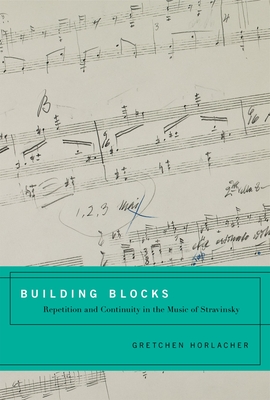
Building Blocks : Repetition and Continuity in the Music of Stravinsky
Book Details
Format
Hardback
ISBN-10
0195370864
ISBN-13
9780195370867
Publisher
Oxford University Press Inc
Imprint
Oxford University Press Inc
Country of Manufacture
US
Country of Publication
GB
Publication Date
May 26th, 2011
Print length
232 Pages
Weight
502 grams
Dimensions
16.50 x 24.30 x 2.20 cms
KSh 16,750.00
Temporarily out of stock, due soon
0 in stock
Delivery Location
Delivery fee: Select location
Secure
Quality
Fast
Presenting an innovative, alternative analytical model for Stravinsky''s compositions, Building Blocks seeks a fuller perspective, and enables a fresh, insightful approach to this music and the theoretical constructs behind it. Author Gretchen Horlacher portrays the whole of Stravinsky''s repertoire as radical or modern not because it eschews continuity and connection, but because it places them in relation to their opposites.
A pioneer of musical modernism, Igor Stravinsky marked a significant turn in compositional method. He broke free from traditional styles and contemporary trends in the early part of the twentieth century to achieve an entirely new and truly modern aesthetic. Striking a remarkable concurrence of stasis and discontinuity, Stravinsky crafted large-scale compositions out of short repeating melodies, juxtaposed these primary motives with contrasting and varying fragments, and layered on fixed ostinati which repeated at their own rates throughout the piece. Previous scholarship on Stravinsky focuses on the disparate and independent nature of such textures, conceiving them as separated and deadlocked, unable to escape their repetitions, and having no goal. This connects Stravinsky''s procedures with the more radical music of subsequent composers for whom disconnection has served as a primary aesthetic. Yet, from the perspective of his later works, the static and discontinuous depictions of Stravinsky''s music seem incomplete and perhaps even simplistic. The "building blocks" of his novel textures often consist of tunes with identifiable intervallic shapes, goal pitches, and defining durational patterns-organizations that engender continuity and connection. In other words, although its basic materials are combined into new, often dissonant and usually repetitive textures, those materials still originate in, and depend upon, traditional concepts of melody, harmony, and pulsation. Presenting an innovative analytical model for Stravinsky''s compositions, Building Blocks seeks a fuller perspective, and enables a fresh, insightful approach to this music and the theoretical constructs behind it. Author Gretchen Horlacher portrays the whole of Stravinsky''s repertoire as radical or modern not because it eschews continuity and connection, but because it places them in relation to their opposites: the music holds our interest because undeniable references toward continuity are dynamically coordinated (rather than subsumed) with stasis and discontinuity. From this vantage point, Stravinsky''s music becomes a commentary on the nature of time: the music draws into relation the tension between time as it is punctuated by fixed reference and as it flows from one event to another. It is quintessentially modern because of its inherent emphasis on multiple vantage points. A sensitive and sophisticated approach to the work of this iconic composer, Building Blocks will appeal to students and scholars of Stravinsky and his music, scholars of musical modernism and twentieth century music, and to a more limited extent, to performers-particularly conductors, pianists, and orchestral instrumentalists.
Get Building Blocks by Gretchen Horlacher at the best price and quality guaranteed only at Werezi Africa's largest book ecommerce store. The book was published by Oxford University Press Inc and it has 232 pages.
Customers Who Bought This Also Bought

Rest Is Noise
KSh 3,550.00

Whole World of Music
KSh 11,950.00

American Experimental Music 1890-1940
KSh 10,000.00

The Charles Ives Tunebook, Second Edition
KSh 7,750.00
Gustav Mahler''s Symphonic Landscapes
KSh 17,800.00
The Symphonic Repertoire, Volume IV – The Second Golden Age of the Viennese Symphony: Brahms, Bruckner, Dvorák, Mahler, and Selected Contemporar
KSh 14,900.00
Avant Garde
KSh 19,500.00

The Cambridge Companion to Richard Strauss
KSh 16,550.00

Boulez, Music and Philosophy
KSh 17,100.00
New Musical Resources
KSh 17,100.00

John Cage and David Tudor
KSh 17,800.00

Samuel Coleridge-taylor, a Musical Life
KSh 11,150.00
More in This Genre
Rest Is Noise
KSh 3,550.00
Whole World of Music
KSh 11,950.00
American Experimental Music 1890-1940
KSh 10,000.00
The Charles Ives Tunebook, Second Edition
KSh 7,750.00
Gustav Mahler''s Symphonic Landscapes
KSh 17,800.00
The Symphonic Repertoire, Volume IV – The Second Golden Age of the Viennese Symphony: Brahms, Bruckner, Dvorák, Mahler, and Selected Contemporar
KSh 14,900.00
