
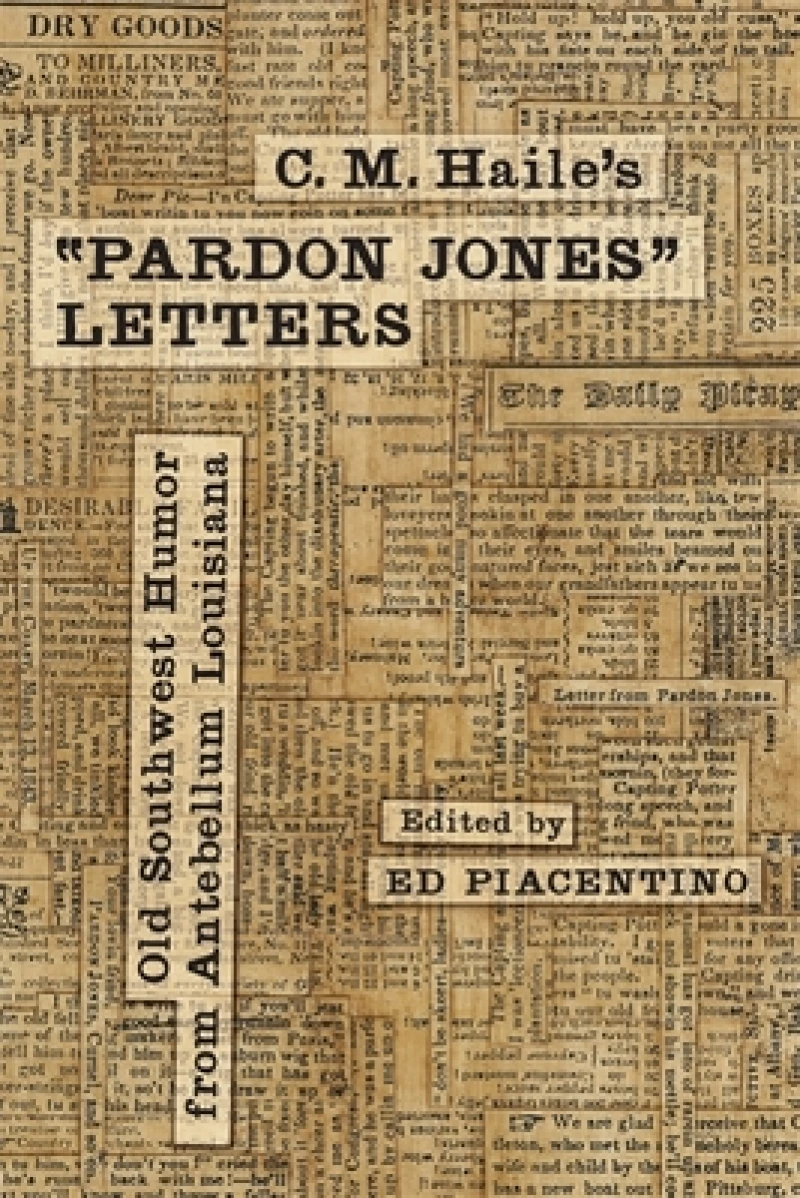
C. M. Haile''s ""Pardon Jones"" Letters : Old Southwest Humor from Antebellum Louisiana
Book Details
Format
Hardback or Cased Book
Book Series
Southern Literary Studies
ISBN-10
0807134376
ISBN-13
9780807134375
Publisher
Louisiana State University Press
Imprint
Louisiana State University Press
Country of Manufacture
US
Country of Publication
GB
Publication Date
Jul 1st, 2009
Print length
256 Pages
Weight
333 grams
Dimensions
22.80 x 15.20 x 2.50 cms
Product Classification:
Diaries, letters & journalsPublished diaries, letters and journals
Ksh 6,500.00
Temporarily out of stock, due soon
0 in stock
Delivery Location
Delivery fee: Select location
Secure
Quality
Fast
From 1840 to 1848, journalist C. M. Haile published a series of mock letters-to-the-editor in the New Orleans Picayune under the pseudonym “Pardon Jones”. In this volume, Ed Piacentino collects all of Haile's epistles, highlighting this trove of Old Southwest humour and the prolific writer's foremost literary achievement.
From 1840 to 1848, journalist C. M. Haile published a series of mock letters-to-the-editor in the New Orleans Picayune under the pseudonym ""Pardon Jones."" With their rural dialect, outlandish and amusing characters, and farcical situations, the letters proved extremely popular with readers and became a regular feature in the newspaper. In C. M. Haile's ""Pardon Jones"" Letters, Ed Piacentino collects all of Haile's sixty-seven epistles, highlighting this trove of Old Southwest humor and the prolific writer's foremost literary achievement.
The humor of the Old Southwest flourished in the sparsely settled frontier regions of Georgia, the Carolinas, Louisiana, and other southern states from the 1830s to the end of the Civil War, with amateur humorists anonymously or pseudonymously publishing pieces written in backwoods vernacular in their local and regional newspapers. Like others in the genre, Haile's ""Pardon Jones"" letters gently burlesque the eccentricities, scams, scrapes, and other misadventures of his plain folk characters. Unlike his contemporaries, however, Haile also used his mock epistles to discuss key political matters of the day, imbuing his characters with a liberal voice and an engaging dramatic presence.
Set in three different venues - Louisiana, Massachusetts, and Mexico - the letters allude to national issues such as the tariff debate, boundary disputes between the United States and Canada, the controversy over a national bank, the conflict between states' rights and nationalism, and the debate over the annexation of Texas. Uniquely among Old Southwest humorists, Haile wrote from Mexico of Americans' encounter with a culture that lay south of the United States. By choosing to emphasise the marginalized Mexican ""other,"" Haile expanded the contours of Old Southwest humor and imaginatively enriched the sociocultural milieu of his fictive letters.
Piacentino's informative introduction provides a meticulously researched account of Haile's life and career. His annotations identify obscure allusions throughout the book, and a glossary provides help with words and phrases of the dialect and with other unfamiliar references. With his lively ""Pardon Jones"" letters, C. M. Haile gave common folk a voice, a privilege rarely afforded to them in earlier American literature.
The humor of the Old Southwest flourished in the sparsely settled frontier regions of Georgia, the Carolinas, Louisiana, and other southern states from the 1830s to the end of the Civil War, with amateur humorists anonymously or pseudonymously publishing pieces written in backwoods vernacular in their local and regional newspapers. Like others in the genre, Haile's ""Pardon Jones"" letters gently burlesque the eccentricities, scams, scrapes, and other misadventures of his plain folk characters. Unlike his contemporaries, however, Haile also used his mock epistles to discuss key political matters of the day, imbuing his characters with a liberal voice and an engaging dramatic presence.
Set in three different venues - Louisiana, Massachusetts, and Mexico - the letters allude to national issues such as the tariff debate, boundary disputes between the United States and Canada, the controversy over a national bank, the conflict between states' rights and nationalism, and the debate over the annexation of Texas. Uniquely among Old Southwest humorists, Haile wrote from Mexico of Americans' encounter with a culture that lay south of the United States. By choosing to emphasise the marginalized Mexican ""other,"" Haile expanded the contours of Old Southwest humor and imaginatively enriched the sociocultural milieu of his fictive letters.
Piacentino's informative introduction provides a meticulously researched account of Haile's life and career. His annotations identify obscure allusions throughout the book, and a glossary provides help with words and phrases of the dialect and with other unfamiliar references. With his lively ""Pardon Jones"" letters, C. M. Haile gave common folk a voice, a privilege rarely afforded to them in earlier American literature.
Get C. M. Haile''s ""Pardon Jones"" Letters by at the best price and quality guaranteed only at Werezi Africa's largest book ecommerce store. The book was published by Louisiana State University Press and it has pages.

