
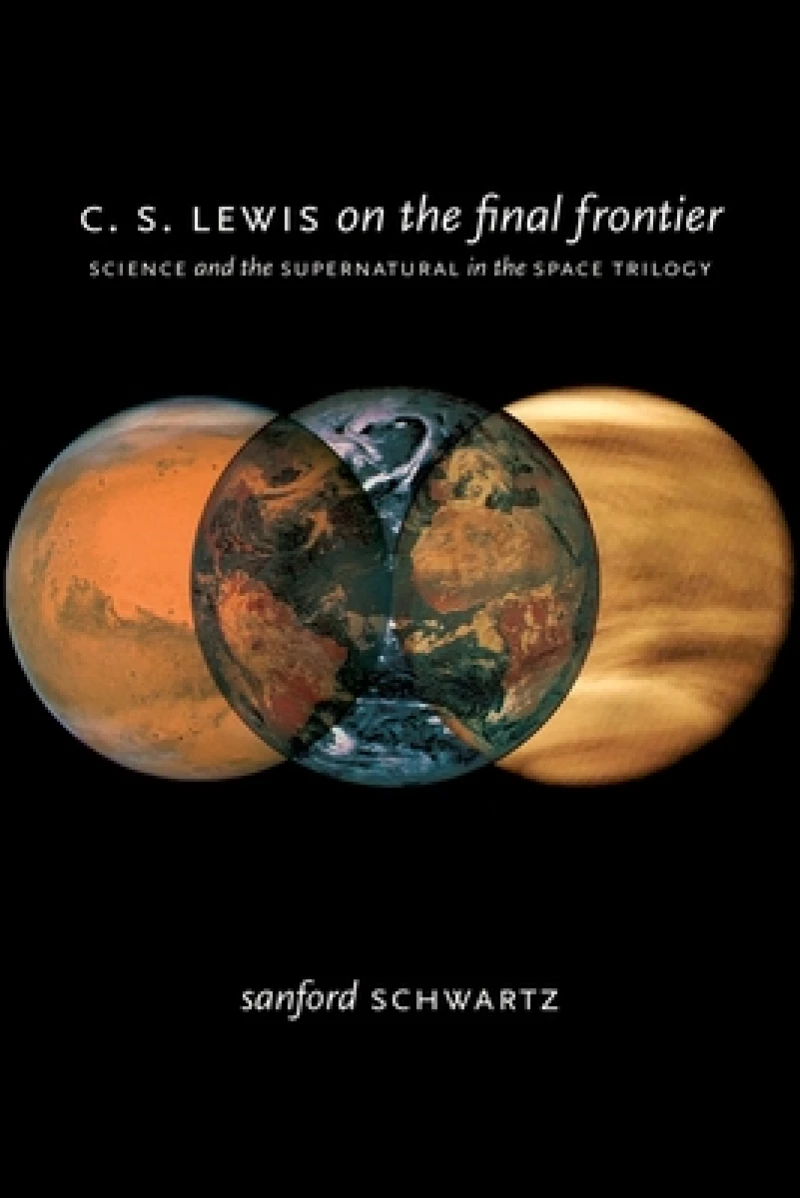
C. S. Lewis on the Final Frontier : Science and the Supernatural in the Space Trilogy
Book Details
Format
Hardback or Cased Book
ISBN-10
019537472X
ISBN-13
9780195374728
Publisher
Oxford University Press Inc
Imprint
Oxford University Press Inc
Country of Manufacture
GB
Country of Publication
GB
Publication Date
Jul 16th, 2009
Print length
256 Pages
Weight
390 grams
Dimensions
21.40 x 15.10 x 2.30 cms
Product Classification:
Philosophy of religionReligion & science
Ksh 7,900.00
Manufactured on Demand
0 in stock
Delivery Location
Delivery fee: Select location
Secure
Quality
Fast
C.S. Lewis's space trilogy - Out of the Silent Planet (1938), Perelandra (1943), That Hideous Strength (1945) - has been both admired and dismissed for its staging of a sharply defined struggle between religious and naturalistic points of view. Proceeding from Mars and Venus to a final showdown on our own planet, each installment takes up another facet of the seemingly impassable conflict between Christianity and the tendencies of modern thought that arose in the wake of the Darwinian revolution in biology. In Out of the Silent Planet, the target is evolutionary naturalism, primarily as it appears in the science fiction of H.G. Wells. In Perelandra, it is the alluring but perilous doctrine of "creative" evolution inaugurated by Henri Bergson. In That Hideous Strength, Lewis depicts an insidious organization - the National Institute of Coordinated Experiments - whose friendly acronym, NICE, belies its pursuit of a eugenically inspired program to assume control over the evolutionary process and thereby achieve everlasting dominion over the planet. Taken together, these seemingly clear-cut confrontations between Christian tradition and modern apostasy reinforce the image of Lewis as the voice of an endangered heritage, a self-styled "dinosaur" waging spiritual warfare against the corruption and confusions of his age. Sanford Schwartz here offers a new reading of the trilogy that challenges the prevailing view of Lewis, shared by advocates and adversaries alike, as champion of the "discarded image" of premodern cosmology. Through his close reading of Lewis's work, Schwartz is able to discern the outlines of a Lewis who is far more deeply engaged with modern developments in science and philosophy, and more prepared to explore the possibilities for transforming these developments in ways that are not only compatible with traditional Christian doctrine but also speak to the distinctive problems of the modern condition. Unlike the Chronicles of Narnia, the Trilogy has received little scholarly attention. Schwartz's study fills a major gap in the literature and will appeal to a wide range of scholars and students as well as to Lewis's many devoted fans.
C.S. Lewis''s space trilogy - Out of the Silent Planet (1938), Perelandra (1943), That Hideous Strength (1945) - has been both admired and dismissed for its staging of a sharply defined struggle between religious and naturalistic points of view. Proceeding from Mars and Venus to a final showdown on our own planet, each installment takes up another facet of the seemingly impassable conflict between Christianity and the tendencies of modern thought that arose in the wake of the Darwinian revolution in biology. In Out of the Silent Planet, the target is evolutionary naturalism, primarily as it appears in the science fiction of H.G. Wells. In Perelandra, it is the alluring but perilous doctrine of "creative" evolution inaugurated by Henri Bergson. In That Hideous Strength, Lewis depicts an insidious organization - the National Institute of Coordinated Experiments - whose friendly acronym, NICE, belies its pursuit of a eugenically inspired program to assume control over the evolutionary process and thereby achieve everlasting dominion over the planet. Taken together, these seemingly clear-cut confrontations between Christian tradition and modern apostasy reinforce the image of Lewis as the voice of an endangered heritage, a self-styled "dinosaur" waging spiritual warfare against the corruption and confusions of his age. Sanford Schwartz here offers a new reading of the trilogy that challenges the prevailing view of Lewis, shared by advocates and adversaries alike, as champion of the "discarded image" of premodern cosmology. Through his close reading of Lewis''s work, Schwartz is able to discern the outlines of a Lewis who is far more deeply engaged with modern developments in science and philosophy, and more prepared to explore the possibilities for transforming these developments in ways that are not only compatible with traditional Christian doctrine but also speak to the distinctive problems of the modern condition. Unlike the Chronicles of Narnia, the Trilogy has received little scholarly attention. Schwartz''s study fills a major gap in the literature and will appeal to a wide range of scholars and students as well as to Lewis''s many devoted fans.
Get C. S. Lewis on the Final Frontier by at the best price and quality guaranteed only at Werezi Africa's largest book ecommerce store. The book was published by Oxford University Press Inc and it has pages.

