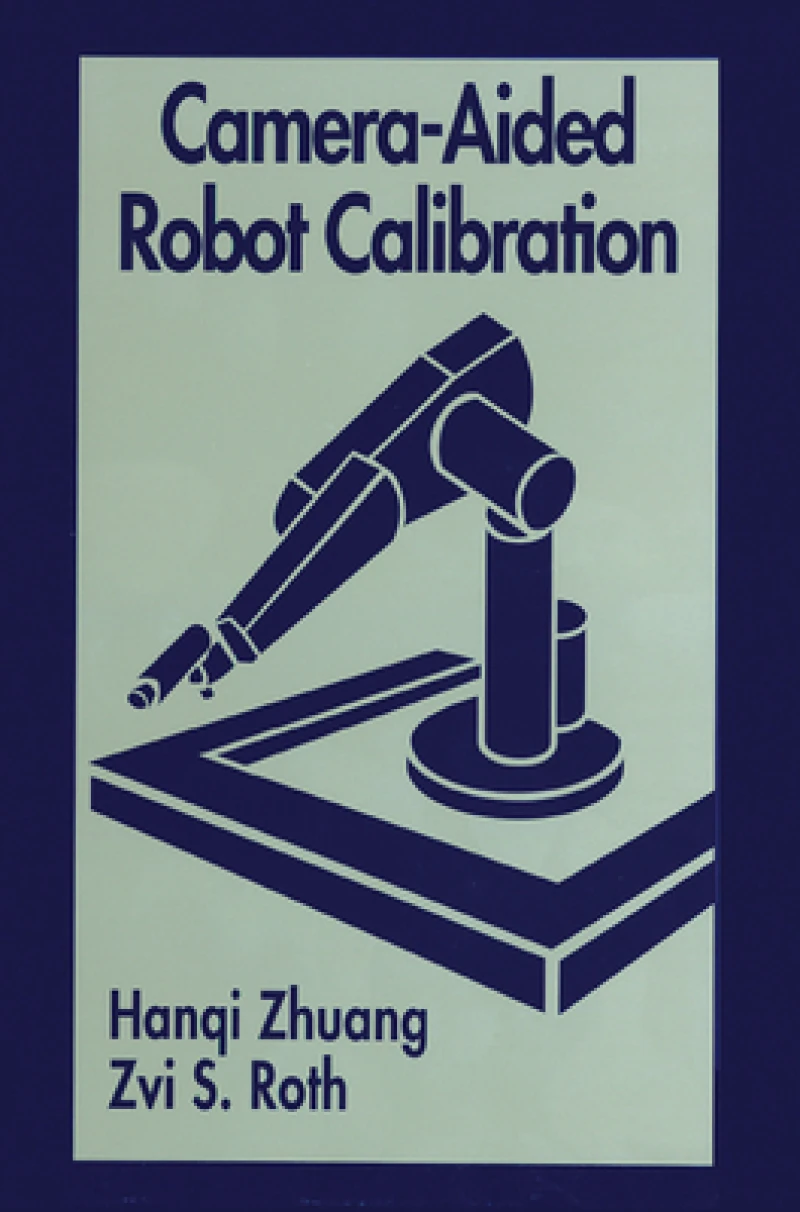
Camera-Aided Robot Calibration
Book Details
Format
Paperback / Softback
ISBN-10
036744853X
ISBN-13
9780367448530
Publisher
Taylor & Francis Ltd
Imprint
CRC Press
Country of Manufacture
GB
Country of Publication
GB
Publication Date
Jun 30th, 2020
Print length
368 Pages
Weight
680 grams
Ksh 12,400.00
Werezi Extended Catalogue
0 in stock
Delivery Location
Delivery fee: Select location
Secure
Quality
Fast
This book, being the first on the topic of robot calibration using computer vision technology, covers the entire process of vision-based robot calibration, including kinematic modeling, pose measurement, error parameter identification, and compensation.
Robot calibration is the process of enhancing the accuracy of a robot by modifying its control software. This book provides a comprehensive treatment of the theory and implementation of robot calibration using computer vision technology. It is the only book to cover the entire process of vision-based robot calibration, including kinematic modeling, camera calibration, pose measurement, error parameter identification, and compensation.
The book starts with an overview of available techniques for robot calibration, with an emphasis on vision-based techniques. It then describes various robot-camera systems. Since cameras are used as major measuring devices, camera calibration techniques are reviewed.
Camera-Aided Robot Calibration studies the properties of kinematic modeling techniques that are suitable for robot calibration. It summarizes the well-known Denavit-Hartenberg (D-H) modeling convention and indicates the drawbacks of the D-H model for robot calibration. The book develops the Complete and Parametrically Continuous (CPC) model and the modified CPC model, that overcome the D-H model singularities. The error models based on these robot kinematic modeling conventions are presented.
No other book available addresses the important, practical issue of hand/eye calibration. This book summarizes current research developments and demonstrates the pros and cons of various approaches in this area. The book discusses in detail the final stage of robot calibration - accuracy compensation - using the identified kinematic error parameters. It offers accuracy compensation algorithms, including the intuitive task-point redefinition and inverse-Jacobian algorithms and more advanced algorithms based on optimal control theory, which are particularly attractive for highly redundant manipulators.
Camera-Aided Robot Calibration defines performance indices that are designed for off-line, optimal selection of measurement configurations. It then describes three approaches: closed-form, gradient-based, and statistical optimization. The included case study presents experimental results that were obtained by calibrating common industrial robots. Different stages of operation are detailed, illustrating the applicability of the suggested techniques for robot calibration. Appendices provide readers with preliminary materials for easier comprehension of the subject matter. Camera-Aided Robot Calibration is a must-have reference for researchers and practicing engineers-the only one with all the information!
The book starts with an overview of available techniques for robot calibration, with an emphasis on vision-based techniques. It then describes various robot-camera systems. Since cameras are used as major measuring devices, camera calibration techniques are reviewed.
Camera-Aided Robot Calibration studies the properties of kinematic modeling techniques that are suitable for robot calibration. It summarizes the well-known Denavit-Hartenberg (D-H) modeling convention and indicates the drawbacks of the D-H model for robot calibration. The book develops the Complete and Parametrically Continuous (CPC) model and the modified CPC model, that overcome the D-H model singularities. The error models based on these robot kinematic modeling conventions are presented.
No other book available addresses the important, practical issue of hand/eye calibration. This book summarizes current research developments and demonstrates the pros and cons of various approaches in this area. The book discusses in detail the final stage of robot calibration - accuracy compensation - using the identified kinematic error parameters. It offers accuracy compensation algorithms, including the intuitive task-point redefinition and inverse-Jacobian algorithms and more advanced algorithms based on optimal control theory, which are particularly attractive for highly redundant manipulators.
Camera-Aided Robot Calibration defines performance indices that are designed for off-line, optimal selection of measurement configurations. It then describes three approaches: closed-form, gradient-based, and statistical optimization. The included case study presents experimental results that were obtained by calibrating common industrial robots. Different stages of operation are detailed, illustrating the applicability of the suggested techniques for robot calibration. Appendices provide readers with preliminary materials for easier comprehension of the subject matter. Camera-Aided Robot Calibration is a must-have reference for researchers and practicing engineers-the only one with all the information!
Get Camera-Aided Robot Calibration by at the best price and quality guaranteed only at Werezi Africa's largest book ecommerce store. The book was published by Taylor & Francis Ltd and it has pages.