
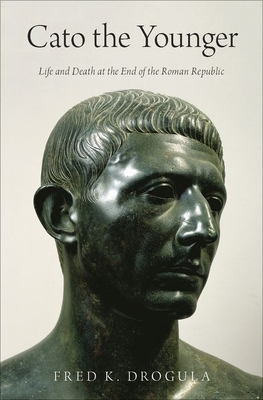
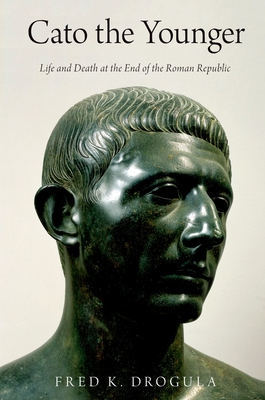
Cato the Younger : Life and Death at the End of the Roman Republic
Book Details
Format
Hardback
ISBN-10
019086902X
ISBN-13
9780190869021
Publisher
Oxford University Press Inc
Imprint
Oxford University Press Inc
Country of Manufacture
US
Country of Publication
GB
Publication Date
Jun 6th, 2019
Print length
376 Pages
Weight
766 grams
Dimensions
16.60 x 24.30 x 3.50 cms
Product Classification:
Biography: generalBiography: general
KSh 7,600.00
Currently unavailable
0 in stock
Delivery Location
Delivery fee: Select location
Secure
Quality
Fast
Marcus Porcius Cato ("the Younger") is most famous for being Julius Caesar''s nemesis. His sustained antagonism was in large part responsible for pushing the Romans towards civil war. Yet Cato never wanted war even though he used the threat of violence against Caesar. This strategic gamble misfired as Caesar, instead of yielding, marched on Rome, hurling the Republic into a bloody civil war. Refusing to inhabit a world ruled by Caesar, Cato took his own life. Although the Roman historian Sallust identified Cato and Caesar as the two most outstanding men of their age, modern scholars have tended to dismiss Cato as a cantankerous conservative who, while colorful, was not a critical player in the events that overtook the Republic. This book, in providing a much-needed reliable biography of Cato, contradicts that assessment. In addition to being Caesar''s adversary, Cato is an important and fascinating historical figure in his own right, and his career-in particular, his idiosyncrasies-shed light on the changing political culture of the late Republic. Cato famously reached into Rome''s hallowed past and found mannerisms and habits to adopt that transformed him into the foremost champion of ancestral custom. Thus Cato did things that seemed strange and even bizarre such as wearing an old-fashioned tint of purple on his senatorial toga, refusing to ride a horse when on public business, and going about barefoot and without the usual tunic as an undergarment. His extreme conservatism-which became celebrated in later ages, especially in Enlightenment Europe and revolutionary America--was actually designed to give him a unique advantage in Roman politics. This is not to claim that he was insincere in his combative promotion of the mos maiorum (the way of the ancestors), but his political manipulation of the Romans'' reverence for their traditions was masterful. By providing a new, detailed portrait of Cato, the book also presents a unique narrative of the age he helped shape and inadvertently destroy.
Get Cato the Younger by Fred K. Drogula at the best price and quality guaranteed only at Werezi Africa's largest book ecommerce store. The book was published by Oxford University Press Inc and it has 376 pages.
Customers Who Bought This Also Bought

The Second Emancipation – Nkrumah, Pan–Africanism, and Global Blackness at High Tide
KSh 5,650.00

Maurice and Maralyn
KSh 2,000.00
Crusade for Justice – The Autobiography of Ida B. Wells, Second Edition
KSh 4,050.00

Ecce Homo
KSh 1,800.00

The Life of the Author – Maya Angelou
KSh 3,600.00

Centre Cannot Hold
KSh 3,050.00

Year of Magical Thinking
KSh 2,000.00

Muhammad: His Life Based on the Earliest Sources
KSh 3,600.00

Survive the Savage Sea
KSh 2,600.00

Buckley
KSh 6,250.00

Life in Letters
KSh 5,400.00

Green Hills of Africa
KSh 1,800.00

More in This Genre
The Second Emancipation – Nkrumah, Pan–Africanism, and Global Blackness at High Tide
KSh 5,650.00
Maurice and Maralyn
KSh 2,000.00
Crusade for Justice – The Autobiography of Ida B. Wells, Second Edition
KSh 4,050.00
Ecce Homo
KSh 1,800.00
The Life of the Author – Maya Angelou
KSh 3,600.00
Centre Cannot Hold
KSh 3,050.00
