
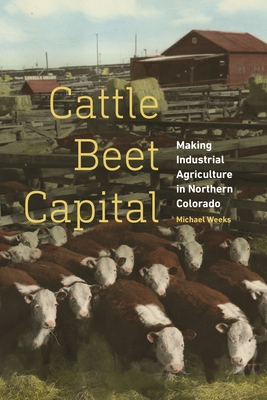
Cattle Beet Capital : Making Industrial Agriculture in Northern Colorado
Book Details
Format
Hardback
ISBN-10
1496208412
ISBN-13
9781496208415
Publisher
University of Nebraska Press
Imprint
University of Nebraska Press
Country of Manufacture
GB
Country of Publication
GB
Publication Date
Jul 1st, 2022
Print length
348 Pages
KSh 8,650.00
Currently unavailable
0 in stock
Delivery Location
Delivery fee: Select location
Secure
Quality
Fast
In 1870 several hundred settlers arrived at a patch of land at the confluence of the South Platte and Cache la Poudre Rivers in Colorado Territory. Their planned agricultural community, which they named Greeley, was centered around small landholdings, shared irrigation, and a variety of market crops. One hundred years later, Greeley was the home of the world’s largest concentrated cattle-feeding operation, with the resources of an entire region directed toward manufacturing beef. How did that transformation happen? Cattle Beet Capital is animated by that question.
Expanding outward from Greeley to all of northern Colorado, Cattle Beet Capital shows how the beet sugar industry came to dominate the region in the early twentieth century through a reciprocal relationship with its growers that supported a healthy and sustainable agriculture while simultaneously exploiting tens of thousands of migrant laborers. Michael Weeks shows how the state provided much of the scaffolding for the industry in the form of tariffs and research that synchronized with the agendas of industry and large farmers. The transformations that led to commercial feedlots began during the 1930s as farmers replaced crop rotations and seasonal livestock operations with densely packed cattle pens, mono-cropped corn, and the products pouring out of agro-industrial labs and factories. Using the lens of the northern Colorado region, Cattle Beet Capital illuminates the historical processes that made our modern food systems.
Expanding outward from Greeley to all of northern Colorado, Cattle Beet Capital shows how the beet sugar industry came to dominate the region in the early twentieth century through a reciprocal relationship with its growers that supported a healthy and sustainable agriculture while simultaneously exploiting tens of thousands of migrant laborers. Michael Weeks shows how the state provided much of the scaffolding for the industry in the form of tariffs and research that synchronized with the agendas of industry and large farmers. The transformations that led to commercial feedlots began during the 1930s as farmers replaced crop rotations and seasonal livestock operations with densely packed cattle pens, mono-cropped corn, and the products pouring out of agro-industrial labs and factories. Using the lens of the northern Colorado region, Cattle Beet Capital illuminates the historical processes that made our modern food systems.
Get Cattle Beet Capital by Michael Weeks at the best price and quality guaranteed only at Werezi Africa's largest book ecommerce store. The book was published by University of Nebraska Press and it has 348 pages.
Customers Who Bought This Also Bought

Crusade for Justice – The Autobiography of Ida B. Wells, Second Edition
KSh 4,050.00

Killers of the Flower Moon
KSh 2,000.00

Warmth of Other Suns
KSh 3,050.00

Frederick Douglass
KSh 3,350.00

107 Days
KSh 4,500.00

Second Treatise of Government – Norton Library
KSh 1,600.00

Tuesdays With Morrie
KSh 2,000.00
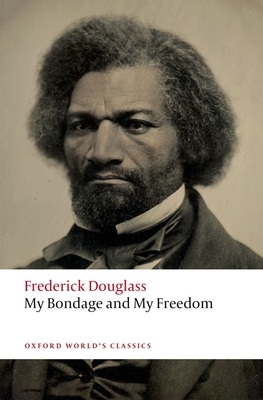
My Bondage and My Freedom
KSh 1,600.00

Hidden Figures
KSh 2,000.00

America, América
KSh 3,650.00

Holding the Line
KSh 2,000.00

Nuclear Folly
KSh 3,050.00
More by Michael Weeks

Programming Fundamentals Using MATLAB
KSh 10,750.00

Complete American Revolution Road Trip Guide – More than 500 Sites from Lexington to Yorktown
KSh 3,600.00

The Complete Civil War Road Trip Guide
KSh 3,800.00

Civil War Road Trip, Volume II
KSh 3,300.00

Civil War Road Trip, Volume I: A Guide to Northern Virginia, Maryland & Pennsylvania, 1861-1863
KSh 3,350.00
