
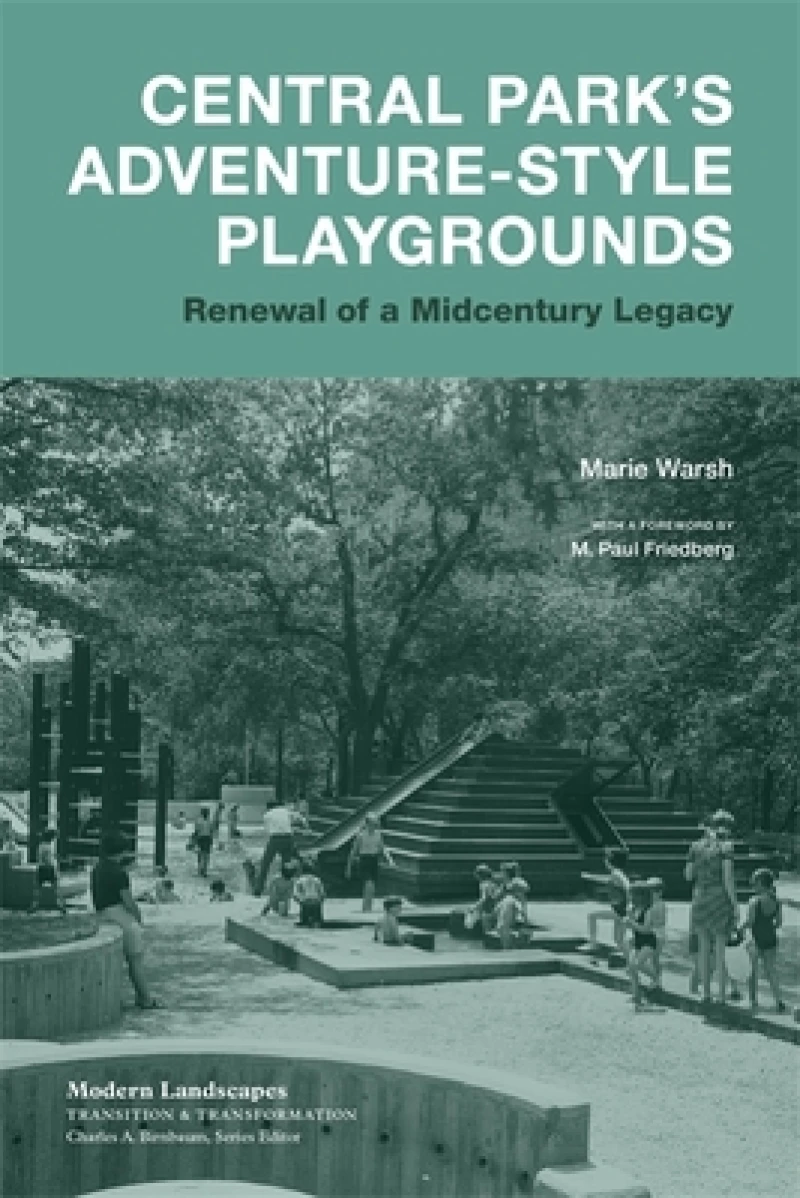
Central Park''s Adventure-Style Playgrounds : Renewal of a Midcentury Legacy
by
Marie Warsh
Book Details
Format
Paperback / Softback
Book Series
Modern Landscapes: Transition & Transformation
ISBN-10
0807172014
ISBN-13
9780807172018
Publisher
Louisiana State University Press
Imprint
Louisiana State University Press
Country of Manufacture
US
Country of Publication
GB
Publication Date
Nov 20th, 2019
Print length
184 Pages
Weight
410 grams
Dimensions
22.90 x 15.20 x 1.30 cms
Ksh 5,100.00
Temporarily out of stock, due soon
0 in stock
Delivery Location
Delivery fee: Select location
Secure
Quality
Fast
In New York's Central Park, some of the playgrounds constructed as part of the midcentury experimental “playground revolution” still remain. Marie Warsh tells the history of these playscapes built in the 1960s and ‘70s, exploring their connections to the art, recreational design, urbanism, and child-development theories of the period.
In New York's Central Park, some of the playgrounds constructed as part of the midcentury experimental ""playground revolution"" still remain. In Central Park's Adventure-Style Playgrounds, Marie Warsh tells the engrossing history of these playscapes built in the 1960s and 1970s, exploring their connections to the art, recreational design, urbanism, grassroots movements, and child-development theories of the period. She further details the Central Park Conservancy's efforts decades later to preserve and renew these playgrounds.
So-called adventure-style playgrounds featured interconnected forms including pyramids, mounds, and steps, and basic materials such as water and sand, encouraging new levels of creativity and interaction. By the end of the 1970s, ten of Central Park's twenty-two existing playgrounds, formerly paved, sterile, standard-equipment-filled lots dating to the 1930s, had been transformed according to the new design ideals. With time, deterioration prompted concerns about safety, and much of the equipment was removed. However, community interest led the Central Park Conservancy to update and preserve the playgrounds that remained in the park.
Building on successful aspects of the playgrounds, designers incorporated new technologies, materials, and equipment that reflect contemporary ideas about children's play and approaches to urban park management. They also developed strategies to better integrate them into the landscapes of the park. Today, Central Park's adventure-style playgrounds represent significant works of renewed modern landscape architecture as well as models for new thinking about playground design.
So-called adventure-style playgrounds featured interconnected forms including pyramids, mounds, and steps, and basic materials such as water and sand, encouraging new levels of creativity and interaction. By the end of the 1970s, ten of Central Park's twenty-two existing playgrounds, formerly paved, sterile, standard-equipment-filled lots dating to the 1930s, had been transformed according to the new design ideals. With time, deterioration prompted concerns about safety, and much of the equipment was removed. However, community interest led the Central Park Conservancy to update and preserve the playgrounds that remained in the park.
Building on successful aspects of the playgrounds, designers incorporated new technologies, materials, and equipment that reflect contemporary ideas about children's play and approaches to urban park management. They also developed strategies to better integrate them into the landscapes of the park. Today, Central Park's adventure-style playgrounds represent significant works of renewed modern landscape architecture as well as models for new thinking about playground design.
Get Central Park''s Adventure-Style Playgrounds by at the best price and quality guaranteed only at Werezi Africa's largest book ecommerce store. The book was published by Louisiana State University Press and it has pages.

