
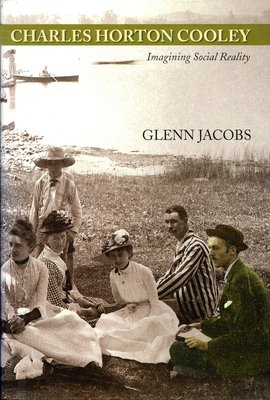
Charles Horton Cooley : Imagining Social Reality
by
Glenn Jacobs
Book Details
Format
Hardback
ISBN-10
1558495193
ISBN-13
9781558495197
Publisher
University of Massachusetts Press
Imprint
University of Massachusetts Press
Country of Manufacture
US
Country of Publication
GB
Publication Date
Feb 27th, 2006
Print length
272 Pages
Weight
564 grams
Dimensions
23.50 x 16.00 x 2.50 cms
Product Classification:
Biography: generalBiography: generalSociology & anthropologySociology and anthropology
KSh 6,150.00
Temporarily out of stock, due soon
0 in stock
Delivery Location
Delivery fee: Select location
Secure
Quality
Fast
An intellectual biography of a pre-eminent American sociologist.
An intellectual biography of a preeminent American sociologist One of the founders of sociology in the United States, Charles Horton Cooley (1864-1929) is perhaps best known for his concepts of the looking-glass self and the primary group. But according to Glenn Jacobs, he also deserves to be remembered as the first scholar of his generation to develop a viable concept of the social Characterizing Cooley as an ""exceptional exceptionalist,"" Jacobs shows how his unique adaptation of Adam Smith''s liberalism and his rejection of Herbert Spencer resulted in a notion of the social that set him apart from the burgeoning professional social science movements of his time. In surveying Cooley''s thought, Jacobs emphasizes the role that the sociologist''s own ""inner work"" played in the development of his idea of the self. Particularly important in this respect was Cooley''s deep commitment to the essay tradition, a literary genre distinguished by autobiographical reflection and conversational discourse that he described as ""a society of men speaking to each other across the ages."" A close reading of the journal that Cooley kept for over forty years reveals how be worked out many of his key concepts and theories in his personal writing. It was through this exercise that he developed his distinct literary-aesthetic perspective, eventually resulting in a methodology that stands out for setting qualitative sociology on an epistemological foundation. In a chapter devoted to Cooley''s qualitative approach, Jacobs analyzes his vivid ethnographic observations of the Lower East Side Jewish ghetto and Hull House in Chicago, as well as his reflections on the death of his daughter and his own impending death in 1929. Another chapter looks at Cooley''s little-known writing on economic sociology, focusing on his understanding of the market as an institution. By examining the full range of Charles Horton Cooley''s contributions to belles letters as well as social science, often allowing him to speak for himself, Jacobs makes a strong case for elevating Cooley''s rank among the most influential American sociologists.
Get Charles Horton Cooley by Glenn Jacobs at the best price and quality guaranteed only at Werezi Africa's largest book ecommerce store. The book was published by University of Massachusetts Press and it has 272 pages.
Customers Who Bought This Also Bought

The Second Emancipation – Nkrumah, Pan–Africanism, and Global Blackness at High Tide
KSh 5,650.00

Maurice and Maralyn
KSh 2,000.00

Crusade for Justice – The Autobiography of Ida B. Wells, Second Edition
KSh 4,050.00

Ecce Homo
KSh 1,800.00

The Life of the Author – Maya Angelou
KSh 3,600.00

Centre Cannot Hold
KSh 3,050.00

Year of Magical Thinking
KSh 2,000.00

Muhammad: His Life Based on the Earliest Sources
KSh 3,600.00

Survive the Savage Sea
KSh 2,600.00

Buckley
KSh 6,250.00

Life in Letters
KSh 5,400.00

Green Hills of Africa
KSh 1,800.00
More by Glenn Jacobs

More in This Genre
The Second Emancipation – Nkrumah, Pan–Africanism, and Global Blackness at High Tide
KSh 5,650.00
Maurice and Maralyn
KSh 2,000.00
Crusade for Justice – The Autobiography of Ida B. Wells, Second Edition
KSh 4,050.00
Ecce Homo
KSh 1,800.00
The Life of the Author – Maya Angelou
KSh 3,600.00
Centre Cannot Hold
KSh 3,050.00
