
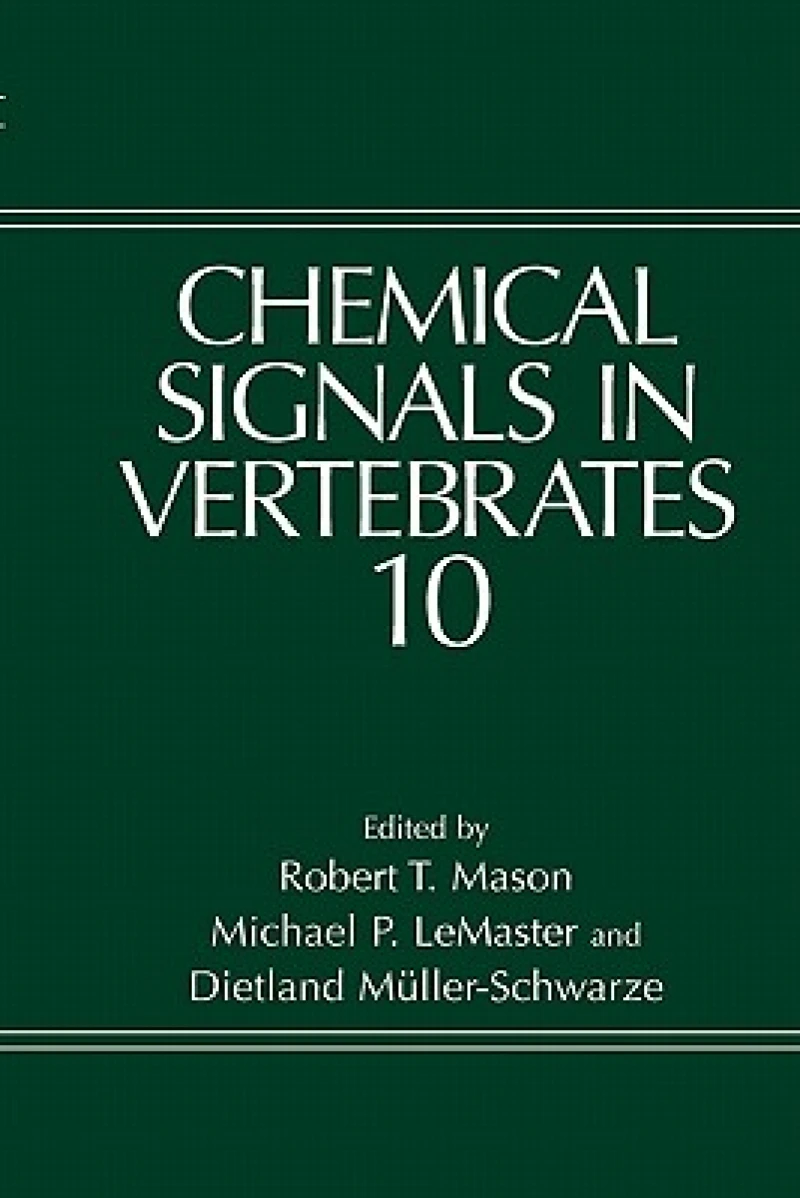
Chemical Signals in Vertebrates 10
1st ed. Softcover of orig. ed. 2005
Book Details
Format
Paperback / Softback
ISBN-10
1441937765
ISBN-13
9781441937766
Edition
1st ed. Softcover of orig. ed. 2005
Publisher
Springer-Verlag New York Inc.
Imprint
Springer-Verlag New York Inc.
Country of Manufacture
US
Country of Publication
GB
Publication Date
Oct 29th, 2010
Print length
430 Pages
Ksh 32,400.00
Werezi Extended Catalogue
0 in stock
Delivery Location
Delivery fee: Select location
Secure
Quality
Fast
The editors and contributors to this volume should be justifiably proud of their participation in the tenth triennial meeting of the Chemical Signals in Vertebrates International Symposium. This book also represents the tenth in a series of books on chemical communication, chemical ecology, olfactory and vomeronasal research in vertebrate species.
Thirty years on the odor trail: From the first to the tenth international symposium on chemical signals in vertebrates -Pheromones: Convergence and contrasts in insects and vertebrates -The discovery and characterization of splendipherin, the first anuran sex pheromone -Chemically mediated mate recognition in the tailed frog -Responses to sex and species specific chemical signals in allopatric and sympatric salamander species -The pheromonal repelling response in red spotted newts -The effects of cloacal secretions on brown tree snake behavior -Species and sub species recognition in the North American beaver -Self grooming in meadow voles -Protein content of male diet does not influence proceptive behavior in female meadow voles - The signalin of competitive ability by male house mice -A possible function for female enurination in the mara - The evolution of perfume-blending and wing sacs in emballonurid bats -Behavioral responsiveness of captive giant pandas -Chemical signals in giant panda urine -Chemical communication of musth in captive Asian elephants -Chemical analysis of preovulatory female African elephant urine: A search for putative pheromones -Assessing chemical communication in elephants -The gland and the sac the preorbital apparatus of muntjacs - The chemistry of scent marking in two lemurs -Soiled bedding from group-housed females exerts strong influence on male reproductive condition - The role of the major histocompatibility complex in scent communication -Characterization of proteins in scent marks; proteomics meets semiochemistry -The ''scents'' of ownership -The role of scent in inter-male aggression in house mice & laboratory mice -Chemical signals and vomeronasal system function in axolotls -From the eye to the nose: ancient orbital to vomeronasal communication in tetrapods -Prey chemical signal transduction in the vomeronasal system of garter snakes -Mode of delivery of prey-derived chemoattractants to the olfactory and vomeronasal epitheliaresults in differential firing of mitral cells in the main and accessory olfactory bulds of garter snakes -Communication by mosaic signals: individual recognition and underlying neural mechanisms - Sexual dimorphism in the accessory olfactory bulb and vomeronasal organ of the gray short-tailed opossum -The neurobiology of odor-based sexual preference: the case of the golden hamster -Retention of olfactory memories by newborn infants -Human sweaty smell does not affect women''s menstrual cycle -Local predation risk assessment based on low concentration chemical alarm cues in prey fishes: evidence for threat sensitivity -learned recognition of heterospecific alarm cues by prey fishes: a case study of minnows and stickleback -The response of prey fishes to chemical alarm cues: what recent field experiments reveal about the old testing paradigm -Response of juvenile goldfish to chemical alarm cues: Relationship between response intensity, response duration, and the level of predation risk -The effects of predation of phenotypic and life history variation in an aquatic vertebrate -Nocturnal shift in the antipredator response to predator diet cues in laboratory and field trials -Long term persistence of a salamander anti-predator cue - Decline in avoidance of predator chemical cues: habituation or biorhythm shift? -Chemically mediated life-histroy shifts in embryonic amphibians -Latent alarm signals: are they present in vertebrates? -Blood is not a cue for poststrike trailing in rattlesnakes -Rattlesnakes can use airborne cues during post-strike prey relocation -The sense of smell in procellariiforms: an overview and new direction -Cottontails and gopherweed: anti-feeding compunds from a spurge -Subject Index
Get Chemical Signals in Vertebrates 10 by at the best price and quality guaranteed only at Werezi Africa's largest book ecommerce store. The book was published by Springer-Verlag New York Inc. and it has pages.

