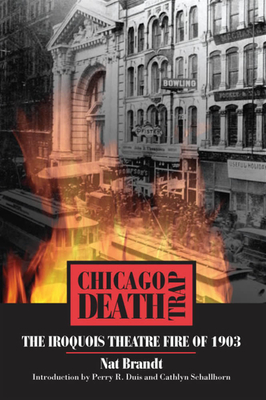
Chicago Death Trap : The Iroquois Theatre Fire of 1903
by
Nat Brandt
Book Details
Format
Paperback / softback
ISBN-10
080932721X
ISBN-13
9780809327218
Publisher
Southern Illinois University Press
Imprint
Southern Illinois University Press
Country of Manufacture
US
Country of Publication
GB
Publication Date
Aug 30th, 2006
Print length
240 Pages
Weight
348 grams
Dimensions
15.90 x 23.10 x 1.90 cms
KSh 2,700.00
Temporarily out of stock, due soon
0 in stock
Delivery Location
Delivery fee: Select location
Secure
Quality
Fast
On the afternoon of December 30, 1903, during a sold out matinee performance, a fire broke out in Chicago's Iroquois Theatre. This work provides a chronicle of this event to assess the titanic tragedy of the fire itself and also the municipal corruption that kindled the flames beforehand and the political cover-ups hidden in the smoke.
On the afternoon of December 30, 1903, during a sold out matinee performance, a fire broke out in Chicago''s Iroquois Theatre. In the short span of twenty minutes, more than six hundred people were asphyxiated, burned, or trampled to death in a panicked mob''s failed attempt to escape. In ""Chicago Death Trap: The Iroquois Theatre Fire of 1903"", Nat Brandt provides a detailed chronicle of this horrific event to assess not only the titanic tragedy of the fire itself but also the municipal corruption and greed that kindled the flames beforehand and the political cover-ups hidden in the smoke and ash afterwards. Advertised as ""absolutely fireproof,"" the Iroquois was Chicago''s most modern playhouse when it opened in the fall of 1903. With the approval of the city''s building department, theater developers Harry J. Powers and William J. Davis opened the theater prematurely to take full advantage of the holiday crowds, ignoring flagrant safety violations in the process. The aftermath of the fire proved to be a study in the miscarriage of justice. Despite overwhelming evidence that the building was not complete, that fire safety laws were ignored, and that management had deliberately sealed off exits during the performance, no one was ever convicted or otherwise held accountable for the enormous loss of life. Lavishly illustrated and featuring an introduction by Chicago historians Perry R. Duis and Cathlyn Schallhorn, ""Chicago Death Trap: The Iroquois Theatre Fire of 1903"" is rich with vivid details about this horrific disaster, captivatingly presented in human terms without losing sight of the broader historical context.
Get Chicago Death Trap by Nat Brandt at the best price and quality guaranteed only at Werezi Africa's largest book ecommerce store. The book was published by Southern Illinois University Press and it has 240 pages.
Customers Who Bought This Also Bought

Tennis Partner
KSh 2,350.00

By Grand Central Station I
KSh 1,800.00

Into the Wild
KSh 2,000.00

Slouching Towards Bethlehem
KSh 1,800.00

Awakenings
KSh 2,000.00

Seabiscuit
KSh 2,700.00

True Stories
KSh 3,400.00

The Au Pair
KSh 2,850.00

Three Women
KSh 2,000.00

Truce That Is Not Peace
KSh 3,050.00

This is Not Miami
KSh 2,350.00

Tweak
KSh 1,800.00