
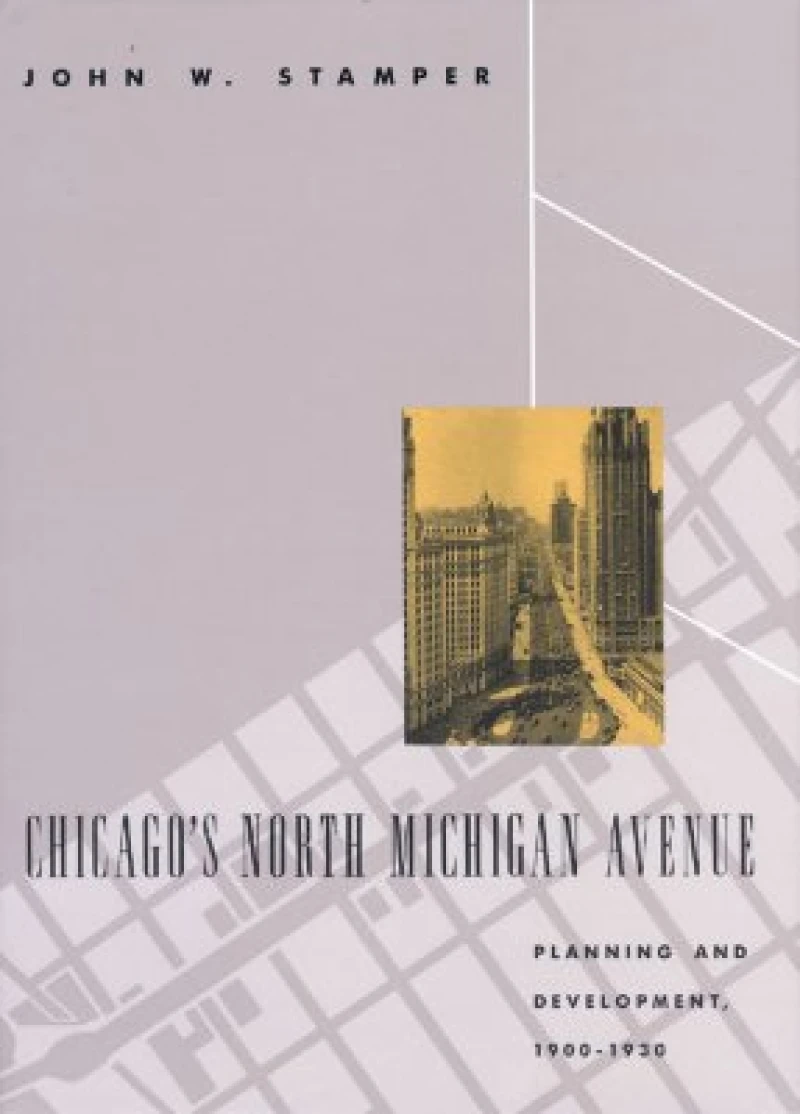
Chicago's North Michigan Avenue : Planning and Development, 1900-1930
Book Details
Format
Hardback or Cased Book
Book Series
Chicago Architecture and Urbanism
ISBN-10
0226770850
ISBN-13
9780226770857
Publisher
The University of Chicago Press
Imprint
University of Chicago Press
Country of Manufacture
GB
Country of Publication
GB
Publication Date
Aug 27th, 1991
Print length
344 Pages
Weight
822 grams
Dimensions
2.40 x 1.70 x 0.30 cms
Product Classification:
Architecture
Ksh 18,000.00
Werezi Extended Catalogue
0 in stock
Delivery Location
Delivery fee: Select location
Secure
Quality
Fast
Since its opening in the 1920s, Chicago's North Michigan Avenue has been one of the city's most prestigious commerical corridors, lined by some of its most architecturally distinctive business, residential, and hotel buildings. Planned by Daniel Burnham in 1909, the avenue became the principal connecting link between downtown and the wealthy, residential "Gold Coast" north of the Loop. Some thirty buildings were constructed along its path in the ten-year period before the Depression, an urban expansion comparable in significance to that of Pennsylvania and Park Avenues. John W. Stamper traces the complex development of North Michigan Avenue from the 1880s to the 1920s building boom that solidified its character and economic base, describing the initiation of the planning process by private interests to its execution aided by the city's powerful condemnation and taxation proceedings. He focuses on individual buildings constructed on the avenue, including the Renaissance- and Gothic-inspired Wrigley Building, Tribune Tower, and Drake Hotel, and places them within the context of factors governing their construction—property ownership, financing, zoning laws, design theory, and advertising. Stamper compares this stylistically diverse mixture of low- and high-rise structures with earlier, rejected planning proposals, all of which had prescribed a uniformly designed, European-like avenue of continuous cornice heights, consistent facade widths, and complementary stylistic features. He analyzes the drastically different character the avenue took by 1930, with high-rise towers reaching thirty stories and beyond, in terms of the clash among economic, political, and architectural interests. His argument—that the discrepancies between the rejected plans and reality illustrate the developers' choice of economic return on their investment over aesthetic community—is extended through to the present avenue and the virtual disregard of the urban qualities proposed at its inception. Generously illustrated, with an epilogue condensing the avenue's history between the end of World War II and the present, this is an exhaustive account of an important topic in the history of modern architecture and city planning.
Get Chicago's North Michigan Avenue by at the best price and quality guaranteed only at Werezi Africa's largest book ecommerce store. The book was published by The University of Chicago Press and it has pages.

