

Child Language
Book Details
Format
Hardback
Book Series
Cambridge Textbooks in Linguistics
ISBN-10
0521225183
ISBN-13
9780521225182
Publisher
Cambridge University Press
Imprint
Cambridge University Press
Country of Manufacture
GB
Country of Publication
GB
Publication Date
Mar 24th, 1981
Print length
200 Pages
Weight
445 grams
Product Classification:
Language acquisition
KSh 5,200.00
Re-Printing
0 in stock
Delivery Location
Delivery fee: Select location
Secure
Quality
Fast
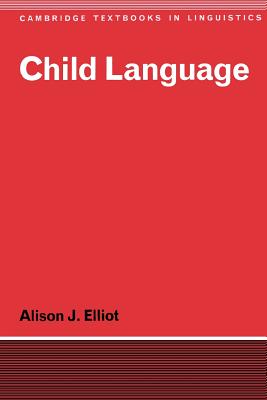
The way children learn their native language has been the subject of intense and widespread investigation in the last decades, stimulated by advances in theoretical linguistics and the behavioural sciences. For the student, this has meant a bewildering number of research reports, often differing in their theoretical viewpoint and the methodological approach they advocate, and apparently conflicting in their conclusions. Child Language provides the student with a cool, clear and concise survey of the most important recent research work, and puts into perspective the contributions made by Chomsky, Piaget and others. The research surveyed, though primarily of English-speaking children, includes studies of children whose first language is not English and bilingual children. Dr Elliot believes that the study of child language necessarily raises questions about the nature of language - is human language something only humans can learn? - and about learning itself - how does our ability to learn language depend on biological factors, such as our age, and how important is our social and linguistic environment? Little justification is found for the view that language has an independent existence for the young child, and their linguistic achievements are studied within the context of their development in general.
The way children learn their native language has been the subject of intense and widespread investigation in the last decades, stimulated by advances in theoretical linguistics and the behavioural sciences. For the student, this has meant a bewildering number of research reports, often differing in their theoretical viewpoint and the methodological approach they advocate, and apparently conflicting in their conclusions. Child Language provides the student with a cool, clear and concise survey of the most important recent research work, and puts into perspective the contributions made by Chomsky, Piaget and others. The research surveyed, though primarily of English-speaking children, includes studies of children whose first language is not English and bilingual children. Dr Elliot believes that the study of child language necessarily raises questions about the nature of language - is human language something only humans can learn? - and about learning itself - how does our ability to learn language depend on biological factors, such as our age, and how important is our social and linguistic environment? Little justification is found for the view that language has an independent existence for the young child, and their linguistic achievements are studied within the context of their development in general.
Get Child Language by Alison J. Elliot at the best price and quality guaranteed only at Werezi Africa's largest book ecommerce store. The book was published by Cambridge University Press and it has 200 pages.
Customers Who Bought This Also Bought

Second Language Acquisition
KSh 7,550.00

Vital Literacies from the Clinic to the Classroom
KSh 30,950.00

Vital Literacies from the Clinic to the Classroom
KSh 8,650.00

Talking Time
KSh 27,900.00
Linguistic theory and adult second language acquisition
KSh 9,800.00
Language Teacher Identity in TESOL
KSh 30,950.00
English Language Teaching and Teacher Education in East Asia
KSh 19,600.00
Second Language Speech Learning
KSh 19,600.00
Social Dimensions of Autonomy in Language Learning
KSh 16,200.00

Second Language Anxiety
KSh 21,600.00

Self-Concept in Foreign Language Learning
KSh 8,650.00
Optimizing a Lexical Approach to Instructed Second Language Acquisition
KSh 16,200.00
More by Alison J. Elliot
More in This Genre
Second Language Acquisition
KSh 7,550.00
Vital Literacies from the Clinic to the Classroom
KSh 30,950.00
Vital Literacies from the Clinic to the Classroom
KSh 8,650.00
Talking Time
KSh 27,900.00
Linguistic theory and adult second language acquisition
KSh 9,800.00
Language Teacher Identity in TESOL
KSh 30,950.00
