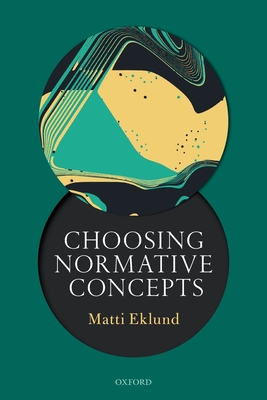
Choosing Normative Concepts
by
Matti Eklund
Book Details
Format
Hardback
ISBN-10
0198717822
ISBN-13
9780198717829
Publisher
Oxford University Press
Imprint
Oxford University Press
Country of Manufacture
GB
Country of Publication
GB
Publication Date
Aug 17th, 2017
Print length
232 Pages
Weight
504 grams
Dimensions
16.40 x 24.20 x 2.50 cms
Product Classification:
Philosophy of languageEthics & moral philosophyEthics and moral philosophy
KSh 15,650.00
Currently unavailable
0 in stock
Delivery Location
Delivery fee: Select location
Secure
Quality
Fast
The concepts we use to value and prescribe (concepts like good, right, ought) are historically contingent, and we could have found ourselves with others. But what does it mean to say that some concepts are better than others for purposes of action-guiding and deliberation? What is it to choose between different normative conceptual frameworks?
Theorists working on metaethics and the nature of normativity typically study goodness, rightness, what ought to be done, and so on. In their investigations they employ and consider our actual normative concepts. But the actual concepts of goodness, rightness, and what ought to be done are only some of the possible normative concepts there are. There are other possible concepts, ascribing different properties. Matti Eklund explores the consequences of this thought, for example for the debate over normative realism, and for the debate over what it is for concepts and properties to be normative. Conceptual engineering - the project of considering how our concepts can be replaced by better ones - has become a central topic in philosophy. Eklund applies this methodology to central normative concepts and discusses the special complications that arise in this case. For example, since talk of improvement is itself normative, how should we, in the context, understand talk of a concept being better?
Get Choosing Normative Concepts by Matti Eklund at the best price and quality guaranteed only at Werezi Africa's largest book ecommerce store. The book was published by Oxford University Press and it has 232 pages.
Customers Who Bought This Also Bought

Recognising the Stranger
KSh 1,800.00
The Origin of Language
KSh 4,500.00
Sharing Thoughts
KSh 17,000.00

An Inquiry Into Meaning and Truth
KSh 3,750.00
Semiotics and the Philosophy of Language
KSh 3,400.00
An Introduction to Logic
KSh 6,650.00

Walker Percy''s Search for Community
KSh 5,950.00
Film Figures
KSh 16,450.00

The Tacit Dimensions of Language and Logic
KSh 15,800.00

Metaphors in Action
KSh 21,600.00
Frontiers in Semiotics
KSh 3,000.00

A Theory of Death
KSh 11,900.00