
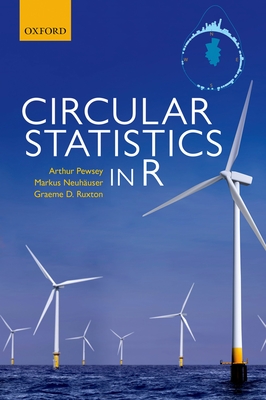
Circular Statistics in R
Book Details
Format
Paperback / softback
ISBN-10
0199671133
ISBN-13
9780199671137
Publisher
Oxford University Press
Imprint
Oxford University Press
Country of Manufacture
GB
Country of Publication
GB
Publication Date
Sep 26th, 2013
Print length
208 Pages
Weight
316 grams
Dimensions
23.00 x 15.80 x 1.20 cms
KSh 9,700.00
Currently unavailable
0 in stock
Delivery Location
Delivery fee: Select location
Secure
Quality
Fast
Measurements like mass, length and speed are "linear "; but compass direction or the time of the year are "circular". Circular data have a repeating nature and an arbitrary zero: 12 months after the 1st of July it is the 1st of July again. This book explains how to easily and effectively analyse circular data statistically.
Circular Statistics in R provides the most comprehensive guide to the analysis of circular data in over a decade. Circular data arise in many scientific contexts whether it be angular directions such as: observed compass directions of departure of radio-collared migratory birds from a release point; bond angles measured in different molecules; wind directions at different times of year at a wind farm; direction of stress-fractures in concrete bridge supports; longitudes of earthquake epicentres or seasonal and daily activity patterns, for example: data on the times of day at which animals are caught in a camera trap, or in 911 calls in New York, or in internet traffic; variation throughout the year in measles incidence, global energy requirements, TV viewing figures or injuries to athletes. The natural way of representing such data graphically is as points located around the circumference of a circle, hence their name. Importantly, circular variables are periodic in nature and the origin, or zero point, such as the beginning of a new year, is defined arbitrarily rather than necessarily emerging naturally from the system. This book will be of value both to those new to circular data analysis as well as those more familiar with the field. For beginners, the authors start by considering the fundamental graphical and numerical summaries used to represent circular data before introducing distributions that might be used to model them. They go on to discuss basic forms of inference such as point and interval estimation, as well as formal significance tests for hypotheses that will often be of scientific interest. When discussing model fitting, the authors advocate reduced reliance on the classical von Mises distribution; showcasing distributions that are capable of modelling features such as asymmetry and varying levels of kurtosis that are often exhibited by circular data. The use of likelihood-based and computer-intensive approaches to inference and modelling are stressed throughout the book. The R programming language is used to implement the methodology, particularly its "circular" package. Also provided are over 150 new functions for techniques not already covered within R. This concise but authoritative guide is accessible to the diverse range of scientists who have circular data to analyse and want to do so as easily and as effectively as possible.
Get Circular Statistics in R by Arthur Pewsey, Graeme D Ruxton at the best price and quality guaranteed only at Werezi Africa's largest book ecommerce store. The book was published by Oxford University Press and it has 208 pages.
Customers Who Bought This Also Bought

Apostles of Development
KSh 5,600.00

Elementary Statistics in Social Research: Essentials
KSh 13,700.00
Narrative Inquiry – Experience and Story in Qualitative Research
KSh 4,850.00

Scouting and Scoring – How We Know What We Know about Baseball
KSh 3,050.00

Shared Beginnings, Divergent Lives
KSh 5,400.00

The Nagorno-Karabakh Conflict
KSh 8,800.00

Multiple Attribute Decision Making
KSh 7,400.00

World Food and Agriculture – Statistical Pocketbook 2024
KSh 4,500.00

National Accounts Statistics
KSh 16,050.00

The Southwest
KSh 2,500.00

World Food and Agriculture – Statistical Pocketbook 2022
KSh 4,500.00

Research Design in Political Science
KSh 6,300.00
More by Arthur Pewsey, Graeme D Ruxton



More in This Genre
Apostles of Development
KSh 5,600.00
Elementary Statistics in Social Research: Essentials
KSh 13,700.00
Narrative Inquiry – Experience and Story in Qualitative Research
KSh 4,850.00
Scouting and Scoring – How We Know What We Know about Baseball
KSh 3,050.00
Shared Beginnings, Divergent Lives
KSh 5,400.00
The Nagorno-Karabakh Conflict
KSh 8,800.00
