
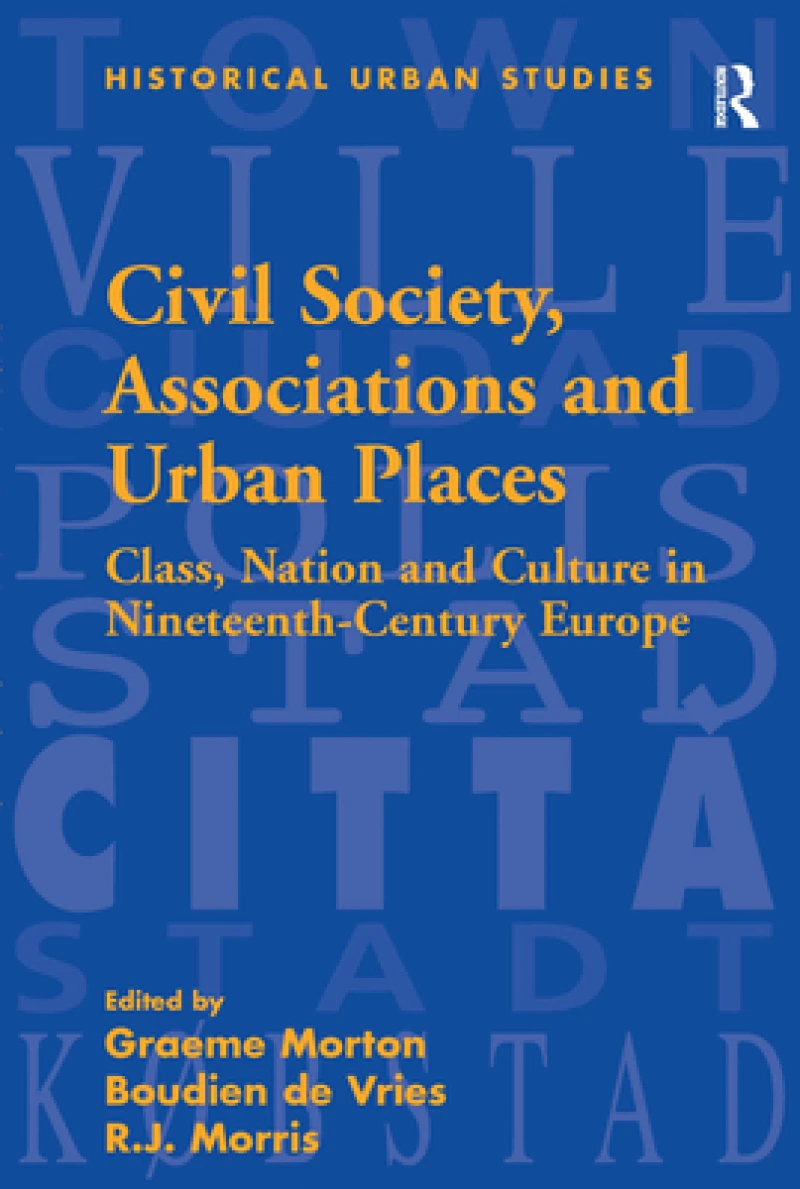
Civil Society, Associations and Urban Places : Class, Nation and Culture in Nineteenth-Century Europe
Book Details
Format
Hardback or Cased Book
Book Series
Historical Urban Studies Series
ISBN-10
0754652475
ISBN-13
9780754652472
Publisher
Taylor & Francis Ltd
Imprint
Routledge
Country of Manufacture
GB
Country of Publication
GB
Publication Date
Jul 28th, 2006
Print length
240 Pages
Weight
486 grams
Dimensions
24.30 x 16.30 x 1.10 cms
Product Classification:
Social & cultural historyUrban communities
Ksh 30,950.00
Re-Printing
0 in stock
Delivery Location
Delivery fee: Select location
Secure
Quality
Fast
Examines the construction of civil society from associational activity in the urban place. This volume reflects on the construction of class, nation and culture in the associations of the nineteenth-century urban place. It shows that a deep and interlocking civil society does not automatically lead to a rise in democratic activity.
In recent years the concept of ''civil society'' has become central to the historian''s understanding of class, cultural and political power in the nineteenth-century town and city. Increasingly clubs and voluntary societies have been regarded as an important step in the formation of formal political parties, particularly for the working and middle classes. The result of this is the assertion that the more associations existing in a particular society, the deeper democracy becomes entrenched. In order to test this hypothesis, this volume brings together essays by an international group of urban historians who examine the construction of civil society from associational activity in the urban place. From their studies, it soon becomes clear that such simple propositions do not adequately reflect the dynamics of nineteenth-century urban society and politics. Urban associations were ideological in purpose and deliberately discriminatory and as such set the boundaries of civil society. Thus competing and segmented associations were not only an indication of pluralism and strength, but also highlighted a fundamental weakness when faced down by the interests of the state. Through a wide array of urban associations in a broad range of settings, comprising Austria and Bratislava, France and Italy, the Netherlands, Austro-Hungary, England, Scotland and the US, this volume reflects on the construction of class, nation and culture in the associations of the nineteenth-century urban place. In so doing it shows that a deep and interlocking civil society does not automatically lead to a rise in democratic activity. Expansion of the networks of urban association could equally result in greater subdivision and to the fragmentation and isolation of certain groups. Partition as much as coherence is our understanding of civil society and associations in the nineteenth-century urban place.
Get Civil Society, Associations and Urban Places by at the best price and quality guaranteed only at Werezi Africa's largest book ecommerce store. The book was published by Taylor & Francis Ltd and it has pages.

