Search

Categories

    • categories-img Jacket, Women
    • categories-img Woolend Jacket
    • categories-img Western denim
    • categories-img Mini Dresss
    • categories-img Jacket, Women
    • categories-img Woolend Jacket
    • categories-img Western denim
    • categories-img Mini Dresss
    • categories-img Jacket, Women
    • categories-img Woolend Jacket
    • categories-img Western denim
    • categories-img Mini Dresss
    • categories-img Jacket, Women
    • categories-img Woolend Jacket
    • categories-img Western denim
    • categories-img Mini Dresss
    • categories-img Jacket, Women
    • categories-img Woolend Jacket
    • categories-img Western denim
    • categories-img Mini Dresss

Filter By Price

$
-
$

Dietary Needs

Top Rated Product

product-img product-img

Modern Chair

$165.00
product-img product-img

Plastic Chair

$165.00
product-img product-img

Design Rooms

$165.00

Brands

  • Wooden
  • Chair
  • Modern
  • Fabric
  • Shoulder
  • Winter
  • Accessories
  • Dress

Welcome and thank you for visiting us. For any query call us on 0799 626 359 or Email [email protected]

Offcanvas Menu Open

Shopping Cart

Africa largest book store

Sub Total:

Search for any Title

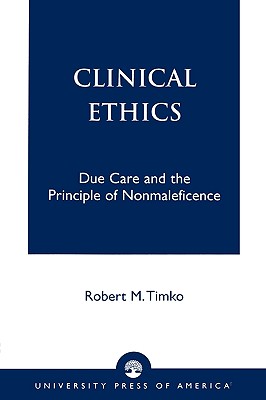
Clinical Ethics : Due Care and the Principle of Nonmaleficence

By: (Author) Robert M. Timko

Manufactured on Demand
Delivery in 29 days

Ksh 10,650.00

Format: Paperback / Softback

ISBN-10: 0761820892

ISBN-13: 9780761820895

Publisher: University Press of America

Imprint: University Press of America

Country of Manufacture: GB

Country of Publication: GB

Publication Date: Sep 21st, 2001

Print length: 194 Pages

Weight: 263 grams

Dimensions (height x width x thickness): 21.60 x 14.00 x 1.50 cms

Choose your Location

Shipping & Delivery

Door Delivery

Delivery fee

Delivery in 29 days

  • Description

  • Reviews

In Clinical Ethics, Robert Timko argues that the moral dilemmas of clinical medical practice can best be resolved within a framework of prima facie duties, and that the most stringent duty is that of nonmaleficence. Timko shows that respect for individual autonomy and the principle of beneficence are inadequate for the moral practice of medicine since simple adherence to either principle may be insufficient for the provision of 'due care.' Clinical health care practitioners should know and understand their clients' perceptions of illness and suffering and their life-plans and values if they wish to avoid bringing further harm to their clients. Additionally, Timko argues that the prevention of harm is best served and 'due care' best provided if the clinical relationship is defined within the framework of a covenantal agreement between health-care practitioners and the moral community. Intrinsic to his argument is the belief that it is not only permissible to limit a client's autonomy, but that is sometimes obligatory to do so. In terms of a community's overall good, paternalistic interventions appear to be justifiable and sometimes necessary. Finally, Joan Hoff provides an insightful commentary on the logic of a communitarian ethic as the foundation for a just health-care system and the understanding of virtue and responsibility in health-care practice.
In Clinical Ethics, Robert Timko argues that the moral dilemmas of clinical medical practice can best be resolved within a framework of prima facie duties, and that the most stringent duty is that of nonmaleficence. Timko shows that respect for individual autonomy and the principle of beneficence are inadequate for the moral practice of medicine since simple adherence to either principle may be insufficient for the provision of ''due care.'' Clinical health care practitioners should know and understand their clients'' perceptions of illness and suffering and their life-plans and values if they wish to avoid bringing further harm to their clients. Additionally, Timko argues that the prevention of harm is best served and ''due care'' best provided if the clinical relationship is defined within the framework of a covenantal agreement between health-care practitioners and the moral community. Intrinsic to his argument is the belief that it is not only permissible to limit a client''s autonomy, but that is sometimes obligatory to do so. In terms of a community''s overall good, paternalistic interventions appear to be justifiable and sometimes necessary. Finally, Joan Hoff provides an insightful commentary on the logic of a communitarian ethic as the foundation for a just health-care system and the understanding of virtue and responsibility in health-care practice.

Get Clinical Ethics by at the best price and quality guranteed only at Werezi Africa largest book ecommerce store. The book was published by University Press of America and it has pages. Enjoy Shopping Best Offers & Deals on books Online from Werezi - Receive at your doorstep - Fast Delivery - Secure mode of Payment

Customer Reviews

Based on 0 reviews

Mind, Body, & Spirit