
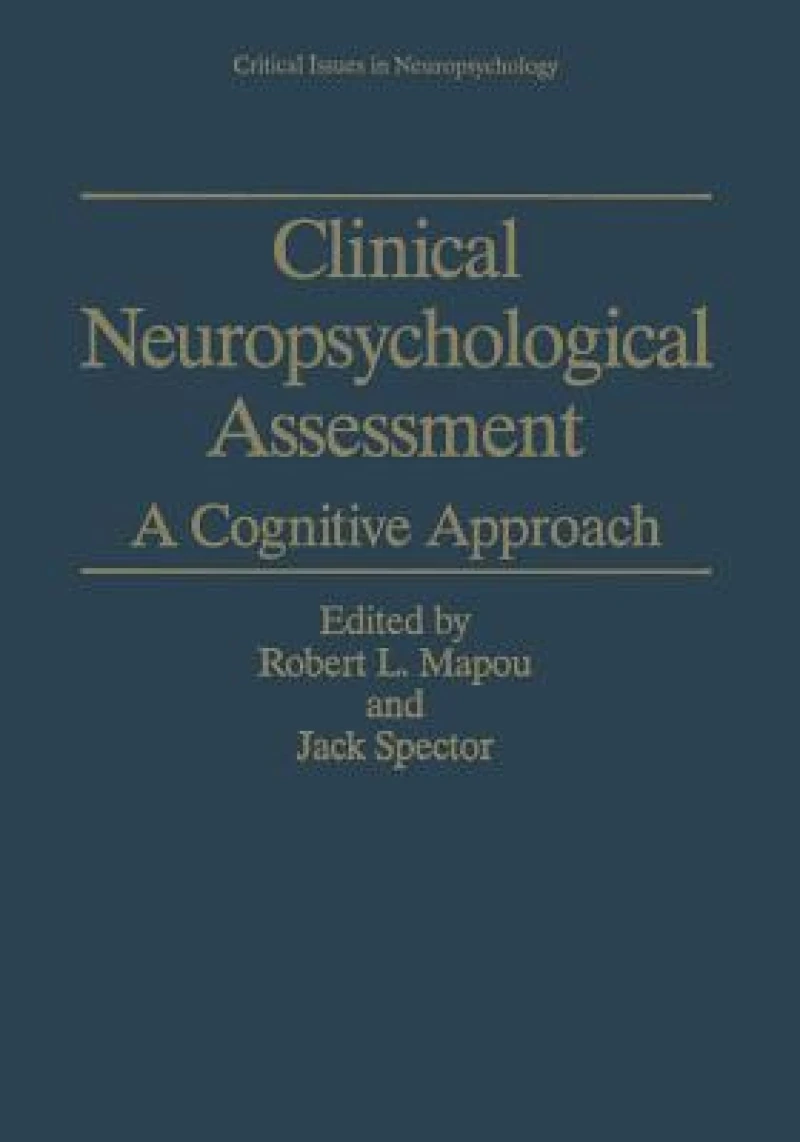
Clinical Neuropsychological Assessment : A Cognitive Approach
Softcover reprint of the original 1st ed. 1995
Book Details
Format
Paperback / Softback
Book Series
Critical Issues in Neuropsychology
ISBN-10
1475797117
ISBN-13
9781475797114
Edition
Softcover reprint of the original 1st ed. 1995
Publisher
Springer-Verlag New York Inc.
Imprint
Springer-Verlag New York Inc.
Country of Manufacture
US
Country of Publication
GB
Publication Date
May 22nd, 2013
Print length
362 Pages
Product Classification:
Physiological & neuro-psychology, biopsychologyHealth psychologyPsychiatry
Ksh 23,400.00
Werezi Extended Catalogue
0 in stock
Delivery Location
Delivery fee: Select location
Secure
Quality
Fast
Practicing neuropsychologists and students in clinical neuropsychology must increas ingly cross disciplinary boundaries to understand and appreciate the neuroanatomical, neurophysiological, and neuropharmacological bases of cognition and behavior, cur rent cognitive theory in many different domains of functioning, and the nature and tools of clinical assessment. Although the cognitive functions and abilities of interest are often the same, each of these fields has grappled with them from sometimes very different perspectives. Terminology is often specific to a particular discipline or ap proach, methods are diverse, and the goals or outcomes of study or investigation are usually very different. This book poises itself to provide a largely missing link between traditional approaches to assessment and the growing area of cognitive neuropsy chology. Historically, neuropsychology had as its central core the consideration of evidence from clinical cases. It was the early work of neurologists such as Broca, Wernicke, Hughlings-Jackson, and Liepmann, who evaluated and described the behavioral cor relates of prescribed lesions in individual patients and focused investigation on the lateralization and localization of cognitive abilities in humans. An outgrowth of those approaches was the systematic development of experimental tasks that could be used to elucidate the nature of cognitive changes in individuals with well-described brain lesions.
Practicing neuropsychologists and students in clinical neuropsychology must increas ingly cross disciplinary boundaries to understand and appreciate the neuroanatomical, neurophysiological, and neuropharmacological bases of cognition and behavior, cur rent cognitive theory in many different domains of functioning, and the nature and tools of clinical assessment. Although the cognitive functions and abilities of interest are often the same, each of these fields has grappled with them from sometimes very different perspectives. Terminology is often specific to a particular discipline or ap proach, methods are diverse, and the goals or outcomes of study or investigation are usually very different. This book poises itself to provide a largely missing link between traditional approaches to assessment and the growing area of cognitive neuropsy chology. Historically, neuropsychology had as its central core the consideration of evidence from clinical cases. It was the early work of neurologists such as Broca, Wernicke, Hughlings-Jackson, and Liepmann, who evaluated and described the behavioral cor relates of prescribed lesions in individual patients and focused investigation on the lateralization and localization of cognitive abilities in humans. An outgrowth of those approaches was the systematic development of experimental tasks that could be used to elucidate the nature of cognitive changes in individuals with well-described brain lesions.
Get Clinical Neuropsychological Assessment by at the best price and quality guaranteed only at Werezi Africa's largest book ecommerce store. The book was published by Springer-Verlag New York Inc. and it has pages.

