
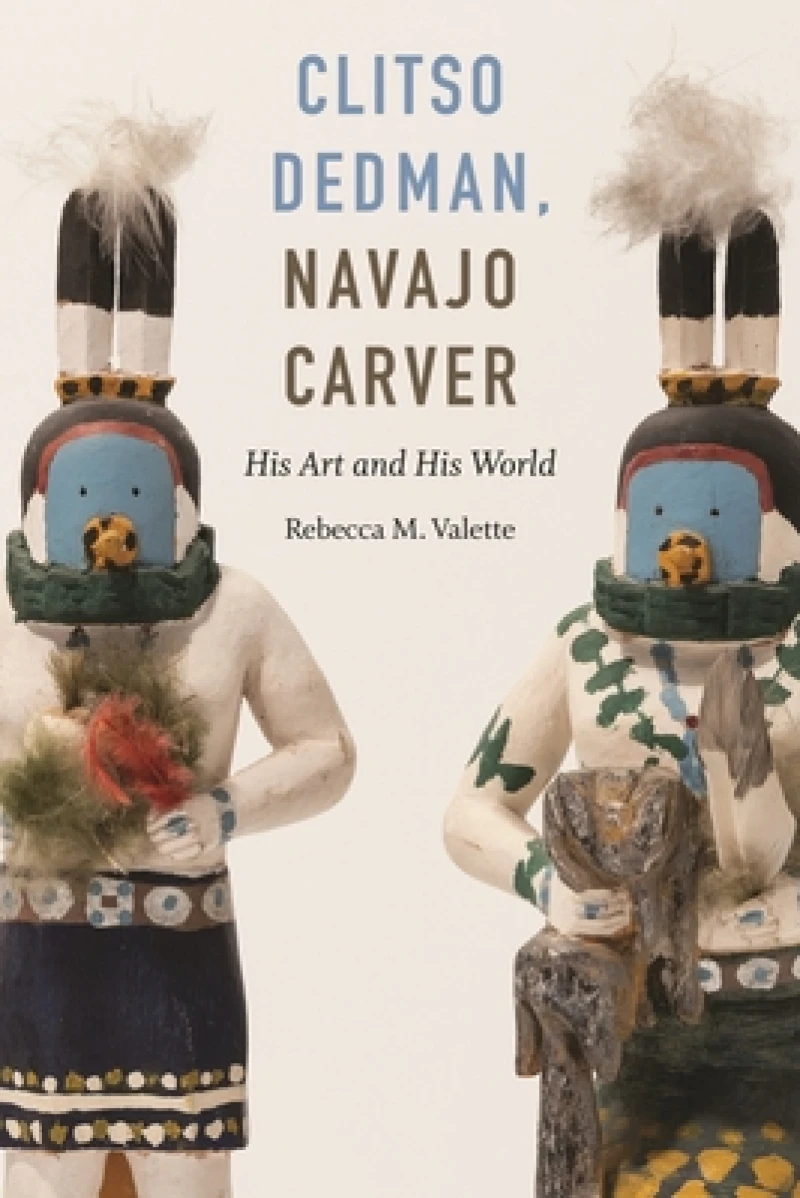
Clitso Dedman, Navajo Carver : His Art and His World
Book Details
Format
Hardback or Cased Book
ISBN-10
1496235819
ISBN-13
9781496235817
Publisher
University of Nebraska Press
Imprint
University of Nebraska Press
Country of Manufacture
GB
Country of Publication
GB
Publication Date
Jan 1st, 2024
Print length
288 Pages
Product Classification:
Relating to Native American people / First AmericansIndividual artists, art monographsIndividual photographersIndividual photographersIndividual architects & architectural firmsIndividual architects and architectural firmsBiography: arts & entertainmentBiography: arts and entertainmentSocial & cultural historyIndigenous peoples / IndigeneityIndigenous peoplesSocial and cultural history
Ksh 5,750.00
Not Yet Published
0 in stock
Delivery Location
Delivery fee: Select location
Secure
Quality
Fast
Rebecca Valette’s Clitso Dedman, Navajo Carver is the first biography of artist Clitso Dedman (1876–1953), one of the most important but overlooked DinÉ (Navajo) artists of his generation. Dedman was born to a traditional Navajo family in Chinle, Arizona, and herded sheep as a child. He was educated in the late 1880s and early 1890s at the Fort Defiance Indian School, then at the Teller Institute in Grand Junction, Colorado. After graduation Dedman moved to Gallup, New Mexico, where he worked in the machine shop of the Atchison, Topeka, and Santa Fe Railway before opening his first of three Navajo trading posts in Rough Rock, Arizona. After tragedy struck his life in 1915, he moved back to Chinle and abruptly changed careers to become a blacksmith and builder.
At age sixty, suffering from arthritis, Dedman turned his creative talent to wood carving, thus initiating a new Navajo art form. Although the neighboring Hopis had been carving Kachina dolls for generations, the Navajos traditionally avoided any permanent reproduction of their Holy People, and even of human figures. Dedman was the first to ignore this proscription, and for the rest of his life he focused on creating wooden sculptures of the various participants in the Yeibichai dance, which closed the Navajo Nightway ceremony. These secular carvings were immediately purchased and sold to tourists by regional Indian traders. Today Dedman’s distinctive and highly regarded work can be found in private collections, galleries, and museums, such as the Navajo Nation Museum at Window Rock, the California Academy of Sciences in San Francisco, and the Arizona State Museum in Tucson. Clitso Dedman, Navajo Carver, with its extensive illustrations, is the story of a remarkable and underrecognized figure of twentieth-century Navajo artistic creation and innovation.
At age sixty, suffering from arthritis, Dedman turned his creative talent to wood carving, thus initiating a new Navajo art form. Although the neighboring Hopis had been carving Kachina dolls for generations, the Navajos traditionally avoided any permanent reproduction of their Holy People, and even of human figures. Dedman was the first to ignore this proscription, and for the rest of his life he focused on creating wooden sculptures of the various participants in the Yeibichai dance, which closed the Navajo Nightway ceremony. These secular carvings were immediately purchased and sold to tourists by regional Indian traders. Today Dedman’s distinctive and highly regarded work can be found in private collections, galleries, and museums, such as the Navajo Nation Museum at Window Rock, the California Academy of Sciences in San Francisco, and the Arizona State Museum in Tucson. Clitso Dedman, Navajo Carver, with its extensive illustrations, is the story of a remarkable and underrecognized figure of twentieth-century Navajo artistic creation and innovation.
Get Clitso Dedman, Navajo Carver by at the best price and quality guaranteed only at Werezi Africa's largest book ecommerce store. The book was published by University of Nebraska Press and it has pages.

