
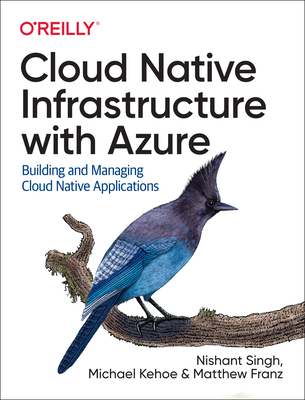
Cloud Native Infrastructure with Azure : Building and Managing Cloud Native Applications
Book Details
Format
Paperback / softback
ISBN-10
1492090964
ISBN-13
9781492090960
Publisher
O'Reilly Media
Imprint
O'Reilly Media
Country of Manufacture
US
Country of Publication
GB
Publication Date
Feb 28th, 2022
Print length
350 Pages
Weight
560 grams
Dimensions
17.70 x 23.30 x 2.00 cms
Product Classification:
Cloud computing
KSh 9,550.00
Temporarily out of stock, due soon
0 in stock
Delivery Location
Delivery fee: Select location
Secure
Quality
Fast
This practical book shows you how to build a true cloud native infrastructure on Microsoft Azure, following guidelines from the Cloud Native Computing Foundation (CNCF).
The cloud is becoming the de facto home for companies ranging from enterprises to startups. Moving to the cloud means moving your applications from monolith to microservices. But once you do, running and maintaining these services brings its own level of complexity. The answer? Modularity, deployability, observability, and self-healing capacity through cloud native development. With this practical book, Nishant Singh and Michael Kehoe show you how to build a true cloud native infrastructure using Microsoft Azure or another cloud computing solution by following guidelines from the Cloud Native Computing Foundation (CNCF). DevOps and site reliability engineers will learn how adapting applications to cloud native early in the design phase helps you fully utilize the elasticity and distributed nature of the cloud. This book helps you explore:Why go cloud native?How to use infrastructure as codeWhat it takes to containerize an applicationWhy and how Kubernetes is the "grand orchestrator"How to create a Kubernetes cluster on AzureHow observability complements monitoringHow to use service discovery and a service mesh to find new territoriesHow networking and policy management serve as gatekeepersHow distributed databases and storage work
Get Cloud Native Infrastructure with Azure by Michael Kehoe, Nishant Singh at the best price and quality guaranteed only at Werezi Africa's largest book ecommerce store. The book was published by O'Reilly Media and it has 350 pages.
Customers Who Bought This Also Bought

Cloud Computing Security
KSh 13,850.00

Cilium: Up & Running
KSh 11,500.00

Cloud-native Application Architecture
KSh 8,100.00

Cloud Computing
KSh 10,800.00

Economic Models for Managing Cloud Services
KSh 8,100.00
Cloud Computing
KSh 16,200.00

The Complete AZ-900 Handbook
KSh 6,350.00

AWS Certified Cloud Practitioner (CLF-C02) Study Guide
KSh 8,650.00
Cloud as a Service
KSh 7,200.00

Multimodal Artificial Intelligence and Large Language Models
KSh 26,300.00

Automating SRE and Operations on AWS
KSh 6,200.00

Intelligent Computing and Networking
KSh 36,000.00


