
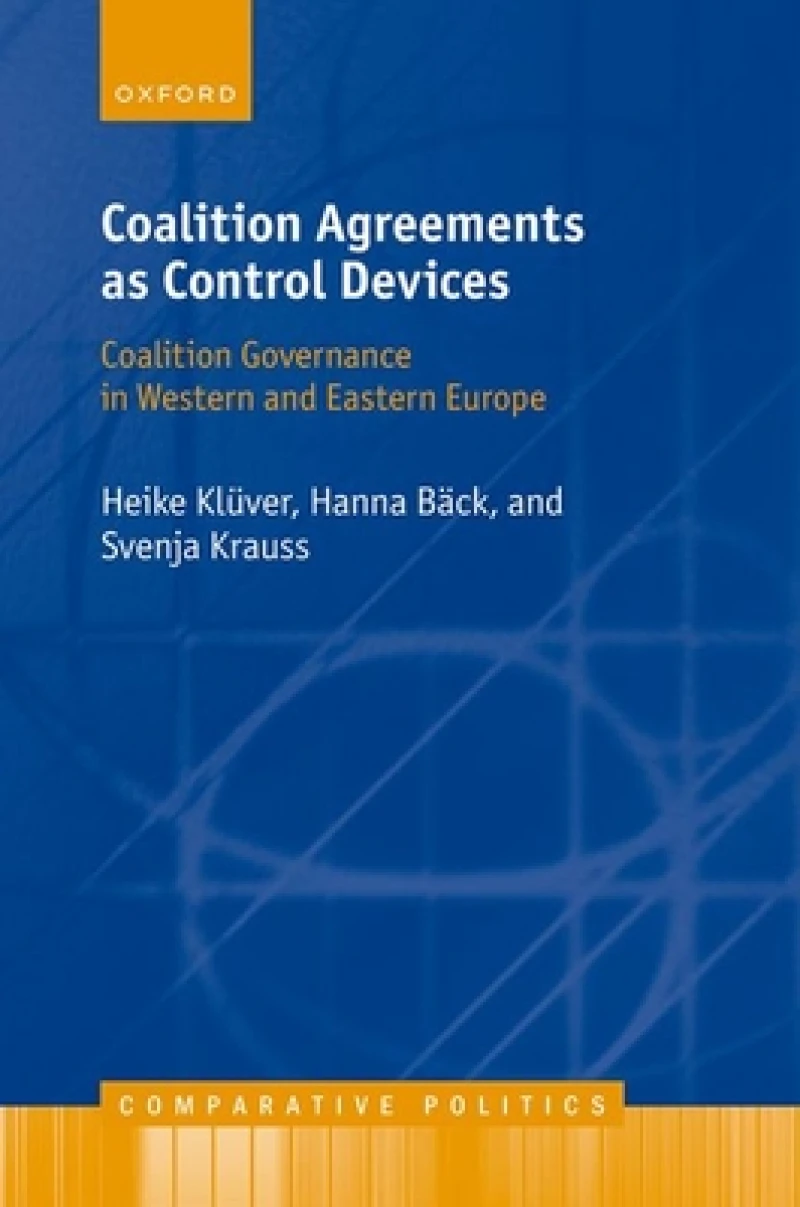
Coalition Agreements as Control Devices : Coalition Governance in Western and Eastern Europe
Book Details
Format
Hardback or Cased Book
Book Series
Comparative Politics
ISBN-10
0192899910
ISBN-13
9780192899910
Publisher
Oxford University Press
Imprint
Oxford University Press
Country of Manufacture
GB
Country of Publication
GB
Publication Date
Apr 20th, 2023
Print length
300 Pages
Weight
624 grams
Dimensions
16.50 x 24.20 x 2.70 cms
Ksh 15,450.00
Werezi Extended Catalogue
0 in stock
Delivery Location
Delivery fee: Select location
Secure
Quality
Fast
This book explores why political parties negotiate lengthy coalition contracts, and argues that these agreements are important control devices that allow coalition parties to keep their partners in line. The authors draw on a large dataset of 229 coalition agreements negotiated in 24 Western and Eastern European countries between 1945 and 2015.
Many coalition cabinets negotiate lengthy coalition contracts outlining the agenda for the time in office. Not only does negotiating these agreements take up time and resources, but compromises have to be made, which may result in cabinet conflicts and electoral costs. This book explores why political parties negotiate such agreements, and argues that coalition agreements are important control devices that allow coalition parties to keep their partners in line. The authors show that their use varies with the preference configuration in cabinet and the allocation of ministerial portfolios. First, they posit that parties will only negotiate policy issues in a coalition agreement when they disagree on these issues and when they are important to all partners. Second, since controlling a ministry provides parties with important information and policy-making advantages, parties use agreements to constrain their partners particularly when they control the ministry in charge of a policy area. Finally, they argue that coalition agreements only work as effective control devices if coalition parties settle controversial issues in these contracts. The COALITIONAGREE Dataset is used to evaluate the expectations set out in the book; the dataset maps the content of 229 coalition agreements that were negotiated by 189 parties between 1945 and 2015 in 24 Western and Eastern European countries. The results show that coalition parties systematically use agreements to control their partners when policy issues are divisive and salient and when they are confronted with a hostile minister. These agreements only effectively contain conflicts, however, when parties negotiate a compromise on precisely the issues that divide them.Comparative Politics is a series for researchers, teachers, and students of political science that deals with contemporary government and politics. Global in scope, books in the series are characterized by a stress on comparative analysis and strong methodological rigour. The series is published in association with the European Consortium for Political Research. For more information visit: www.ecprnet.eu.The series is edited by Nicole Bolleyer, Chair of Comparative Political Science, Geschwister Scholl Institut, LMU Munich and Jonathan Slapin, Professor of Political Institutions and European Politics, Department of Political Science, University of Zurich.
Get Coalition Agreements as Control Devices by at the best price and quality guaranteed only at Werezi Africa's largest book ecommerce store. The book was published by Oxford University Press and it has pages.

