
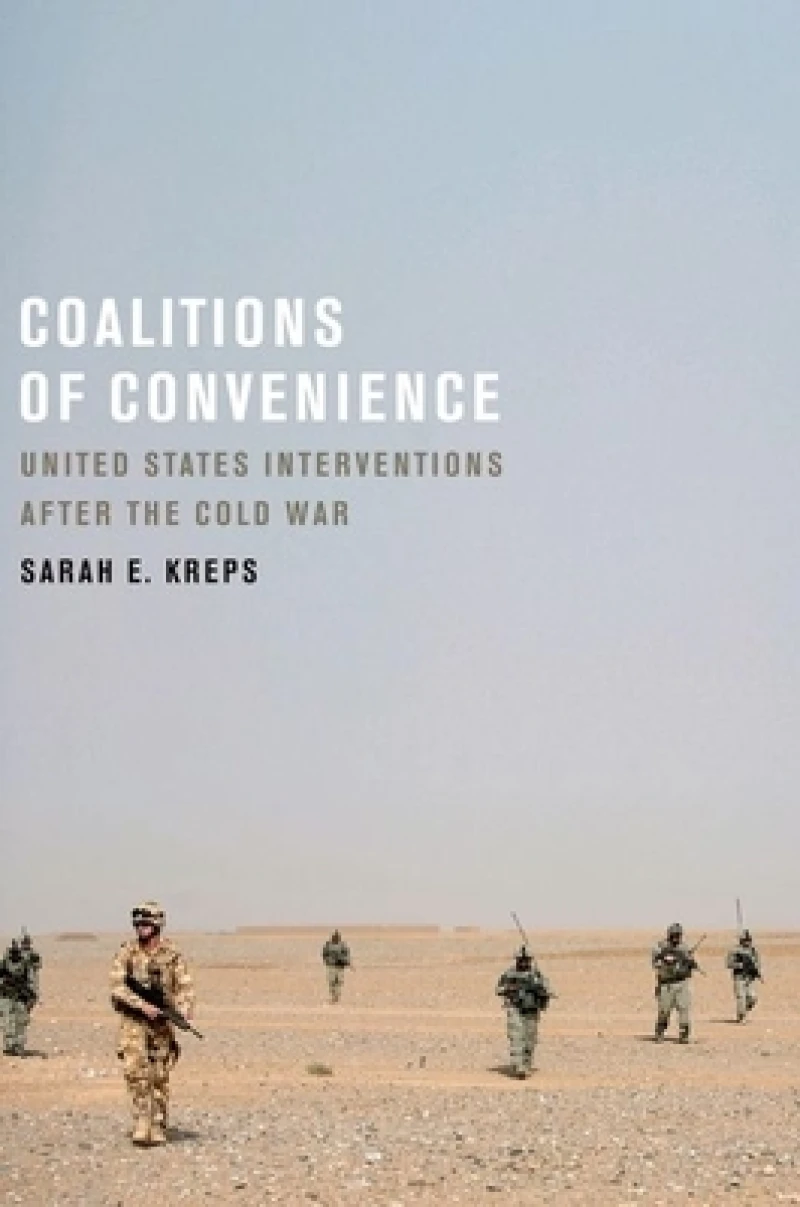
Coalitions of Convenience : United States Military Interventions after the Cold War
Book Details
Format
Hardback or Cased Book
ISBN-10
0199753792
ISBN-13
9780199753796
Publisher
Oxford University Press Inc
Imprint
Oxford University Press Inc
Country of Manufacture
US
Country of Publication
GB
Publication Date
Feb 10th, 2011
Print length
240 Pages
Weight
462 grams
Dimensions
16.00 x 23.90 x 2.00 cms
Product Classification:
International relationsWarfare & defence
Ksh 14,100.00
Manufactured on Demand
0 in stock
Delivery Location
Delivery fee: Select location
Secure
Quality
Fast
In Coalitions of Convenience, Sarah E. Kreps shows that even powerful states have incentives to intervene multilaterally. Coalitions and international organization blessing confer legitimacy and provide ways to share what are often costly burdens of war.
When the Clinton Administration sent the United States military into Haiti in 1994, it first sought United Nations authorization and assembled a large coalition of allies. With a defense budget 20 times the entire GDP of Haiti, why did the US seek multilateral support when its military could quickly and easily have overpowered the 7,600-soldier Haitian army? The US has enjoyed unrivaled military power after the Cold War and yet in eight out of ten post-Cold War military interventions, it has chosen to use force multilaterally rather than going alone. Why does the US seek allies when, as the case of Haiti so starkly illustrates, it does not appear to need their help? Why in other instances such as the 2003 Iraq War does it largely sidestep international institutions and allies and intervene unilaterally?In Coalitions of Convenience, Sarah E. Kreps answers these questions through a study of US interventions after the post-Cold War. She shows that even powerful states have incentives to intervene multilaterally. Coalitions and international organization blessing confer legitimacy and provide ways to share what are often costly burdens of war. But those benefits come at some cost, since multilateralism is less expedient than unilateralism. With long time horizons--in which threats are distant--states will welcome the material assistance and legitimacy benefits of multilateralism. Short time horizons, however, will make immediate payoffs of unilateralism more attractive, even if it means foregoing the longer-term benefits of multilateralism. Coalitions of Convenience ultimately shows that power may create more opportunities for states such as the US to act alone, but that the incentives are stacked against doing so. The implications of the argument go beyond questions of how the US uses force. They speak to questions about how the world works when power is concentrated in the hands of one state, how international institutions function, and what the rise of China and resurgence of Russia may mean for international cooperation and conflict.
Get Coalitions of Convenience by at the best price and quality guaranteed only at Werezi Africa's largest book ecommerce store. The book was published by Oxford University Press Inc and it has pages.

