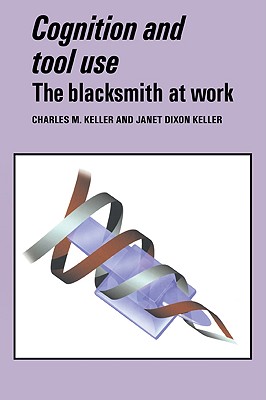
Cognition and Tool Use : The Blacksmith at Work
Book Details
Format
Hardback
ISBN-10
0521552397
ISBN-13
9780521552394
Publisher
Cambridge University Press
Imprint
Cambridge University Press
Country of Manufacture
GB
Country of Publication
GB
Publication Date
Sep 28th, 1996
Print length
220 Pages
Weight
515 grams
Dimensions
22.90 x 15.20 x 1.60 cms
KSh 19,600.00
Currently unavailable
0 in stock
Delivery Location
Delivery fee: Select location
Secure
Quality
Fast
Anthropologists Janet and Charles Keller provide an account of situated learning based on the ethnographic study of blacksmithing. Through both concrete and abstract accomplishment, they demonstrate a dynamic dialectic between knowledge and practice which characterizes this specific trade and much of human behaviour.
In Cognition and Tool Use, anthropologists Janet and Charles Keller provide an account of human accomplishment based on ethnographic study. Blacksmithing, the transformation of glowing iron into artistic and utilitarian products, is the activity they chose to develop a study of situated learning. This domain, permeated by visual imagery and physical virtuosity rather than verbal logic, appears antithetical to the usual realms of cognitive study. For this reason, it provides a new entree to human thought and an empirical test for an anthropology of knowledge. How does a mind in practice approach a stable, 'sedimented' body of knowledge and create something truly original? What does human tool use say about human thought? What does someone need to know to successfully produce a material artifact and how do they learn it? In addressing these questions, the authors offer an interdisciplinary perspective on the principled creativity of human behaviour.
Get Cognition and Tool Use by Charles M. Keller, Janet Dixon Keller at the best price and quality guaranteed only at Werezi Africa's largest book ecommerce store. The book was published by Cambridge University Press and it has 220 pages.
Customers Who Bought This Also Bought

The Culture Map
KSh 3,050.00

Abundance
KSh 2,150.00

Think Again
KSh 2,000.00

Amusing Ourselves to Death
KSh 2,000.00

The Sane Society
KSh 3,500.00

Abundance
KSh 3,050.00
Art of Gathering
KSh 2,150.00

The Anxious Generation
KSh 2,000.00
How To Know a Person
KSh 2,350.00

Righteous Mind
KSh 2,700.00
Outliers
KSh 1,250.00

Persuaders
KSh 3,600.00