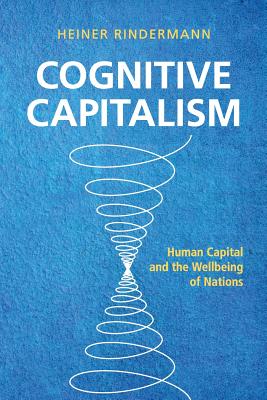
Cognitive Capitalism : Human Capital and the Wellbeing of Nations
Book Details
Format
Hardback
ISBN-10
1107050162
ISBN-13
9781107050167
Publisher
Cambridge University Press
Imprint
Cambridge University Press
Country of Manufacture
US
Country of Publication
GB
Publication Date
Feb 15th, 2018
Print length
592 Pages
Weight
1,036 grams
Dimensions
16.10 x 23.60 x 14.30 cms
KSh 21,800.00
Currently unavailable
0 in stock
Delivery Location
Delivery fee: Select location
Secure
Quality
Fast
This book studies cross-country differences in cognitive capital, exploring how levels of education are linked to a nation's economic development. It is for graduates and research in a wide range of fields, including economics, psychology, sociology and political science.
Nations can vary greatly in their wealth, democratic rights and the wellbeing of their citizens. These gaps are often obvious, and by studying the flow of immigration one can easily predict people''s wants and needs. But why are there also large differences in the level of education indicating disparities in cognitive ability? How are they related to a country''s economic, political and cultural development? Researchers in the paradigms of economics, psychology, sociology, evolution and cultural studies have tried to find answers for these hotly debated issues. In this book, Heiner Rindermann establishes a new model: the emergence of a burgher-civic world, supported by long-term background factors, furthered education and thinking. The burgher-civic world initiated a reciprocal development changing society and culture, resulting in past and present cognitive capital and wealth differences. This is an important text for graduate students and researchers in a wide range of fields, including economics, psychology, sociology and political science, and those working on economic growth, human capital formation and cognitive development.
Get Cognitive Capitalism by Heiner Rindermann at the best price and quality guaranteed only at Werezi Africa's largest book ecommerce store. The book was published by Cambridge University Press and it has 592 pages.
Customers Who Bought This Also Bought
How Emotions Are Made
KSh 2,350.00

Gödel, Escher, Bach
KSh 4,200.00
Thinking, Fast and Slow
KSh 3,050.00

The Art of Seduction
KSh 5,050.00
Noise
KSh 2,000.00
Thinking, Fast and Slow
KSh 2,700.00
Seven and a Half Lessons About the Brain
KSh 2,000.00
Influence: Science and Practice
KSh 12,850.00

Do the Work
KSh 1,450.00

Thinking in Bets
KSh 5,050.00

Art Of Listening
KSh 3,050.00
Mind''s Eye
KSh 2,000.00