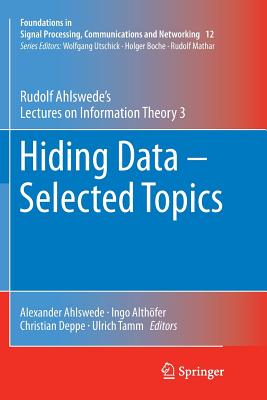
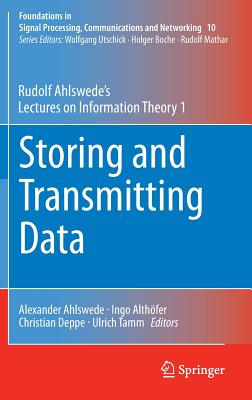
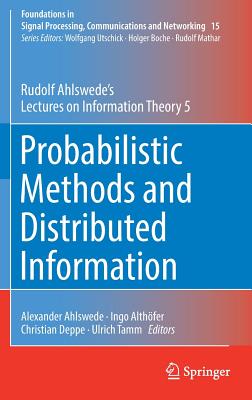
Combinatorial Methods and Models : Rudolf Ahlswede’s Lectures on Information Theory 4
Softcover reprint of the original 1st ed. 2018
Book Details
Format
Paperback / softback
ISBN-10
3319850733
ISBN-13
9783319850733
Edition
Softcover reprint of the original 1st ed. 2018
Publisher
Springer International Publishing AG
Imprint
Springer International Publishing AG
Country of Manufacture
GB
Country of Publication
GB
Publication Date
May 13th, 2018
Print length
385 Pages
Product Classification:
Discrete mathematicsMathematical theory of computation
KSh 13,500.00
Publisher Out of Stock
0 in stock
Delivery Location
Delivery fee: Select location
Secure
Quality
Fast
Whereas the first part of the book concentrateson combinatorial methods in order to analyse classical codes as prefix codes or codes in the Hamming metric, the second is devoted to combinatorial models in Information Theory.
The fourth volume of Rudolf Ahlswede’s lectures on Information Theory is focused on Combinatorics. Ahlswede was originally motivated to study combinatorial aspects of Information Theory via zero-error codes: in this case the structure of the coding problems usually drastically changes from probabilistic to combinatorial. The best example is Shannon’s zero error capacity, where independent sets in graphs have to be examined. The extension to multiple access channels leads to the Zarankiewicz problem. A code can be regarded combinatorially as a hypergraph; and many coding theorems can be obtained by appropriate colourings or coverings of the underlying hypergraphs. Several such colouring and covering techniques and their applications are introduced in this book. Furthermore, codes produced by permutations and one of Ahlswede’s favourite research fields -- extremal problems in Combinatorics -- are presented. Whereas the first part of the book concentrateson combinatorial methods in order to analyse classical codes as prefix codes or codes in the Hamming metric, the second is devoted to combinatorial models in Information Theory. Here the code concept already relies on a rather combinatorial structure, as in several concrete models of multiple access channels or more refined distortions. An analytical tool coming into play, especially during the analysis of perfect codes, is the use of orthogonal polynomials. Classical information processing concerns the main tasks of gaining knowledge and the storage, transmission and hiding of data. The first task is the prime goal of Statistics. For transmission and hiding data, Shannon developed an impressive mathematical theory called Information Theory, which he based on probabilistic models. The theory largely involves the concept of codes with small error probabilities in spite of noise in the transmission, which is modeled by channels. The lectures presentedin this work are suitable for graduate students in Mathematics, and also for those working in Theoretical Computer Science, Physics, and Electrical Engineering with a background in basic Mathematics. The lectures can be used as the basis for courses or to supplement courses in many ways. Ph.D. students will also find research problems, often with conjectures, that offer potential subjects for a thesis. More advanced researchers may find questions which form the basis of entire research programs.
Get Combinatorial Methods and Models by Rudolf Ahlswede at the best price and quality guaranteed only at Werezi Africa's largest book ecommerce store. The book was published by Springer International Publishing AG and it has 385 pages.
Customers Who Bought This Also Bought

The Random Number Code
KSh 36,000.00

Iteration Stable Tessellations
KSh 30,350.00

Monoidal Functors, Species and Hopf Algebras
KSh 27,200.00
Knapsack Problems
KSh 39,600.00
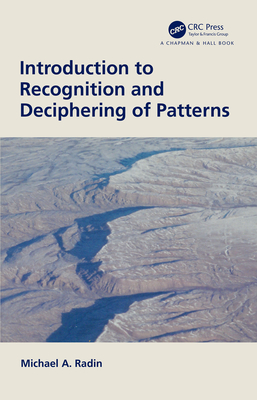
Introduction to Recognition and Deciphering of Patterns
KSh 9,700.00

Introduction to Data Science
KSh 24,300.00

The Baseball Mysteries
KSh 5,450.00
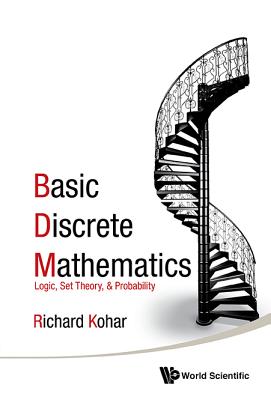
Basic Discrete Mathematics
KSh 11,700.00

New Digital Signal Processing Methods
KSh 25,200.00

The Shrikhande Graph
KSh 5,050.00

Neutrosophic Computing and Vague Data Analysis
KSh 22,500.00
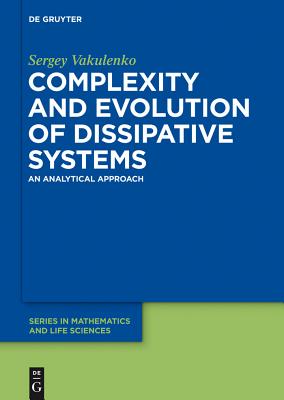
Complexity and Evolution of Dissipative Systems
KSh 27,350.00