
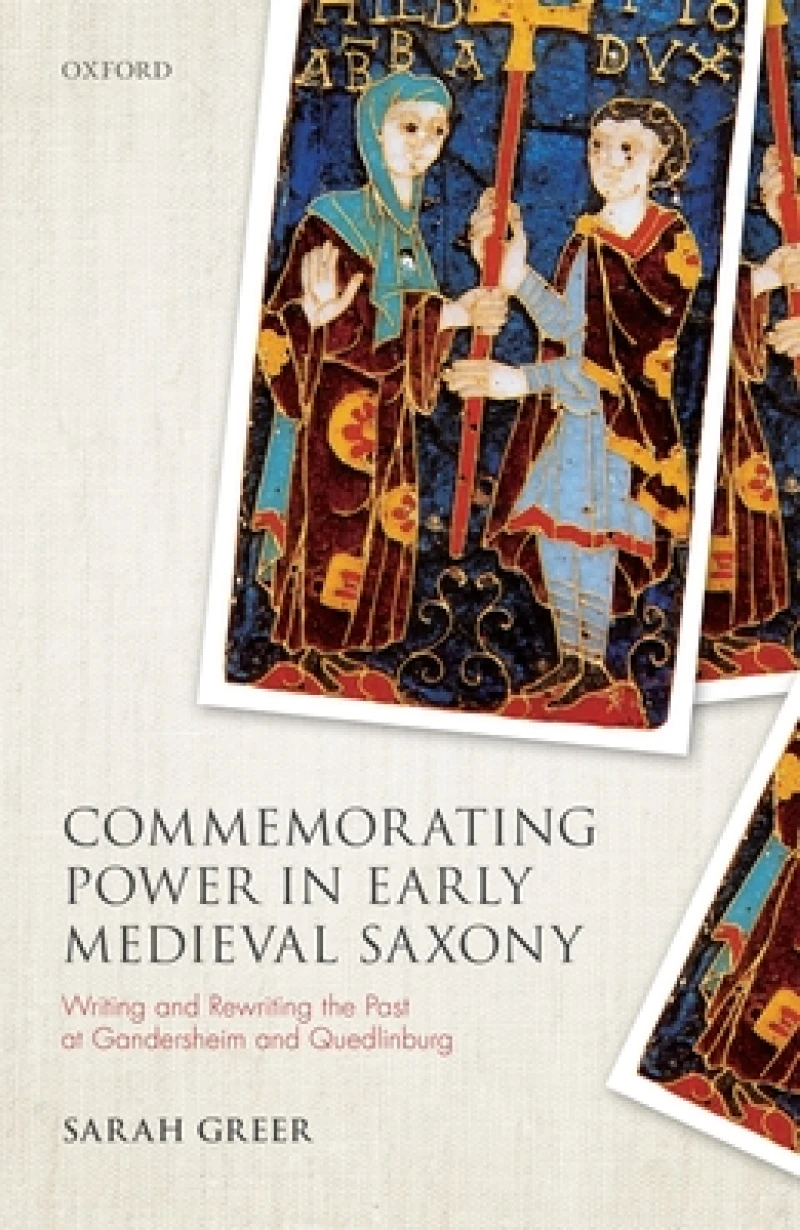
Commemorating Power in Early Medieval Saxony : Writing and Rewriting the Past at Gandersheim and Quedlinburg
by
Sarah Greer
Book Details
Format
Hardback or Cased Book
Book Series
Studies in German History
ISBN-10
0198850131
ISBN-13
9780198850137
Publisher
Oxford University Press
Imprint
Oxford University Press
Country of Manufacture
GB
Country of Publication
GB
Publication Date
Oct 26th, 2021
Print length
222 Pages
Weight
528 grams
Dimensions
24.00 x 26.50 x 1.20 cms
Ksh 18,850.00
Werezi Extended Catalogue
0 in stock
Delivery Location
Delivery fee: Select location
Secure
Quality
Fast
Commemorating Power looks at how the past was evoked for political purposes under a new Saxon dynasty, the Ottonians, who came to dominate post-Carolingian Europe after 888 as the rulers of a new empire in Germany and Italy, focusing on two convents of monastic women who played a significant role in Ottonian politics.
In the early medieval world, the way people remembered the past changed how they saw the present. New accounts of former leaders and their deeds could strengthen their successors, establish novel claims to power, or criticize the current ruler. After 888, when the Carolingian Empire fractured into the smaller kingdoms of medieval western Europe, memory became a vital tool for those seeking to claim royal power for themselves. Commemorating Power in Early Medieval Saxony looks at how the past was evoked for political purposes under a new Saxon dynasty, the Ottonians, who came to dominate post-Carolingian Europe as the rulers of a new empire in Germany and Italy. With the accession of the first Ottonian king, Henry I, in 919, sites commemorating the king''s family came to the foreground of the medieval German kingdom. The most remarkable of these were two convents of monastic women, Gandersheim and Quedlinburg, whose prominence and prestige in Ottonian politics have been seen as exceptional in the history of early medieval western Europe. In this volume, Sarah Greer offers a fresh interpretation of how these convents became central sites in the new Ottonian empire by revealing how the women in these communities themselves were skilful political actors who were more than capable of manipulating memory for their own benefit. In this first major study in English of how these Saxon convents functioned as memorial centres, Greer presents a new vision of the first German dynasty, one characterized by contingency, versatility, and the power of the past.
Get Commemorating Power in Early Medieval Saxony by at the best price and quality guaranteed only at Werezi Africa's largest book ecommerce store. The book was published by Oxford University Press and it has pages.

