
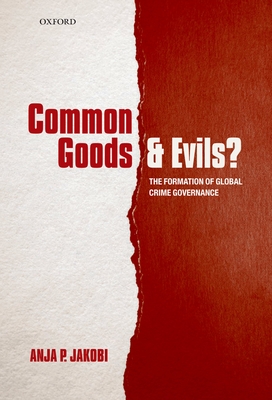
Common Goods and Evils? : The Formation of Global Crime Governance
Book Details
Format
Hardback
ISBN-10
0199674604
ISBN-13
9780199674602
Publisher
Oxford University Press
Imprint
Oxford University Press
Country of Manufacture
GB
Country of Publication
GB
Publication Date
Jul 4th, 2013
Print length
330 Pages
Weight
658 grams
Dimensions
24.20 x 15.70 x 2.40 cms
Product Classification:
GlobalizationCrime & criminologyInternational relationsOrganizational theory & behaviour
KSh 22,800.00
Temporarily out of stock, due soon
0 in stock
Delivery Location
Delivery fee: Select location
Secure
Quality
Fast
The book provides an up-to date account to global crime governance, containing in-depth case studies on money laundering, corruption, and human trafficking. It explains why the form of global governance - the institutional design - related to these cases differs widely.
Global crime governance has emerged as an important component of world politics. It is manifested in national and international agendas, the proliferation of global regulations, growing international budgets, and the enlarged mandates of international organizations. As a result, the definition and prosecution of crime is now increasingly homogenous, but it also shows variance: some crime policies are institutionalized coherently or attached to strong international organizations, while others are weak or dispersed across different forums. Based on sociological institutionalism, this book examines questions of structural variance in the institutional design of global governance. It shows that the interplay of strong actors and rationalization principles lead to more coherent forms of global crime governance, while normative arguments related to crime are more likely to result in fragmented forms. In consequence -- and contrary to many scholars'' assumptions -- global crime governance is strongest in those areas that are least attached to moral statements. The book develops a theory of society and applies this framework to explaining the sources and consequences of institutional design. Drawing on qualitative and quantitative methods, the text analyzes the origins of global regulations, how they are disseminated, and why differences exist. The role of the United States in creating global rules and disseminating them is emphasized. Readers interested in international relations, global governance, globalization studies, world society studies, and criminology will benefit from the theoretical and empirical results of this book.
Get Common Goods and Evils? by Anja P. Jakobi at the best price and quality guaranteed only at Werezi Africa's largest book ecommerce store. The book was published by Oxford University Press and it has 330 pages.
Customers Who Bought This Also Bought

Age of Revolutions
KSh 2,350.00
New Confessions of an Economic Hit Man
KSh 2,700.00

Good Economics for Hard Times
KSh 2,350.00

Winners Take All
KSh 2,350.00
Progress
KSh 3,050.00

Progress
KSh 3,950.00

No Logo
KSh 2,000.00

World is Flat
KSh 3,050.00

Global Citizenship
KSh 6,100.00

Mouth Full of Blood
KSh 2,350.00
Straight Talk on Trade – Ideas for a Sane World Economy
KSh 2,900.00

Thank You for Being Late
KSh 2,700.00
