
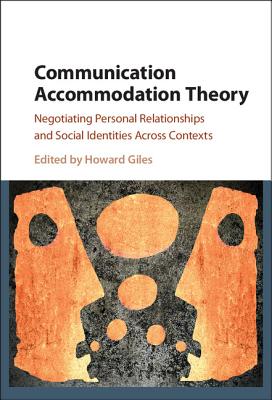
Communication Accommodation Theory : Negotiating Personal Relationships and Social Identities across Contexts
Book Details
Format
Hardback
ISBN-10
110710582X
ISBN-13
9781107105829
Publisher
Cambridge University Press
Imprint
Cambridge University Press
Country of Manufacture
GB
Country of Publication
GB
Publication Date
Aug 18th, 2016
Print length
230 Pages
Weight
488 grams
Dimensions
17.40 x 23.90 x 2.10 cms
Product Classification:
SociolinguisticsAnthropology
KSh 19,600.00
Currently unavailable
0 in stock
Delivery Location
Delivery fee: Select location
Secure
Quality
Fast
A seminal account of how, when, and why we modify telling features of our communication - face-to-face and digitally - across a rich array of situations. It examines this, and critically so, through an impressive array of methods, languages and applied contexts, and it also discusses the social consequences of various accommodative-nonaccommodative stances.
Most people modify their ways of speaking, writing, texting, and e-mailing, and so on, according to the people with whom they are communicating. This fascinating book asks why we 'accommodate' to others in this way, and explores the various social consequences arising from it. Communication Accommodation Theory (CAT), revised and elaborated over the past 40 years, has been applied to a wide range of situations, from families to courtrooms, and from media to hospitals, by means of diverse methodologies in many disciplines, and across numerous languages and cultures. Bringing together a team of experts, this book demonstrates how the theory can help us towards a greater understanding of interpersonal communication in a multitude of contexts. Finally, it examines the principles of the theory, identifying a range of avenues along which research can move forward in future.
Get Communication Accommodation Theory by Howard Giles at the best price and quality guaranteed only at Werezi Africa's largest book ecommerce store. The book was published by Cambridge University Press and it has 230 pages.
Customers Who Bought This Also Bought

Decolonising the Mind
KSh 4,700.00

Cultish
KSh 2,350.00

Digital Plurilingual Pedagogies in Teacher Education
KSh 27,900.00

Linguistic Landscape Studies of Global Chinese
KSh 30,800.00
Voice of Deliverance
KSh 6,450.00

Romania Africana
KSh 32,750.00

Second Language Learning and the COVID-19 Pandemic
KSh 21,250.00

Literacy Mediation
KSh 30,950.00

That''s Not What I Meant!
KSh 1,850.00

Construction Grammar and Sociolinguistic Theory
KSh 20,450.00

The Climate Turn in Language Teaching
KSh 3,250.00
The Cambridge Handbook of Sociolinguistics
KSh 30,100.00
