
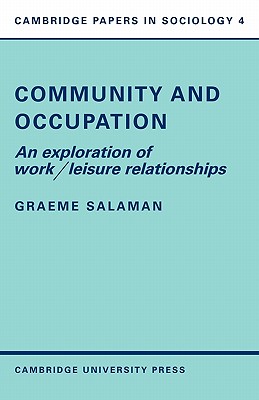
Community and Occupation : An Exploration of Work/Leisure Relationships
Book Details
Format
Paperback / softback
Book Series
Cambridge Papers in Sociology
ISBN-10
0521098521
ISBN-13
9780521098526
Publisher
Cambridge University Press
Imprint
Cambridge University Press
Country of Manufacture
GB
Country of Publication
GB
Publication Date
Jun 20th, 1974
Print length
146 Pages
Weight
202 grams
Dimensions
21.50 x 19.30 x 1.30 cms
Product Classification:
Sociology & anthropologySociology and anthropology
KSh 5,750.00
Currently unavailable
0 in stock
Delivery Location
Delivery fee: Select location
Secure
Quality
Fast
This book explores the relationship between work leisure time. At the opposite extreme to the 'instrumental' attitude, where work and leisure time remain separate, is the close involvement in work and the correspondingly close relationship between working and non-working identities characteristic of 'occupational communities', which this book attempts to define.
This book is concerned with the relationship between a man's work and his leisure time, in its broadest sense. At the opposite extreme to the 'instrumental' attitude, where the worker keeps his work and leisure time completely separate, is the close involvement in work and the correspondingly close relationship between working and non-working identities characteristic of 'occupational communities'. This 1974 book attempts to define the concept. After a survey of the theoretical background, Dr. Salaman presents a model of what an occupational community is and the reasons for its existence. The following chapters consist of empirical discussions on some specific examples. There is a detailed comparison between Cambridge railwaymen and architects. Dr Salaman draws the conclusion that occupational communities may be of two sorts - one based on the occupation as a whole, the other on a particular local workplace - and this distinction has considerable implications for the sociology of work.
Get Community and Occupation by Graeme Salaman at the best price and quality guaranteed only at Werezi Africa's largest book ecommerce store. The book was published by Cambridge University Press and it has 146 pages.
Customers Who Bought This Also Bought
In Spite Of The Gods
KSh 2,500.00

Affirmative Action Around the World – An Empirical Study
KSh 2,900.00

Debatable Land
KSh 3,950.00

The Underground Railroad Records
KSh 2,500.00

I, Rigoberta Menchú
KSh 3,600.00

The Will to Change
KSh 2,000.00

Death and Life of Great American Cities
KSh 3,600.00

Totemism
KSh 2,500.00

Gender Theory in Troubled Times
KSh 3,400.00

Elementary Statistics in Social Research: Essentials
KSh 13,700.00

Gender Theory in Troubled Times
KSh 9,900.00

Race After Technology – Abolitionist Tools for the New Jim Code
KSh 2,700.00
