
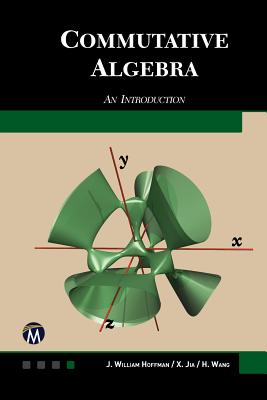
Commutative Algebra : An Introduction
Book Details
Delivery Location
Delivery fee: Select location
The design of the text in each chapter consists of two parts: the fundamentals and the applications, which make it suitable for courses of various lengths, levels, and topics based on the mathematical background of the students. The fundamentals portion of the chapter is intended to be read with minimal outside assistance, and to learn some of the most useful tools in commutative algebra. The applications of the chapter are to provide a glimpse of the advanced mathematical research where the topics and results are related to the material presented earlier. In the applications portion, the authors present a number of results from a wide range of sources without detailed proofs. The applications portion of the chapter is suitable for a reader who knows a little commutative algebra and algebraic geometry already, and serves as a guide to some interesting research topics.
This book should be thought of as an introduction to more advanced texts and research topics. Its novelty is that the material presented is a unique combination of the essential methods and the current research results. The goal is to equip readers with the fundamental classical algebra and geometry tools, ignite their research interests, and initiate some potential research projects in the related areas.
Many years ago by now, indeed on the order of forty (I shudder to think), I was advised by UCLA’s Richard Elman to study the book Introduction to Commutative Algebra by Atiyah and MacDonald (a book which I had the pleasure to review) and happily took his advice. It served me very well then, afterward, and does so still. Moreover, as the mathematical generations process, I am happy to report that I had occasion to use the book myself in a reading course a couple of years ago, with a very gifted student who is now going after his doctorate at Purdue. Suffice it to say, then, that Atiyah-MacDonald is a sine qua non in this arena of mathematical education. It is not the only text in the game, however, as must be the case. One reason is the heterogeneity of today’s student body, even at the highest levels. Things have also changed a great deal as regards what one should know as he enters the fray of mathematical research and high-level teaching. So, in phase with this, the book under review states that “[it] should be thought of as an introduction to more advanced texts and research topics,” which I guess pitches the book as something as a prelude to Atiyah-MacDonald. After all, that book is rather austere and famously (or notoriously) requires the reader to work like mad on the many fabulous but occasionally very sporty problems that book comes equipped with. Thus, despite its undeniable excellence, Atiyah-MacDonald is not every one’s cup of tea.
Against this backdrop, then, the book under review is manifestly a more accessible and user-friendly text — which is not to say that the book is trivial: it certainly is not — and additionally distinguishes itself on a number of counts. For example, true to the Zeitgeist, Hoffman, Jia, and Wang spend a good deal of energy on Gröbner bases (which were not even in the air when I was a student) and accordingly give airplay to computational aspects of homological algebra that are very much on the scene today. As regards this latter orientation, the book’s chapter on modules (over a ring) closes with a section titled “Computational Applications” which is rife with computer programs, all alien to me who still write my papers in long-hand with a fountain pen. This said, Chapter 3 is a good example of another virtue of this book, namely its thoroughness and breadth. The authors do a particularly good job on the subjects of projective and injective modules, tensor products, and flatness, for example. (These topics are particularly close to my heart because of the pleasure I had in learning about them from other sources than Atiyah-MacDonald, i.e. Rotman’s beautifully encyclopedic Advanced Modern Algebra and Cartan and Eilenberg’s Homological Algebra.)
I think this is a good and useful book, doing justice to a number of topics that are bound to figure prominently down the line (anyone’s line). The authors spend a lot of time on graded objects, as well as complexes and their early inner life, all in the context of budding homological algebra. And they get pretty zealous, too: the end of the book sports coverage of local cohomology as well as “applications” such as Castelnuovo-Mumford regularity and MacRae’s invariant (bringing to mind that, after all, much of the raison d’être of commutative algebra is algebraic geometry).
This book delivers what it promises, namely, fundamental (and serious) aspects of commutative algebra plus introductions to current research themes. To wit: “each chapter consists of two parts: fundamentals and … applications, which make it suitable for courses of various lengths.” Additionally, the book is pitched at a good level: after a first year graduate course in abstract algebra, the reader should be able to dive in and swim. It looks to be a valuable pedagogical contribution.
Michael Bert:
Many years ago by now, indeed on the order of forty (I shudder to think), I was advised by UCLA’s Richard Elman to study the book Introduction to Commutative Algebra by Atiyah and MacDonald (a book which I had the pleasure to review) and happily took his advice. It served me very well then, afterward, and does so still. Moreover, as the mathematical generations process, I am happy to report that I had occasion to use the book myself in a reading course a couple of years ago, with a very gifted student who is now going after his doctorate at Purdue. Suffice it to say, then, that Atiyah-MacDonald is a sine qua non in this arena of mathematical education. It is not the only text in the game, however, as must be the case. One reason is the heterogeneity of today’s student body, even at the highest levels. Things have also changed a great deal as regards what one should know as he enters the fray of mathematical research and high-level teaching. So, in phase with this, the book under review states that “[it] should be thought of as an introduction to more advanced texts and research topics,” which I guess pitches the book as something as a prelude to Atiyah-MacDonald. After all, that book is rather austere and famously (or notoriously) requires the reader to work like mad on the many fabulous but occasionally very sporty problems that book comes equipped with. Thus, despite its undeniable excellence, Atiyah-MacDonald is not every one’s cup of tea.
Against this backdrop, then, the book under review is manifestly a more accessible and user-friendly text — which is not to say that the book is trivial: it certainly is not — and additionally distinguishes itself on a number of counts. For example, true to the Zeitgeist, Hoffman, Jia, and Wang spend a good deal of energy on Gröbner bases (which were not even in the air when I was a student) and accordingly give airplay to computational aspects of homological algebra that are very much on the scene today. As regards this latter orientation, the book’s chapter on modules (over a ring) closes with a section titled “Computational Applications” which is rife with computer programs, all alien to me who still write my papers in long-hand with a fountain pen. This said, Chapter 3 is a good example of another virtue of this book, namely its thoroughness and breadth. The authors do a particularly good job on the subjects of projective and injective modules, tensor products, and flatness, for example. (These topics are particularly close to my heart because of the pleasure I had in learning about them from other sources than Atiyah-MacDonald, i.e. Rotman’s beautifully encyclopedic Advanced Modern Algebra and Cartan and Eilenberg’s Homological Algebra.)
I think this is a good and useful book, doing justice to a number of topics that are bound to figure prominently down the line (anyone’s line). The authors spend a lot of time on graded objects, as well as complexes and their early inner life, all in the context of budding homological algebra. And they get pretty zealous, too: the end of the book sports coverage of local cohomology as well as “applications” such as Castelnuovo-Mumford regularity and MacRae’s invariant (bringing to mind that, after all, much of the raison d’être of commutative algebra is algebraic geometry).
This book delivers what it promises, namely, fundamental (and serious) aspects of commutative algebra plus introductions to current research themes. To wit: “each chapter consists of two parts: fundamentals and … applications, which make it suitable for courses of various lengths.” Additionally, the book is pitched at a good level: after a first year graduate course in abstract algebra, the reader should be able to dive in and swim. It looks to be a valuable pedagogical contribution.
Get Commutative Algebra by Haohao Wang, J. William Hoffman at the best price and quality guaranteed only at Werezi Africa's largest book ecommerce store. The book was published by Mercury Learning & Information and it has 300 pages.
Customers Who Bought This Also Bought

Locally Flat Embeddings of 3-Manifolds in S4
KSh 8,100.00
Advanced Problems in Mathematics
KSh 4,800.00

Algebra and Discrete Mathematics for Economics
KSh 13,150.00

Sets and Groups
KSh 18,600.00
Operator Algebras
KSh 32,400.00
The Shaping of Arithmetic after C.F. Gauss''s Disquisitiones Arithmeticae
KSh 16,200.00

Higher Category Theory
KSh 20,000.00

Abstract Algebra
KSh 16,200.00

Residues and Duality for Projective Algebraic Varieties
KSh 10,600.00
Basic Algebra I
KSh 4,500.00
Handbook of Tilting Theory
KSh 17,100.00
Advances in Matrix Inequalities
KSh 19,800.00
More by Haohao Wang, J. William Hoffman
More in This Genre
Locally Flat Embeddings of 3-Manifolds in S4
KSh 8,100.00
Advanced Problems in Mathematics
KSh 4,800.00
Algebra and Discrete Mathematics for Economics
KSh 13,150.00
Sets and Groups
KSh 18,600.00
Operator Algebras
KSh 32,400.00
The Shaping of Arithmetic after C.F. Gauss''s Disquisitiones Arithmeticae
KSh 16,200.00
