
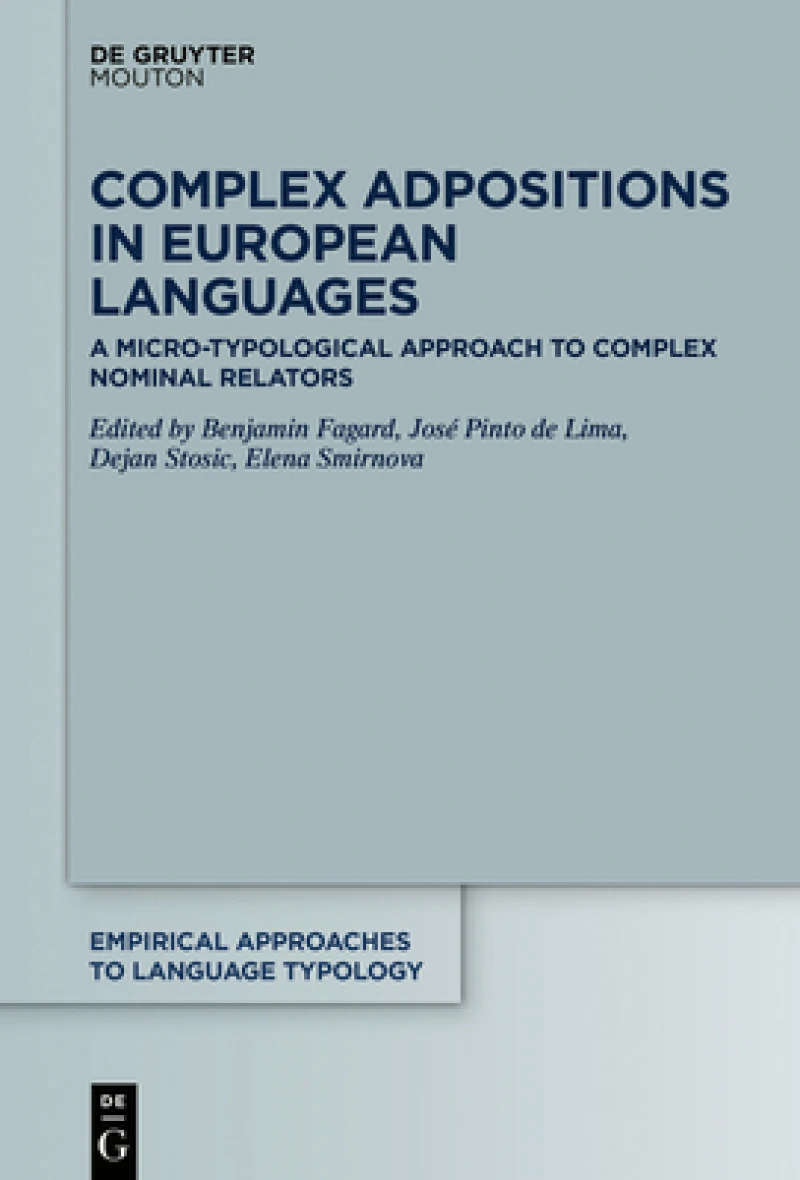
Complex Adpositions in European Languages : A Micro-Typological Approach to Complex Nominal Relators
Book Details
Format
Hardback or Cased Book
Book Series
Empirical Approaches to Language Typology [EALT]
ISBN-10
3110676931
ISBN-13
9783110676938
Publisher
De Gruyter
Imprint
De Gruyter Mouton
Country of Manufacture
GB
Country of Publication
GB
Publication Date
Oct 26th, 2020
Print length
410 Pages
Weight
930 grams
Dimensions
16.50 x 24.20 x 3.50 cms
Product Classification:
linguistics
Ksh 24,550.00
Werezi Extended Catalogue
Delivery in 14 days
2 copies in stock
Delivery Location
Delivery fee: Select location
Delivery in 14 days
Secure
Quality
Fast
The series is a platform for contributions of all kinds to this rapidly developing field. General problems are studied from the perspective of individual languages, language families, language groups, or language samples. Conclusions are the result of a deepened study of empirical data. Special emphasis is given to little-known languages, whose analysis may shed new light on long-standing problems in general linguistics.
While much attention has been devoted to simple nominal relators, especially prepositions and case markers, complex nominal relators have not yet been the focus of a systematic and cross-linguistic study.
The chapters of this volume provide not only a working definition of such constructions, but also a description of complex adpositions and other complex nominal relators in a variety of European languages, both Indo-European and non-Indo-European, including some languages for which this phenomenon had received little attention, such as Breton and Albanian. Building on synchronic and diachronic corpus-based investigations, the authors show commonalities and specificities of these linguistic items across languages, trying to explain why and how they emerged.
The research presented in this volume confirms the wide-spread use of complex adpositions in Europe, and the data reviewed in the final discussion suggests it might be the same in other parts of the world, as well. This book thus offers not only detailed descriptions of complex nominal relators in fifteen languages, but also indications of what to look for in other languages, and how to distinguish between a syntactically free sequence and a genuine complex nominal relator.
The chapters of this volume provide not only a working definition of such constructions, but also a description of complex adpositions and other complex nominal relators in a variety of European languages, both Indo-European and non-Indo-European, including some languages for which this phenomenon had received little attention, such as Breton and Albanian. Building on synchronic and diachronic corpus-based investigations, the authors show commonalities and specificities of these linguistic items across languages, trying to explain why and how they emerged.
The research presented in this volume confirms the wide-spread use of complex adpositions in Europe, and the data reviewed in the final discussion suggests it might be the same in other parts of the world, as well. This book thus offers not only detailed descriptions of complex nominal relators in fifteen languages, but also indications of what to look for in other languages, and how to distinguish between a syntactically free sequence and a genuine complex nominal relator.
Get Complex Adpositions in European Languages by at the best price and quality guaranteed only at Werezi Africa's largest book ecommerce store. The book was published by De Gruyter and it has pages.

