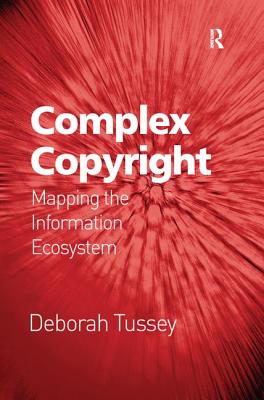
Complex Copyright : Mapping the Information Ecosystem
Book Details
Format
Hardback
ISBN-10
0754677842
ISBN-13
9780754677840
Publisher
Taylor & Francis Ltd
Imprint
Routledge
Country of Manufacture
GB
Country of Publication
GB
Publication Date
Dec 28th, 2011
Print length
156 Pages
Weight
428 grams
Dimensions
24.00 x 16.30 x 1.60 cms
Product Classification:
Design, Industrial and commercial arts, illustrationIndustrial / commercial art & designLibrary & information sciencesLibrary and information sciences / MuseologyOrganizational theory & behaviourOrganizational theory and behaviourJurisprudence & philosophy of lawMethods, theory and philosophy of lawCompany lawIntellectual property lawCopyright lawSocial lawSocial law and Medical law
KSh 30,950.00
Currently unavailable
0 in stock
Delivery Location
Delivery fee: Select location
Secure
Quality
Fast
Argues that copyrighted works are the products of complex creative systems and, consequently, designers of copyright regimes for the global 'information ecosystem' should look to complexity theory for guidance. This study shows how copyright law must tolerate certain chaotic elements that may be essential to the sustainability of complex systems.
This book draws on a wide selection of interdisciplinary literature discussing complex adaptive systems - including scholarship from economics, political science, evolutionary biology, cognitive science, and religion - to apply general complexity tenets to the institutions, conceptual framework, and theoretical justifications of the copyright system, both in the United States and internationally. The author argues that copyrighted works are the products of complex creative systems and, consequently, designers of copyright regimes for the global ''information ecosystem'' should look to complexity theory for guidance. Urging legal scholars to undertake empirical studies of real-world copyright systems, Tussey reveals how the selection of workable configurations for the copyright regime is larger than that encompassed by the traditional, entirely theoretical, debate between private property rights and the commons. Finally, this unique study articulates how copyright law must tolerate certain chaotic elements that may be essential to the sustainability of complex systems.
Get Complex Copyright by Deborah Tussey at the best price and quality guaranteed only at Werezi Africa's largest book ecommerce store. The book was published by Taylor & Francis Ltd and it has 156 pages.
Customers Who Bought This Also Bought

Work for Money, Design for Love
KSh 5,200.00

The Invention of Design
KSh 4,500.00

Belstaff
KSh 13,500.00

Bring No Clothes
KSh 2,350.00

Vanishing World
KSh 4,150.00

Seasonal Living
KSh 2,350.00

Barbie Takes the Catwalk
KSh 8,300.00

Spider-Man: Into the Spider-Verse -The Art of the Movie
KSh 7,000.00

Arcade Adventures
KSh 6,300.00

Design and Nature
KSh 8,000.00

Magazine B Issue #41 ROLEX
KSh 3,600.00

The Disabled Gaze
KSh 4,500.00