
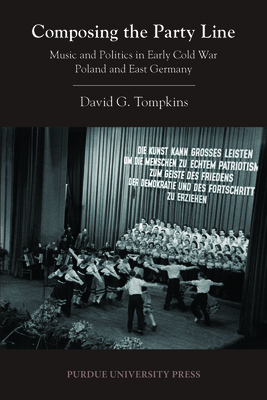
Composing the Party Line : Music and Politics in Early Cold War Poland and East Germany
Book Details
Format
Paperback / softback
Book Series
Central European Studies
ISBN-10
1557536473
ISBN-13
9781557536471
Publisher
Purdue University Press
Imprint
Purdue University Press
Country of Manufacture
US
Country of Publication
GB
Publication Date
Sep 15th, 2013
Print length
300 Pages
Weight
514 grams
Dimensions
15.00 x 23.10 x 2.00 cms
Product Classification:
European historyEuropean history
KSh 5,600.00
Currently unavailable
0 in stock
Delivery Location
Delivery fee: Select location
Secure
Quality
Fast
This book examines the exercise of power in the Stalinist music world as well as the ways in which composers and ordinary people responded to it. It presents a comparative inquiry into the relationship between music and politics in the German Democratic Republic and Poland from the aftermath of World War II through Stalin’s death in 1953, concluding with the slow process of de-Stalinisation in the mid- to late-1950s. The author explores how the Communist parties in both countries expressed their attitudes to music of all kinds, and how composers, performers, and audiences cooperated with, resisted, and negotiated these suggestions and demands.
Based on a deep analysis of the archival and contemporary published sources on state, party, and professional organisations concerned with musical life, Tompkins argues that music, as a significant part of cultural production in these countries, played a key role in instituting and maintaining the regimes of East Central Europe. As part of the Stalinist project to create and control a new socialist identity at the personal as well as collective level, the ruling parties in East Germany and Poland sought to saturate public space through the production of music. Politically effective ideas and symbols were introduced that furthered their attempts to, in the parlance of the day, “engineer the human soul.”
Music also helped the Communist parties establish legitimacy. Extensive state support for musical life encouraged musical elites and audiences to accept the dominant position and political missions of these regimes. Party leaders invested considerable resources in the attempt to create an authorised musical language that would secure and maintain hegemony over the cultural and wider social worlds. The responses of composers and audiences ran the gamut from enthusiasm to suspicion, but indifference was not an option.
Based on a deep analysis of the archival and contemporary published sources on state, party, and professional organisations concerned with musical life, Tompkins argues that music, as a significant part of cultural production in these countries, played a key role in instituting and maintaining the regimes of East Central Europe. As part of the Stalinist project to create and control a new socialist identity at the personal as well as collective level, the ruling parties in East Germany and Poland sought to saturate public space through the production of music. Politically effective ideas and symbols were introduced that furthered their attempts to, in the parlance of the day, “engineer the human soul.”
Music also helped the Communist parties establish legitimacy. Extensive state support for musical life encouraged musical elites and audiences to accept the dominant position and political missions of these regimes. Party leaders invested considerable resources in the attempt to create an authorised musical language that would secure and maintain hegemony over the cultural and wider social worlds. The responses of composers and audiences ran the gamut from enthusiasm to suspicion, but indifference was not an option.
Get Composing the Party Line by David G. Tompkins at the best price and quality guaranteed only at Werezi Africa's largest book ecommerce store. The book was published by Purdue University Press and it has 300 pages.
Customers Who Bought This Also Bought

Age of Revolutions
KSh 2,350.00
Eichmann in Jerusalem
KSh 2,350.00

Trouble With Being Born
KSh 2,000.00

Hiroshima
KSh 2,000.00

Freedom
KSh 6,300.00

Holocaust
KSh 2,700.00
The History of the Peloponnesian War
KSh 2,700.00
Annals
KSh 2,350.00
Greek Lives
KSh 2,150.00

Sleepwalkers
KSh 3,400.00

Napoleon The Great
KSh 3,600.00
Diary of a Young Girl
KSh 1,800.00
