
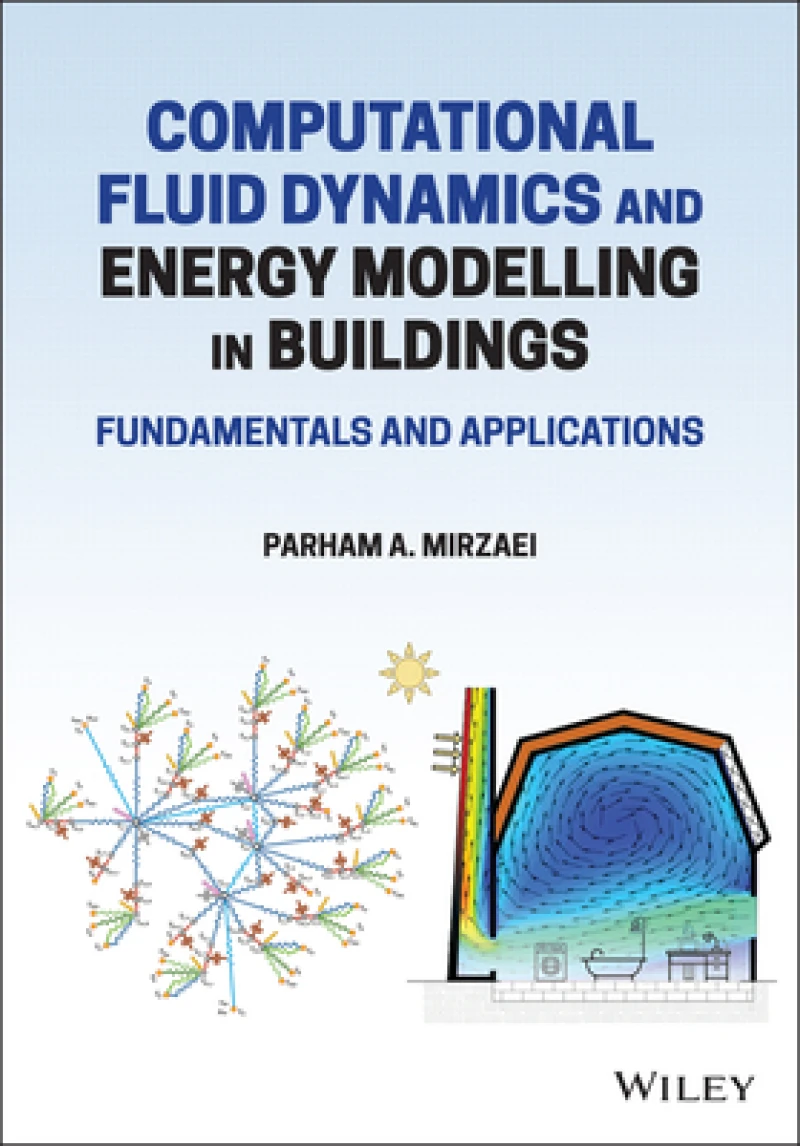
Computational Fluid Dynamics and Energy Modelling in Buildings : Fundamentals and Applications
Book Details
Format
Paperback / Softback
ISBN-10
1119743516
ISBN-13
9781119743514
Publisher
John Wiley and Sons Ltd
Imprint
Wiley-Blackwell
Country of Manufacture
GB
Country of Publication
GB
Publication Date
Nov 24th, 2022
Print length
624 Pages
Weight
1,157 grams
Dimensions
24.40 x 17.00 x 3.60 cms
Product Classification:
Civil engineering, surveying & building
Ksh 11,000.00
Werezi Extended Catalogue
0 in stock
Delivery Location
Delivery fee: Select location
Secure
Quality
Fast
COMPUTATIONAL FLUID DYNAMICS AND ENERGY MODELLING IN BUILDINGS A Comprehensive Overview of the Fundamentals of Heat and Mass Transport Simulation and Energy Performance in Buildings In the first part of Computational Fluid Dynamics and Energy Modelling in Buildings: Fundamentals and Applications, the author explains the fundamentals of fluid mechanics, thermodynamics, and heat transfer, with a specific focus on their application in buildings. This background knowledge sets the scene to further model heat and mass transport in buildings, with explanations of commonly applied simplifications and assumptions. In the second part, the author elaborates how the fundamentals explained in part 1 can be used to model energy flow in buildings, which is the basis of all commercial and educational building energy simulation tools. An innovative illustrative nodal network concept is introduced to help readers comprehend the basics of conservation laws in buildings. The application of numerical techniques to form dynamic simulation tools are then introduced. In general, understanding these techniques will help readers to identify and justify their choices when working with building energy simulation tools, rather than using default settings. Detailed airflow information in buildings cannot be obtained in building energy simulation techniques. Therefore, part three is focused on introducing computational fluid dynamics (CFD) as a detailed modelling technique for airflow in buildings. This part starts with an introduction to the fundamentals of the finite volume method used to solve the governing fluid equations and the related challenges and considerations are discussed. The last chapter of this part covers the solutions to some practical problems of airflow within and around buildings. The key aspect of Computational Fluid Dynamics and Energy Modelling in Buildings: Fundamentals and Applications is that it is tailored for audiences without extensive past experience of numerical methods. Undergraduate or graduate students in architecture, urban planning, geography, architectural engineering, and other engineering fields, along with building performance and simulation professionals, can use this book to gain additional clarity on the topics of building energy simulation and computational fluid dynamics.
Get Computational Fluid Dynamics and Energy Modelling in Buildings by at the best price and quality guaranteed only at Werezi Africa's largest book ecommerce store. The book was published by John Wiley and Sons Ltd and it has pages.

