
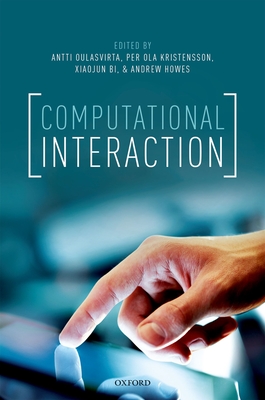
Computational Interaction
Book Details
Format
Paperback / softback
ISBN-10
0198799616
ISBN-13
9780198799610
Publisher
Oxford University Press
Imprint
Oxford University Press
Country of Manufacture
GB
Country of Publication
GB
Publication Date
Feb 8th, 2018
Print length
432 Pages
Weight
712 grams
Dimensions
15.60 x 23.30 x 2.50 cms
Product Classification:
Human-computer interactionHuman–computer interaction
KSh 11,150.00
Currently unavailable
0 in stock
Delivery Location
Delivery fee: Select location
Secure
Quality
Fast
This book introduces a new perspective on how to design user interfaces called "Computational Interaction". This new method applies principles of computational thinking (abstraction, automation and analysis) to inform our understanding of how people interact with user interfaces.
This book presents computational interaction as an approach to explaining and enhancing the interaction between humans and information technology. Computational interaction applies abstraction, automation, and analysis to inform our understanding of the structure of interaction and also to inform the design of the software that drives new and exciting human-computer interfaces. The methods of computational interaction allow, for example, designers to identify user interfaces that are optimal against some objective criteria. They also allow software engineers to build interactive systems that adapt their behaviour to better suit individual capacities and preferences.Embedded in an iterative design process, computational interaction has the potential to complement human strengths and provide methods for generating inspiring and elegant designs. Computational interaction does not exclude the messy and complicated behaviour of humans, rather it embraces it by, for example, using models that are sensitive to uncertainty and that capture subtle variations between individual users. It also promotes the idea that there are many aspects of interaction that can be augmented by algorithms. This book introduces computational interaction design to the reader by exploring a wide range of computational interaction techniques, strategies and methods. It explains how techniques such as optimisation, economic modelling, machine learning, control theory, formal methods, cognitive models and statistical language processing can be used to model interaction and design more expressive, efficient and versatile interaction.
Get Computational Interaction by Andrew Howes at the best price and quality guaranteed only at Werezi Africa's largest book ecommerce store. The book was published by Oxford University Press and it has 432 pages.
Customers Who Bought This Also Bought

God AI
KSh 2,350.00

Proving Ground
KSh 3,050.00

Computer Applications in Industry and Engineering
KSh 10,800.00

Human Interface and the Management of Information. Information and Knowledge in Context
KSh 8,100.00

Exploring the Theory, Pedagogy and Practice of Networked Learning
KSh 16,200.00
Multi-Modal User Interactions in Controlled Environments
KSh 16,200.00

Nature Technology
KSh 8,100.00

Semiotics in Information Systems Engineering
KSh 7,200.00

Advanced Information Systems Engineering
KSh 16,200.00
Community-Built Databases
KSh 16,200.00

Impact
KSh 32,400.00
Angular and Deep Learning Pocket Primer
KSh 6,650.00
More in This Genre
God AI
KSh 2,350.00
Proving Ground
KSh 3,050.00
Computer Applications in Industry and Engineering
KSh 10,800.00
Human Interface and the Management of Information. Information and Knowledge in Context
KSh 8,100.00
Exploring the Theory, Pedagogy and Practice of Networked Learning
KSh 16,200.00
Multi-Modal User Interactions in Controlled Environments
KSh 16,200.00
