
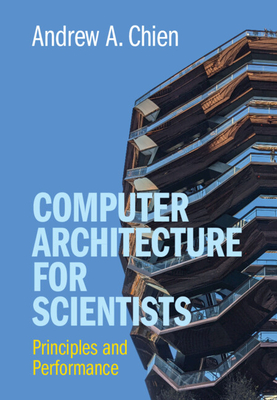
Computer Architecture for Scientists : Principles and Performance
Book Details
Format
Hardback
ISBN-10
1316518531
ISBN-13
9781316518533
Publisher
Cambridge University Press
Imprint
Cambridge University Press
Country of Manufacture
GB
Country of Publication
GB
Publication Date
Mar 10th, 2022
Print length
264 Pages
Weight
644 grams
Dimensions
17.60 x 25.00 x 1.90 cms
Product Classification:
Computer architecture & logic designComputer architecture and logic design
KSh 10,050.00
Currently unavailable
0 in stock
Delivery Location
Delivery fee: Select location
Secure
Quality
Fast
Rapidly growing cadres of sophisticated computing users need to understand how to exploit computing performance and the architecture of computers that give rise to it. With an accessible, principle-based approach, this book offers a high-level view of the four key pillars of performance. Ideal for computer, data, or social scientists and engineers.
The dramatic increase in computer performance has been extraordinary, but not for all computations: it has key limits and structure. Software architects, developers, and even data scientists need to understand how exploit the fundamental structure of computer performance to harness it for future applications. Ideal for upper level undergraduates, Computer Architecture for Scientists covers four key pillars of computer performance and imparts a high-level basis for reasoning with and understanding these concepts: Small is fast – how size scaling drives performance; Implicit parallelism – how a sequential program can be executed faster with parallelism; Dynamic locality – skirting physical limits, by arranging data in a smaller space; Parallelism – increasing performance with teams of workers. These principles and models provide approachable high-level insights and quantitative modelling without distracting low-level detail. Finally, the text covers the GPU and machine-learning accelerators that have become increasingly important for mainstream applications.
Get Computer Architecture for Scientists by Andrew A. Chien at the best price and quality guaranteed only at Werezi Africa's largest book ecommerce store. The book was published by Cambridge University Press and it has 264 pages.
Customers Who Bought This Also Bought

Quantum Symmetry and Entanglement Horizons
KSh 18,700.00

Beyond Algorithms
KSh 22,500.00

Photonic Quantum Information Processing
KSh 18,700.00

Advances in Medical Imaging
KSh 17,450.00

Hardware Supply Chain Security
KSh 19,800.00

Programming Language Pragmatics
KSh 14,650.00
A Practical Introduction to Computer Architecture
KSh 8,500.00

Advances in Intelligent Computing and Communication Technology
KSh 26,300.00

Viruses, Hardware and Software Trojans
KSh 23,400.00
Well-Quasi Orders in Computation, Logic, Language and Reasoning
KSh 28,800.00
In-Memory Computing
KSh 16,200.00

Languages, Design Methods, and Tools for Electronic System Design
KSh 8,100.00
