
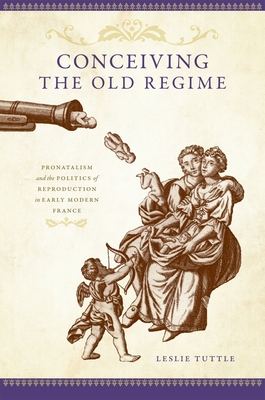
Conceiving the Old Regime : Pronatalism and the Politics of Reproduction in Early Modern France
Book Details
Format
Hardback
ISBN-10
0195381602
ISBN-13
9780195381603
Publisher
Oxford University Press Inc
Imprint
Oxford University Press Inc
Country of Manufacture
GB
Country of Publication
GB
Publication Date
Jul 15th, 2010
Print length
264 Pages
Weight
522 grams
Dimensions
16.00 x 23.60 x 2.50 cms
KSh 15,700.00
Currently unavailable
0 in stock
Delivery Location
Delivery fee: Select location
Secure
Quality
Fast
The French obsession with population has roots in the Old Regime, when the nascent French state used its growing power to convince French men and women to marry and procreate large families. Drawing on extensive archival research, Tuttle explores the interactions of men, women, and officials all vying for control of the reproductive process.
Early modern rulers believed that the more subjects over whom they ruled, the more powerful they would be. Putting this axiom into effect, Louis XIV and his minister Jean-Baptiste Colbert instituted in 1666 policies designed to encourage marriage and very large families. So began a 150-year experiment in governing the reproductive process, the largest populationist initiative since the Roman Empire.This book traces the consequences of premodern pronatalism for the women, men, and government officials tasked with procreating the abundant supply of soldiers, workers and taxpayers deemed essential for France''s glory. While everyone knew-in a practical rather than scientific sense-how babies were made, the notion that humans should exercise control over reproduction remained deeply controversial in a Catholic nation.Leslie Tuttle draws on archival sources to show how royal bureaucrats mobilized the limited power of the premodern state in an attempt to shape procreation in the king''s interest. Married couples, it turned out, were far more likely to exercise control by limiting the size of their families. By the late eighteenth century, marriage, reproduction and family size came to be hot-button political issues, inspiring debates that helped to define the character of the modern French nation.Conceiving the Old Regime shows that France''s perennial concern with population has very deep roots in its history, and demonstrates the centrality of gender and sexuality to state formation.
Get Conceiving the Old Regime by Leslie Tuttle at the best price and quality guaranteed only at Werezi Africa's largest book ecommerce store. The book was published by Oxford University Press Inc and it has 264 pages.
Customers Who Bought This Also Bought

Age of Revolutions
KSh 2,350.00

Eichmann in Jerusalem
KSh 2,350.00

Trouble With Being Born
KSh 2,000.00

Hiroshima
KSh 2,000.00

Freedom
KSh 6,300.00

Holocaust
KSh 2,700.00
The History of the Peloponnesian War
KSh 2,700.00
Annals
KSh 2,350.00
Greek Lives
KSh 2,150.00
Sleepwalkers
KSh 3,400.00

Napoleon The Great
KSh 3,600.00
Diary of a Young Girl
KSh 1,800.00
