
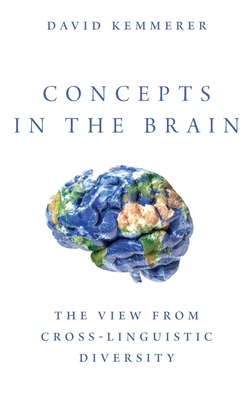
Concepts in the Brain : The View From Cross-linguistic Diversity
Book Details
Format
Hardback
ISBN-10
0190682620
ISBN-13
9780190682620
Publisher
Oxford University Press Inc
Imprint
Oxford University Press Inc
Country of Manufacture
US
Country of Publication
GB
Publication Date
Apr 4th, 2019
Print length
368 Pages
Weight
703 grams
Dimensions
15.70 x 23.60 x 2.80 cms
Product Classification:
PsycholinguisticsCognition & cognitive psychologyNeurosciences
KSh 18,150.00
Temporarily out of stock, due soon
0 in stock
Delivery Location
Delivery fee: Select location
Secure
Quality
Fast
There are roughly 6,500 languages in the world, and they display numerous similarities and differences in the concepts that they encode. This book argues that cognitive neuroscientists must take these findings seriously if they are ever to achieve a truly comprehensive, pan-human account of the cortical underpinnings of semantic knowledge.
For most native speakers of English, the meanings of ordinary words like "blue," "cup," "stumble," and "carve" seem quite natural and self-evident. It turns out, however, that they are far from universal, as shown by recent research in the discipline known as semantic typology. To be sure, the roughly 6,500 languages around the world do have many similarities in the sorts of concepts they encode. But they also vary greatly in numerous ways, such as how they partition particular conceptual domains, how they map those domains onto syntactic categories, which distinctions they force speakers to habitually attend to, and how deeply they weave certain notions into the fabric of their grammar. Although these insights from semantic typology have had a major impact on the field of psycholinguistics, they have been mostly neglected by the branch of cognitive neuroscience that studies how concepts are represented, organized, and processed in our brains. In Concepts in the Brain, David Kemmerer exposes this oversight and demonstrates its significance. He argues that as research on the neural substrates of semantic knowledge moves forward, it should, to the extent possible, expand its purview to embrace the broad spectrum of cross-linguistic variation in the lexical and grammatical representation of meaning. Otherwise, it will never be able to achieve a truly comprehensive, pan-human account of the cortical underpinnings of concepts. Richly illustrated and written in an accessible interdisciplinary style, the book begins by elaborating the different perspectives on concepts that currently exist in the parallel fields of semantic typology and cognitive neuroscience. It then shows how a synthesis of these approaches can lead to a more unified and inclusive understanding of several domains of concrete meaning--specifically, objects, actions, and spatial relations. Finally, it explores a number of intriguing and controversial issues involving the interplay between language, cognition, and consciousness.
Get Concepts in the Brain by David Kemmerer at the best price and quality guaranteed only at Werezi Africa's largest book ecommerce store. The book was published by Oxford University Press Inc and it has 368 pages.
Customers Who Bought This Also Bought

The Perks of Being a Bookworm
KSh 4,500.00

Semiotics and the Philosophy of Language
KSh 3,400.00

Chinese Children''s Reading Acquisition
KSh 16,200.00

New Trends in Language Acquisition Within the Generative Perspective
KSh 21,600.00

Vocabulary Studies in First and Second Language Acquisition
KSh 18,000.00

Improving the Emotional Intelligence of Translators
KSh 10,800.00

Phonology and Language Use
KSh 18,900.00

Engaging Children in Applied Linguistics Research
KSh 17,100.00

Optimality Theory and Pragmatics
KSh 8,100.00

Meaning
KSh 1,800.00

Nonverbal Steps to the Origins of Language
KSh 7,900.00

Active Learning from Infancy to Childhood
KSh 21,600.00


More in This Genre
The Perks of Being a Bookworm
KSh 4,500.00
Semiotics and the Philosophy of Language
KSh 3,400.00
Chinese Children''s Reading Acquisition
KSh 16,200.00
New Trends in Language Acquisition Within the Generative Perspective
KSh 21,600.00
Vocabulary Studies in First and Second Language Acquisition
KSh 18,000.00
Improving the Emotional Intelligence of Translators
KSh 10,800.00
