
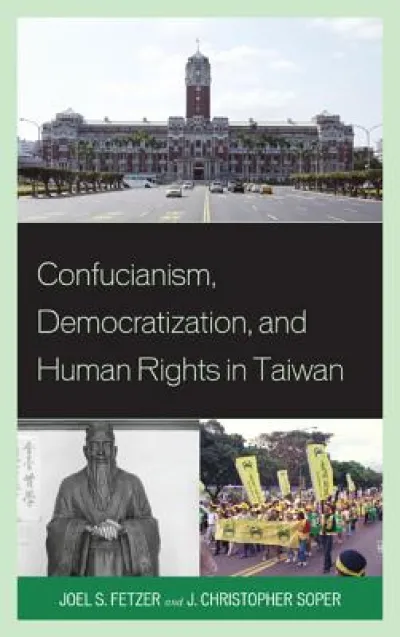
Confucianism, Democratization, and Human Rights in Taiwan
Book Details
Format
Paperback / Softback
ISBN-10
149850325X
ISBN-13
9781498503259
Publisher
Bloomsbury Publishing Plc
Imprint
Lexington Books
Country of Manufacture
GB
Country of Publication
GB
Publication Date
Oct 14th, 2014
Print length
126 Pages
Weight
196 grams
Dimensions
22.80 x 15.20 x 1.00 cms
Product Classification:
Asian historyPolitical structures: democracyInternational relationsHuman rights
Ksh 8,300.00
Manufactured on Demand
0 in stock
Delivery Location
Delivery fee: Select location
Secure
Quality
Fast
Based on elite interviews, survey research, and content analysis of legislative debates and public school textbooks, this study makes a much-needed empirical contribution to the largely theoretical debate about the political effects of Confucianism.
Responding to the “Asian values” debate over the compatibility of Confucianism and liberal democracy, Confucianism, Democratization, and Human Rights in Taiwan, by Joel S. Fetzer and J. Christopher Soper, offers a rigorous, systematic investigation of the contributions of Confucian thought to democratization and the protection of women, indigenous peoples, and press freedom in Taiwan. Relying upon a unique combination of empirical analysis of public opinion surveys, legislative debates, public school textbooks, and interviews with leading Taiwanese political actors, this essential study documents the changing role of Confucianism in Taiwan’s recent political history. While the ideology largely bolstered authoritarian rule in the past and played little role in Taiwan’s democratization, the belief system is now in the process of transforming itself in a pro-democratic direction. In contrast to those who argue that Confucianism is inherently authoritarian, the authors contend that Confucianism is capable of multiple interpretations, including ones that legitimate democratic forms of government. At both the mass and the elite levels, Confucianism remains a powerful ideology in Taiwan despite or even because of the island’s democratization. Borrowing from Max Weber’s sociology of religion, the writers provide a distinctive theoretical argument for how an ideology like Confucianism can simultaneously accommodate itself to modernity and remain faithful to its core teachings as it decouples itself from the state. In doing so, Fetzer and Soper argue, Confucianism is behaving much like Catholicism, which moved from a position of ambivalence or even opposition to democracy to one of full support. The results of this study have profound implications for other Asian countries such as China and Singapore, which are also Confucian but have not yet made a full transition to democracy.
Get Confucianism, Democratization, and Human Rights in Taiwan by at the best price and quality guaranteed only at Werezi Africa's largest book ecommerce store. The book was published by Bloomsbury Publishing Plc and it has pages.

