
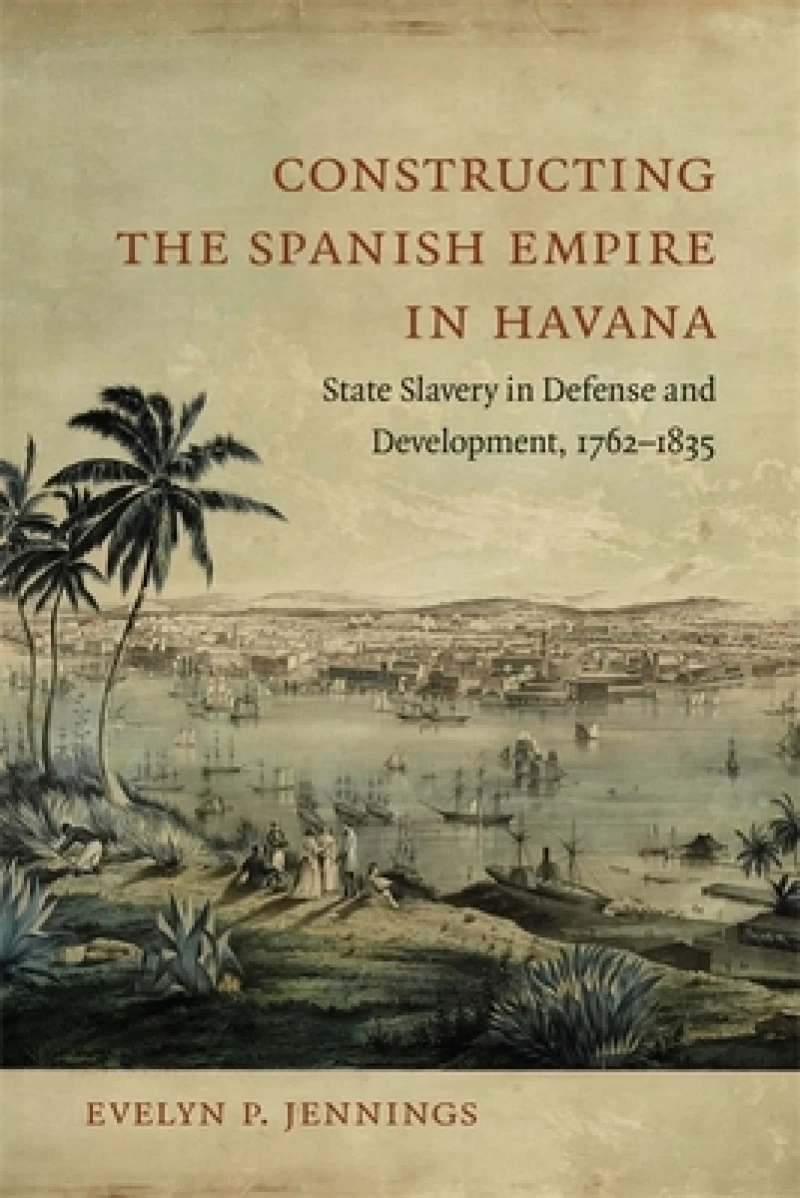
Constructing the Spanish Empire in Havana : State Slavery in Defense and Development, 1762-1835
Book Details
Format
Hardback or Cased Book
ISBN-10
0807173940
ISBN-13
9780807173947
Publisher
Louisiana State University Press
Imprint
Louisiana State University Press
Country of Manufacture
US
Country of Publication
GB
Publication Date
Dec 16th, 2020
Print length
298 Pages
Weight
568 grams
Dimensions
22.80 x 15.20 x 2.00 cms
Product Classification:
General & world historyEuropean historyHistory of the AmericasSlavery & abolition of slaverySocial groups, communities and identitiesSocial groupsPolitical economyGeneral and world historyEuropean historyHistory of the AmericasSlavery, enslaved persons and abolition of slavery
Ksh 6,800.00
Werezi Extended Catalogue
0 in stock
Delivery Location
Delivery fee: Select location
Secure
Quality
Fast
Examines the political economy surrounding the use of enslaved labourers in Spanish imperial Cuba from 1762 to 1835. Evelyn Jennings demonstrates that the Spanish state's policies and practices in the ownership and employment of enslaved workers after 1762 served as a bridge from an economy based on imperial service to a plantation economy.
Constructing the Spanish Empire in Havana examines the political economy surrounding the use of enslaved laborers in the capital of Spanish imperial Cuba from 1762 to 1835. In this first book-length exploration of state slavery on the island, Evelyn P. Jennings demonstrates that the Spanish state's policies and practices in the ownership and employment of enslaved workers after 1762 served as a bridge from an economy based on imperial service to a rapidly expanding plantation economy in the nineteenth century.
The Spanish state had owned and exploited enslaved workers in Cuba since the early 1500s. After the humiliating yearlong British occupation of Havana beginning in 1762, however, the Spanish Crown redoubled its efforts to purchase and maintain thousands of royal slaves to prepare Havana for what officials believed would be the imminent renewal of war with England. Jennings shows that the composition of workforces assigned to public projects depended on the availability of enslaved workers in various interconnected labor markets within Cuba, within the Spanish empire, and in the Atlantic world. Moreover, the site of enslavement, the work required, and the importance of that work according to imperial priorities influenced the treatment and relative autonomy of those laborers as well as the likelihood they would achieve freedom.
As plantation production for export purposes emerged as the most dynamic sector of Cuba's economy by 1810, the Atlantic networks used to obtain enslaved workers showed increasing strain. British abolitionism exerted additional pressure on the slave trade. To offset the loss of access to enslaved laborers, colonial officials expanded the state's authority to sentence deserters, vagrants, and fugitives, both enslaved and free, to labor in public works such as civil construction, road building, and the creation of Havana's defensive forts. State efforts in this area demonstrate the deep roots of state enslavement and forced labor in nineteenth-century Spanish colonialism and in capitalist development in the Atlantic world.
Constructing the Spanish Empire in Havana places the processes of building and sustaining the Spanish empire in the imperial hub of Havana in a comparative perspective with other sites of empire building in the Atlantic world. Furthermore, it considers the human costs of reproducing the Spanish empire in a major Caribbean port, the state's role in shaping the institution of slavery, and the experiences of enslaved and other coerced laborers both before and after the beginning of Cuba's sugar boom in the early nineteenth century.
The Spanish state had owned and exploited enslaved workers in Cuba since the early 1500s. After the humiliating yearlong British occupation of Havana beginning in 1762, however, the Spanish Crown redoubled its efforts to purchase and maintain thousands of royal slaves to prepare Havana for what officials believed would be the imminent renewal of war with England. Jennings shows that the composition of workforces assigned to public projects depended on the availability of enslaved workers in various interconnected labor markets within Cuba, within the Spanish empire, and in the Atlantic world. Moreover, the site of enslavement, the work required, and the importance of that work according to imperial priorities influenced the treatment and relative autonomy of those laborers as well as the likelihood they would achieve freedom.
As plantation production for export purposes emerged as the most dynamic sector of Cuba's economy by 1810, the Atlantic networks used to obtain enslaved workers showed increasing strain. British abolitionism exerted additional pressure on the slave trade. To offset the loss of access to enslaved laborers, colonial officials expanded the state's authority to sentence deserters, vagrants, and fugitives, both enslaved and free, to labor in public works such as civil construction, road building, and the creation of Havana's defensive forts. State efforts in this area demonstrate the deep roots of state enslavement and forced labor in nineteenth-century Spanish colonialism and in capitalist development in the Atlantic world.
Constructing the Spanish Empire in Havana places the processes of building and sustaining the Spanish empire in the imperial hub of Havana in a comparative perspective with other sites of empire building in the Atlantic world. Furthermore, it considers the human costs of reproducing the Spanish empire in a major Caribbean port, the state's role in shaping the institution of slavery, and the experiences of enslaved and other coerced laborers both before and after the beginning of Cuba's sugar boom in the early nineteenth century.
Get Constructing the Spanish Empire in Havana by at the best price and quality guaranteed only at Werezi Africa's largest book ecommerce store. The book was published by Louisiana State University Press and it has pages.

