
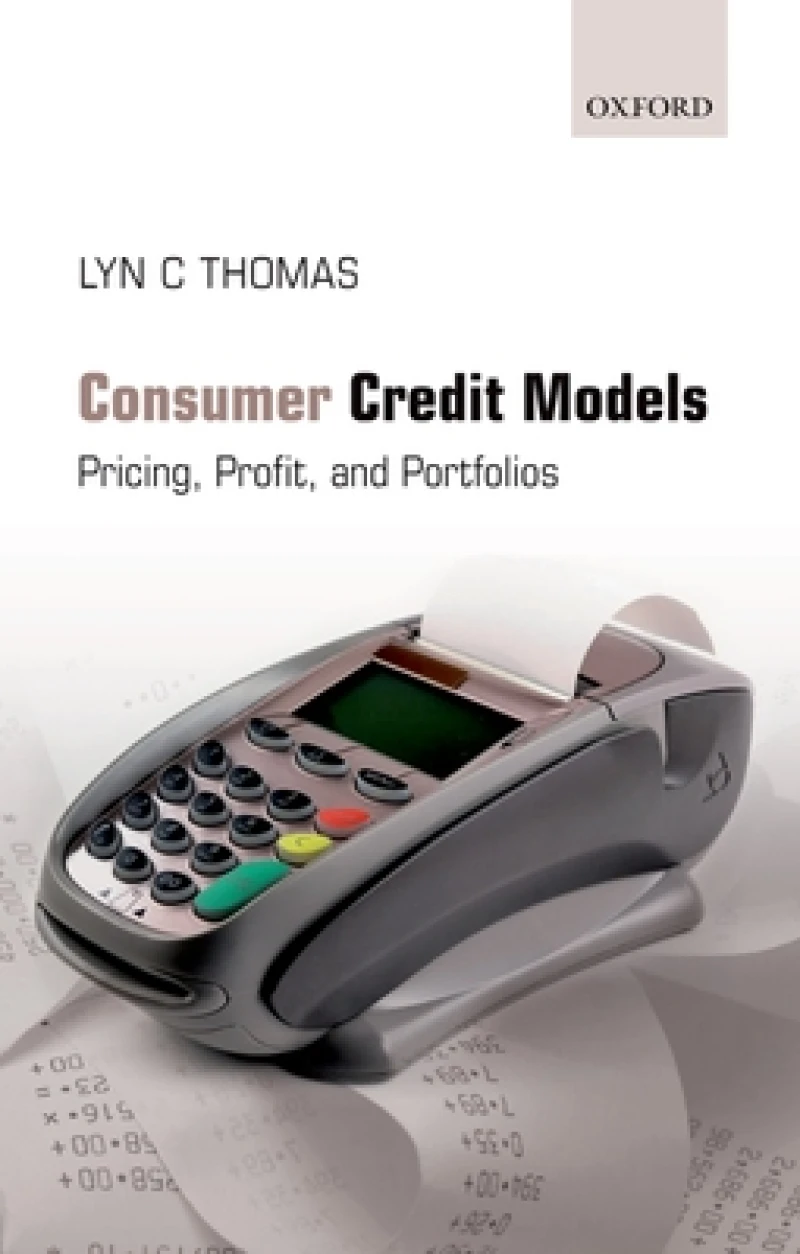
Consumer Credit Models : Pricing, Profit and Portfolios
Book Details
Format
Hardback or Cased Book
ISBN-10
019923213X
ISBN-13
9780199232130
Publisher
Oxford University Press
Imprint
Oxford University Press
Country of Manufacture
GB
Country of Publication
GB
Publication Date
Jan 29th, 2009
Print length
400 Pages
Weight
754 grams
Dimensions
23.50 x 16.30 x 2.70 cms
Ksh 22,950.00
Manufactured on Demand
0 in stock
Delivery Location
Delivery fee: Select location
Secure
Quality
Fast
A text aimed at credit analysts in industry and students in Statistics, Management Science, Operational Research and Banking and Finance Masters courses that will use simple probability models and logical arguments to explain consumer credit scoring.
The use of credit scoring - the quantitative and statistical techniques to assess the credit risks involved in lending to consumers - has been one of the most successful if unsung applications of mathematics in business for the last fifty years. Now with lenders changing their objectives from minimising defaults to maximising profits, the saturation of the consumer credit market allowing borrowers to be more discriminating in their choice of which loans, mortgages and credit cards to use, and the Basel Accord banking regulations raising the profile of credit scoring within banks there are a number of challenges that require new models that use credit scores as inputs and extensions of the ideas in credit scoring. This book reviews the current methodology and measures used in credit scoring and then looks at the models that can be used to address these new challenges. The first chapter describes what a credit score is and how a scorecard is built which gives credit scores and models how the score is used in the lending decision. The second chapter describes the different ways the quality of a scorecard can be measured and points out how some of these measure the discrimination of the score, some the probability prediction of the score, and some the categorical predictions that are made using the score.The remaining three chapters address how to use risk and response scoring to model the new problems in consumer lending. Chapter three looks at models that assist in deciding how to vary the loan terms made to different potential borrowers depending on their individual characteristics. Risk based pricing is the most common approach being introduced. Chapter four describes how one can use Markov chains and survival analysis to model the dynamics of a borrower''s repayment and ordering behaviour . These models allow one to make decisions that maximise the profitability of the borrower to the lender and can be considered as part of a customer relationship management strategy. The last chapter looks at how the new banking regulations in the Basel Accord apply to consumer lending. It develops models that show how they will change the operating decisions used in consumer lending and how their need for stress testing requires the development of new models to assess the credit risk of portfolios of consumer loans rather than a models of the credit risks of individual loans.
Get Consumer Credit Models by at the best price and quality guaranteed only at Werezi Africa's largest book ecommerce store. The book was published by Oxford University Press and it has pages.

